Advancements in AI Coding Agents and Autonomous Workflows
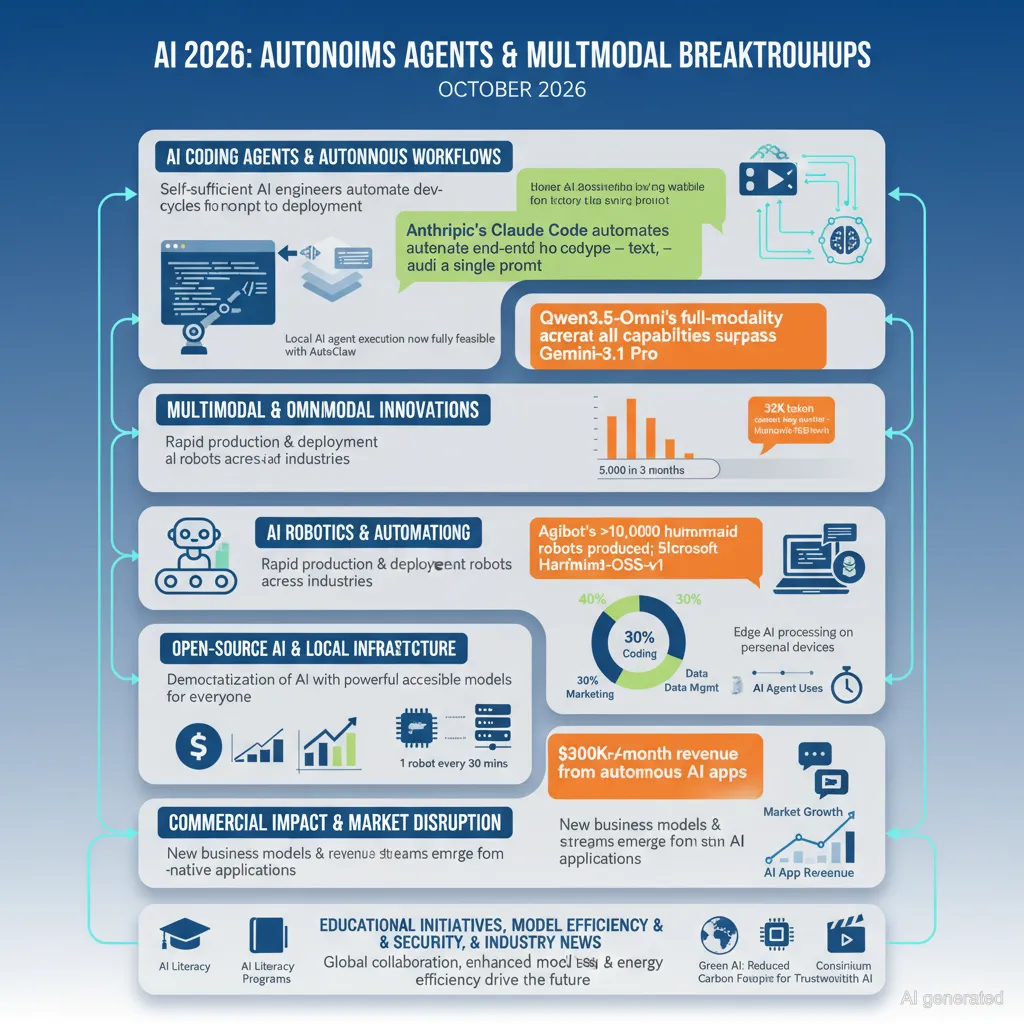
Anthropic’s Claude Code showcases remarkable progress in AI-driven computer use, capable of writing code, compiling, launching apps, debugging, fixing issues, and verifying fixes-all within a single prompt. Similarly, Clawbot autonomously processes voice messages end-to-end by detecting audio formats, converting them, transcribing via Whisper, and generating contextually appropriate replies. This level of agentic automation signals an industry shift from simple task execution toward full autonomous workflows, exemplified by tools like Dispatch and CREAO, which can run persistent background workflows without continuous human intervention. OpenClaw and Hermes agents have evolved to support multi-agent collaboration, significantly enhancing capability over earlier single-agent limitations. New solutions, such as AutoClaw, allow running these agents fully locally, giving users complete data control without API dependencies. Developers are increasingly leveraging these agents to automate complex workflows, including app building, marketing automation, and data management, lowering barriers to entry and enabling rapid prototyping.
Emergence of Multimodal and Omnimodal Models
Alibaba’s launch of Qwen3.5-Omni marks a breakthrough in full-modality AI, featuring advanced audio-visual understanding and generation capabilities that surpass competitors like Google’s Gemini-3.1 Pro. This model supports extensive audio and video context, sophisticated function calling, live search, voice cloning, and semantic interruption detection, enabling rich, native, real-time conversational interactions. A key advancement is Audio-Visual Vibe Coding, which transforms whiteboard brainstorming videos and game clips directly into runnable code without specialized training. Such innovations dramatically reduce the gap between human intent and automated execution, making creative workflows far more seamless.
Progress in AI-Driven Robotics and Automation
The robotics sector is experiencing swift advancements, with Shanghai-based Agibot producing over 10,000 humanoid robots, including 5,000 units in just three months-an unprecedented scaling pace. Similarly, China’s first fully automated humanoid robot production line achieves completion of one robot approximately every 30 minutes, with multiple sites planned. Breakthroughs in robotic manipulation and control, such as Nvidia’s work with humanoid control via deep reinforcement learning and Skild Brain’s single neural network handling GPU rack assembly tasks, point toward a future where robots perform complex operations autonomously. New open-source projects, including the Multitask Diffusion Policy model originally deployed in Boston Dynamics Atlas robots, facilitate advanced robotics research and deployment.
Open-Source Model Development and Local AI Infrastructure
Open-source initiatives continue to democratize AI development and deployment. Projects such as the MatmulFlow interactive tool simplify understanding matrix multiplications, while various AI models-like GLM-OCR, a lightweight multilingual OCR beating existing benchmarks-and Qwen3.5 model family provide high-performance, multimodal capabilities with efficient local inference. Engine platforms such as Ollama optimize model execution on Apple Silicon, significantly improving performance for local use cases. The rise of models supporting long context windows (e.g., Microsoft’s Harrier-OSS-v1 with 32k tokens) and enhanced embedding methods signal improved RAG pipelines and semantic search. Emerging tools like gsd-browser are specifically built to optimize browser automation for AI agents, overcoming limitations of existing wrappers.
Commercial Impact, Market Disruption, and AI-Driven Productivity
Commercial applications powered by AI agents and vibe coding are generating significant revenue, with examples such as open apps earning upwards of $300k/month. Autonomous marketing assistants like Helena automate content creation, campaign management, and competitive analysis, dramatically reducing the required human hours while boosting effectiveness. Industry leaders like Nvidia are strategically positioned to meet surging AI compute demands driven by rapid adoption of coding assistants and AI workloads. The shift toward AI-enabled digital employees managing workflows is fueling enterprise investment in AI infrastructure, including major data center developments in space aiming to alleviate terrestrial AI energy constraints. Moreover, novel sales and distribution strategies-such as programmatic SEO, MCP server integration, and answer engine optimization-are helping startups scale user acquisition in an increasingly AI-native marketplace.
Educational Initiatives and Community Contributions
Integrative educational projects, such as UCLA’s open-source MetaDrive Arena, support reinforcement learning research and experimentation with large student engagement metrics. The AI research community actively fosters knowledge sharing through accessible repositories for agent orchestration (OpenAgents Workspace), open challenges (MedGemma for medical AI), and advanced tutorials on agentic reinforcement learning (PivotRL). Efforts to create comprehensive guides for AI-powered skill acquisition and project planning empower individuals to adopt AI tools effectively. Additionally, multi-agent systems and orchestration are rapidly evolving toward self-managing frameworks, marking a paradigm shift from manual human construction of workflows to fully autonomous AI systems that self-improve and self-adapt over time.
Notable Innovations in AI Model Efficiency and Security
Research continues to enhance AI agent training efficiency and security. NVIDIA’s PivotRL reduces computational cost by focusing training on critical decision points in reinforcement learning, enabling high accuracy agentic post-training with fewer rollouts. Security applications leverage AI for substantially reducing false positives and detecting sophisticated threats using graph neural networks combined with large language models, advancing cyber defense capabilities. Transparency and ethical considerations, highlighted by differential privacy research and calls for trustworthy AI, remain integral to responsible AI deployment frameworks.
Miscellaneous Technological Developments and Industry News
Additional highlights include breakthroughs in quantum computing with Oratomic’s neutral atom qubit initiative, advances in natural human-computer interaction through spatial perception datasets (LingBot-Depth), new AI powered video editing tools such as Seedance 2.0 embedded in ByteDance’s CapCut, and significant growth in AI-powered customer acquisition roles reflecting changing labor markets. The hardware market is also responding with developments from companies like Huawei shipping AI chips compatible with Nvidia’s CUDA ecosystem to meet domestic demand under export restrictions. Leadership appointments, major funding rounds (such as Starcloud’s $170M Series A at a $1.1 billion valuation for space-based data centers), and industry consortia forming around combating online scams illustrate the maturing AI ecosystem and its broad societal impact.
Overall, 2026 continues to be characterized by rapid advancements in autonomous AI agents, multimodal models, scalable robotics, open-source AI infrastructure, and commercial application dominance-signaling profound changes in how technology and society interact in the near future.