
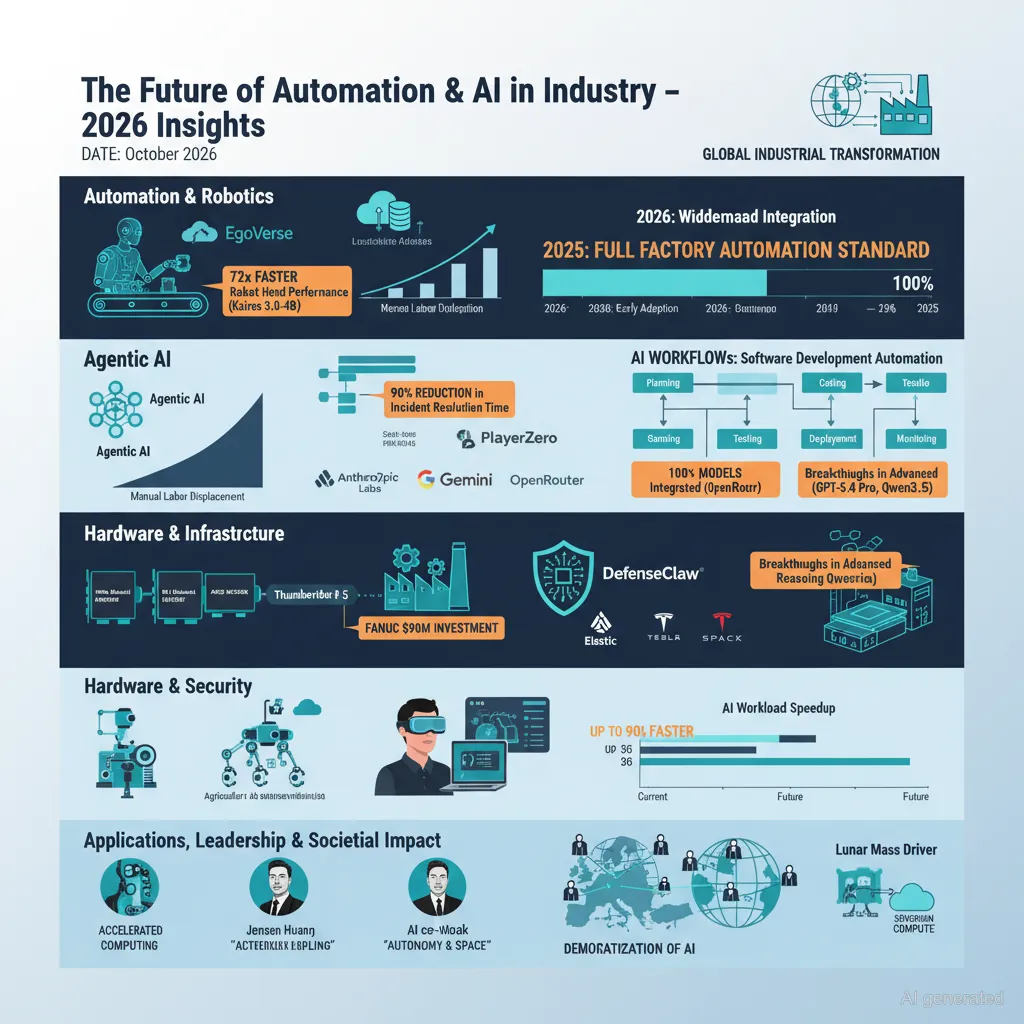
The industrial and technological landscape is rapidly transforming with the rise of autonomous systems, advanced AI, and innovative infrastructure expansions. In manufacturing, humanoid robots capable of sorting, picking, and adapting to real environments have reached practical deployment, enabling a swift scale-up. Predictions indicate that by 2035, fully automated factories will become the standard rather than the exception, displacing manual factory labor almost entirely within this decade.
In robotics, several developments emphasize accessibility and integration. Projects like EgoVerse, developed by research teams from Stanford, Georgia Tech, UC San Diego, and ETH Zurich, are building extensive egocentric human demonstration datasets, unlocking scalable robot intelligence through human-to-robot transfer learning. The open ecosystem allows anyone to collect data, train models, and contribute to robot learning, applied already in tasks such as cup picking and precise manipulation. Additionally, advances in robot hands, exemplified by the open-source Kairos 3.0-4B world model designed for physical robots running on edge platforms, show 72x faster performance than previous benchmarks. Robotics software is also maturing, with frameworks such as norma_core_dev providing unified stacks that integrate motor control, learning, and calibration without manual tuning-significantly reducing hardware-software friction.
The AI software ecosystem has seen remarkable leaps, showcasing transformative capabilities in agentic AI, AI-driven automation, and model infrastructure. Anthropic Labs has shipped several key products including MCP, Skills, Claude Desktop app, and Claude Code, advancing from early prototypes toward full computer use and remote machine control through Dispatch. Tools enabling multi-agent orchestration allow developers to run parallel agents managing complex workflows like frontend and backend development simultaneously, vastly improving productivity. PlayerZero represents a notable stride in production-grade AI by connecting software codebases, observability systems, and support data into unified context graphs, automating bug root cause analysis and reducing incident resolution time by up to 90%.
Google’s Gemini 3.1 Pro and LlamaParse tools create AI-driven workflows capable of parsing complex financial documents with multiple tables and visuals into clean, structured data alongside human-readable summaries, streamlining finance operations. Hugging Face continues democratizing AI by providing APIs that simplify dataset attachment as local filesystems, enabling access to vast remote storage and accelerating model training and inference. Similarly, OpenRouter offers integrations to over 100 models accessible through a single endpoint, enhancing tooling flexibility. Emerging AI models such as GPT-5.4 Pro, Qwen3.5 series, and others demonstrate significant improvements in reasoning, cost efficiency, and scalability, with some achieving breakthroughs in complex mathematical and medical tasks.
Notable hardware advancements complement software progress. New Nvidia hardware including Blackwell GPUs and AMD MI355X demonstrate multiple-speed improvements and total cost advantages in AI workloads. The integration of Thunderbolt 5 ports on latest MacBooks enables RDMA-based clustering for tensor parallelism on consumer hardware, substantially expanding edge compute capabilities. Industrial robotics factories are scaling manufacturing capacity aggressively-FANUC America announced a $90 million investment to build an 840,000 sq.ft facility in Michigan. Tesla and SpaceX plan a joint chip manufacturing plant in Austin aiming to double US computing capacity and extend it into space. Furthermore, plans for robotic mass drivers on the Moon could enable energy and satellite deployment at unprecedented scales, exemplifying Elon Musk’s vision for interplanetary industrialization.
In software ecosystem security and AI operations, companies like Cisco are launching open source mechanisms (e.g., DefenseClaw) to deploy security protocols for AI shells and runtimes, emphasizing open-source’s critical role in safeguarding AI infrastructure. Elastic Security has introduced an agentic XDR platform integrating endpoint, cloud, identity, and network security with automated workflows accessible from alert data, enhancing operational efficiency.
Robotics application continues expanding across domains beyond manufacturing. Clinical pathology labs have deployed fully autonomous robots performing precise manipulations and workflows without teleoperation. Agricultural robotics have emerged, exemplified by autonomous seed-planting and weed removal robots operating without GPS, signaling a fundamental agricultural transformation. Novel interactive applications such as mixed reality rollercoaster design, 3D generative world building, and AI-powered personal agent orchestration for home automation demonstrate the intersection of creativity and AI-driven physical interaction.
Several initiatives and companies highlight the growing importance of AI agent orchestration and open ecosystems. Libraries like Grok CLI and ArrowJS enable multi-agent control, remote operations, and secure AI-generated UI frameworks. Claude’s evolution into a powerful AI agent now capable of fully controlling Macs-including typing, clicking, launching apps, and browser navigation from a phone-places it at the forefront of ambient computing agents. Open-source physical AI platforms (e.g., norma_core_dev and ElRobot), data ecosystems like EgoVerse, and hardware projects targeting auto-calibration aim to reduce the engineering and cost hurdles in robotics development, accelerating the transition from prototype to scalable deployment.
From a strategic and philosophical perspective, prominent leaders like Nvidia CEO Jensen Huang emphasize hiring AI-literate graduates across all trades, preparing the workforce to augment human capability before automation eliminates routine roles. Huang also lauds Elon Musk’s methodological speed driven by aggressive simplification, immediate presence at problem sites, and a relentless urgency reshaping industries. Musk and others envision a future of abundant goods and services powered by robots ubiquitous in daily life, with ambitions extending to sustainable lunar industrialization, interplanetary exploration, and interstellar encounters. Noted scientists urge caution for lethal superintelligence’s risks, recommending international treaties to govern development.
Importantly, technical milestones in AI reasoning, efficiency, and accessibility are rapidly reshaping software engineering and scientific research. Agentic AI enables continuous self-improvement through feedback loops; models exhibit cognitive leaps rivaling advanced human researchers; and new techniques like TinyLoRA dramatically reduce parameter tuning requirements while boosting reasoning accuracy. Research into world modeling architectures, stable joint-embedding predictive systems, and reinforcement learning-integrated sound generation push the boundaries of what AI can achieve autonomously.
The data infrastructure required to sustain these advances remains a priority, with initiatives to expand sovereign compute capacity in Europe, extend secure regional data residency (e.g., Notion offering Japan and Korea options), and leverage vast open datasets stored in cloud repositories scalable to exabytes. These infrastructures aim to support multi-modal, real-time inference at scale, ensuring AI services are both performant and privacy-respecting.
Finally, in the broader cultural and societal realm, AI tools are democratizing access to superhuman capabilities, empowering millions to create, innovate, and work smarter. From building autonomous robots designed by high school students to deploying AI co-workers like Dimension that generate meeting briefs and emails, the rapid proliferation of accessible AI agents is reshaping the nature of work, creativity, and daily life. This transformative era also calls for renewed focus on scientific rigor, ethical leadership, and sustained investment in foundational research to harness AI’s promise responsibly.
—
Key Highlights:
- Automation and Robotics: Humanoid robots and autonomous systems are rapidly entering factories and labs, with scalable open data ecosystems boosting real-world robot intelligence. Advanced AI models enable sophisticated control and learning, with auto-calibration and unified software stacks simplifying deployment.
- AI Software and Infrastructure: Agentic AI tools like Claude Code, PlayerZero, Grok CLI, and Anthropic’s suite demonstrate strides in complex software automation, coding agents, and production-level debugging. Google’s Gemini and Hugging Face APIs enhance AI document parsing and data storage capabilities.
- Hardware Developments: Nvidia and AMD new GPU architectures offer substantial speedups; MacBook Thunderbolt 5 ports enable consumer cluster compute; FANUC and Tesla-SpaceX announce large manufacturing and chip fab investments; lunar mass drivers and space-based data centers are envisioned.
- Security and AI Operations: Open source security protocols (DefenseClaw) and integrated XDR platforms improve AI system protection, while elastic workflows introduce native automation without separate SOAR systems.
- Applications Across Domains: Autonomous robots assist in clinical labs and agriculture; AI-driven creative tools facilitate 3D world-building and video generation; voice shopping and intelligent agents simplify commerce and workflows.
- Leadership and Workforce: Nvidia’s Jensen Huang prioritizes AI skills in hiring; Elon Musk’s operational model emphasizes simplicity, presence, and speed; calls arise for international AI governance addressing superintelligence risks.
- Scientific and Research Advances: Breakthroughs in math problem-solving by AI, efficient model tuning techniques like TinyLoRA, and world model architectures accelerate knowledge production and application.
- Data and Sovereignty: Expansion of sovereign AI compute in Europe, regional data residency options, and massive cloud dataset repositories underpin AI scalability while addressing privacy and security.
- Societal Impact: AI democratization empowers creators, researchers, and general users globally, transforming traditional notions of productivity and enabling unprecedented access to intelligence.