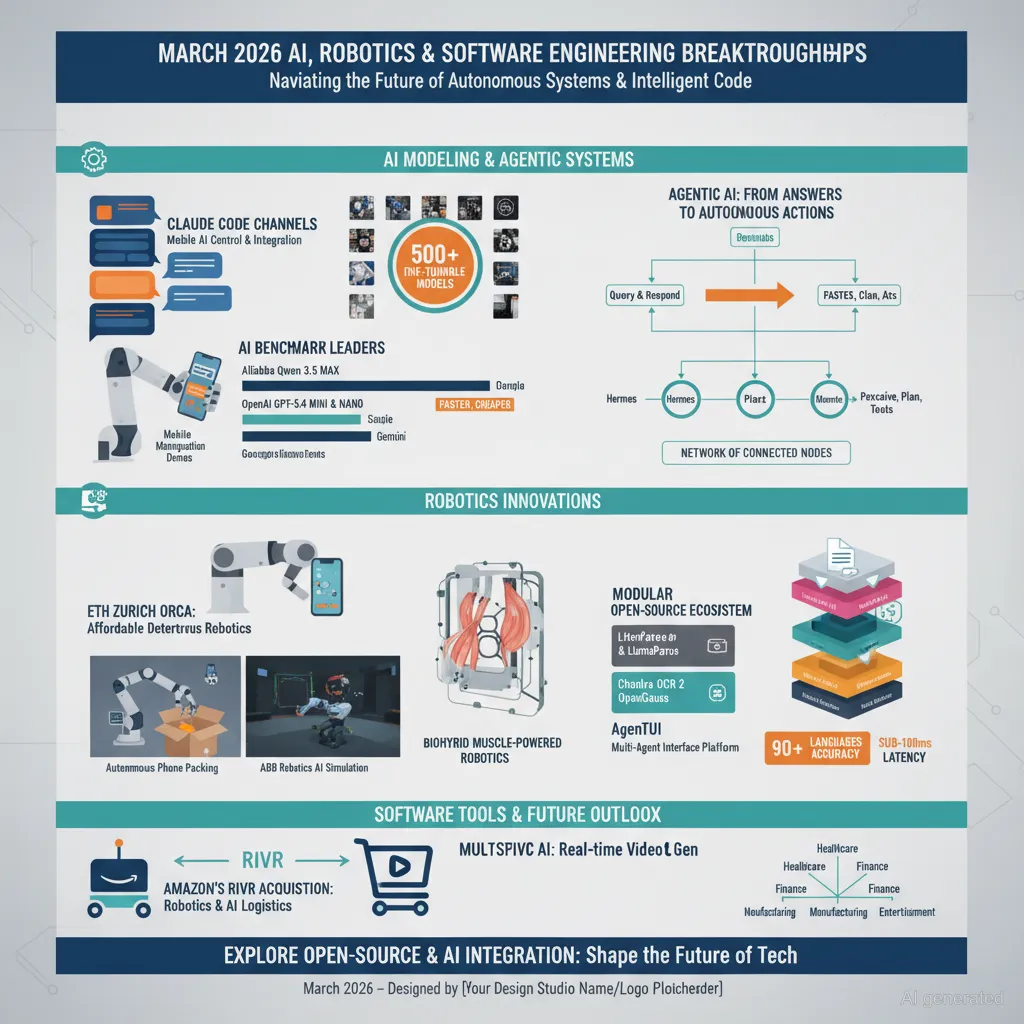
Recent developments across AI, robotics, and software engineering showcase rapid innovation and impressive integration of cutting-edge technologies. Notably, Claude Code has introduced “Claude Code Channels,” enabling users to control sessions via platforms like Telegram and Discord. This facilitates messaging Claude Code directly through mobile devices and allows disabling of AI attribution in code commits, improving workflow customization.
In robotics, ETH Zurich researchers unveiled the Orca robotic hand-a 3D-printable, highly affordable, open-source design offering tactile sensing, dexterous manipulation, and durability comparable to costly advanced hands. Additionally, breakthroughs in mobile manipulation were demonstrated, including autonomous phone packing using vision-based foundation models and ABB Robotics’ integration of AI-driven simulation for factory automation, promising enhanced precision and reduced setup time.
On the AI modeling front, major progress includes the release of over 500 fine-tunable language models supported by the open-source Unsloth web UI, which accelerates training and supports multiple platforms. Alibaba’s Qwen 3.5 Max Preview achieved top rankings in math and expert coding benchmarks, and OpenAI launched high-performance GPT-5.4 Mini & Nano models targeted for coding assistance, providing significant speed and cost efficiency. Google introduced Gemini with advanced tool integration, including Google Maps grounding and automated tool orchestration, expanding multi-agent and multi-tool AI capabilities.
Agentic AI systems are gaining traction as transformative productivity tools. Nvidia CEO Jensen Huang emphasized a shift from AI answering questions towards autonomous action execution, predicting engineers will increasingly “command” multiple AI agents rather than write code directly. This paradigm shift continues with advancements such as Hermes interacting seamlessly with the Pinokio launcher to control applications autonomously and MiroMinder’s research agent incorporating verification at every reasoning step.
Simultaneously, multidisciplinary AI workloads are facilitated by new frameworks and datasets from Nvidia and the broader AI community, enabling enhancements in robotics trajectories, autonomous vehicle modeling, and healthcare applications. Open-sourced tools such as LiteParse and LlamaParse provide robust document parsing and visual grounding capabilities for AI agents, streamlining data ingestion and context engineering, critical for improved agent performance.
In media and creative domains, innovations include real-time video generation models producing HD content with sub-100ms latency, and Google’s Stitch offers an AI-native canvas supporting voice-driven design interaction, instant prototyping, and design system integration, simplifying multimedia creation workflows.
Further noteworthy highlights include:
– The launch of AgentUI, a modular multi-agent chat interface allowing integration of diverse sub-agents specializing in code, web search, and multimodal tasks.
– Advances in biohybrid robotics featuring self-training muscle-powered systems achieving lane swimming speeds, illustrating new frontiers in physical AI.
– Major open-source contributions like the release of Chandra OCR 2 achieving state-of-the-art accuracy across 90+ languages and Math, Inc.’s OpenGauss agent enabling machine-verifiable formal proofs of mathematical theorems.
– Industry acquisitions and partnerships, such as Amazon’s purchase of Zurich-based autonomous delivery robot startup RIVR, and collaborations to push high-fidelity simulation for industrial automation.
Overall, this burst of activity across AI models, agentic systems, robotics, and software tools signifies a broad ecosystem moving rapidly toward AI-driven automation, real-time reasoning, and integration of multimodal data. These advances promise transformative impacts on software engineering, manufacturing, healthcare, creative industries, and scientific discovery. Researchers, developers, and enterprises are encouraged to explore open-source solutions and emerging platforms poised to redefine productivity and innovation in the coming years.