
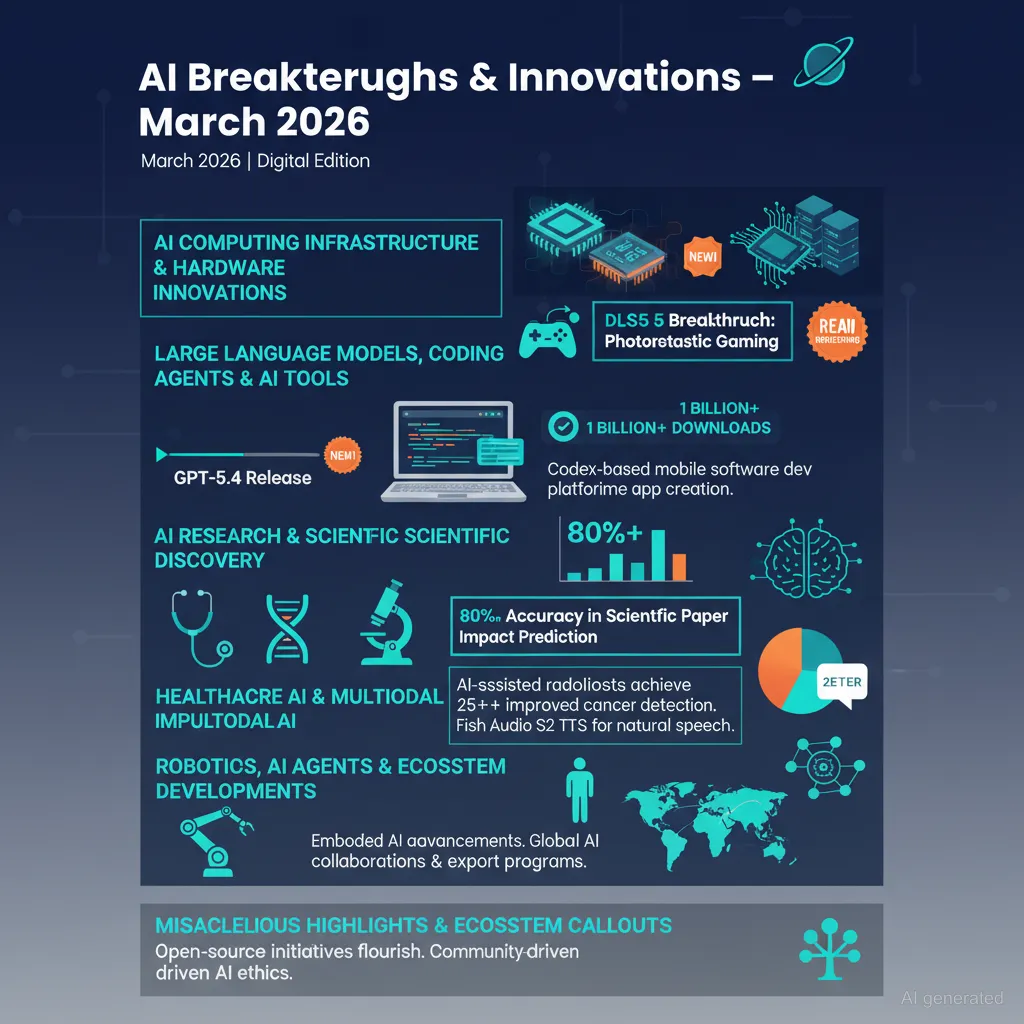
The recent surge in AI and related technologies marks significant advancements across multiple domains including computing infrastructure, scientific research, healthcare, multimodal AI, simulation, and software development.
AI Computing Infrastructure and Hardware Innovations
There is serious discussion about deploying AI data centers in space, leveraging benefits such as infinite solar power, cold vacuum cooling, and planet-scale compute. NVIDIA is actively developing specialized chips for orbital computing, aiming to realize this vision. The company also introduced the Vera Rubin platform, a cutting-edge supercomputer combining several advanced chips such as the Vera CPU and Rubin GPU, to power large-scale AI workloads. Additionally, NVIDIA announced DLSS 5, an AI-powered breakthrough that enhances real-time game graphics with photorealistic lighting and materials, signaling a future where games may appear indistinguishable from reality. Another first is the Vera CPU, optimized specifically for agentic AI and reinforcement learning, delivering improved efficiency and speed over conventional CPUs. Partnerships between NVIDIA and companies like Mistral AI are fostering development of frontier open-source AI models, while new models like Nemotron 3 Nano 4B target constrained hardware for better agent deployment.
Large Language Models, Coding Agents, and AI Tools
OpenAI released GPT-5.4 (including mini and nano variants), optimized for coding, multimodal understanding, and subagents, achieving record usage volumes and improved speed, and significantly enhancing coding experiences like those with Codex. Claude Code emerges as a leading coding AI agent, supporting vision AI and enabling accelerated machine learning research with plugins for experiment tracking, GPU monitoring, and diagram generation. OpenClaw and NemoClaw represent open-source projects striving to bring powerful AI agents to local machines, emphasizing privacy, speed, and cost-effectiveness. Frameworks like LangChain have crossed one billion downloads, indicating broad adoption.
Several groups released AI coding assistants that transform codebases into knowledge graphs to help AI understand complex repositories, improving software development workflows. New CLI tools allow hardware detection and local model deployment with ease. The rise of “cloud coding agents” is notable with companies such as Stripe, Ramp, and Coinbase building internal solutions, while public open-source ones become available.
Innovations in AI Research and Scientific Discovery
Research breakthroughs include AI systems capable of predicting the future impact of scientific papers with greater accuracy than top language models, even across disciplines they were never trained on. Such AI can judge research quality with over 80% accuracy and can generate promising follow-up research ideas. This suggests AI’s ability to fundamentally alter scientific decision-making, funding, and knowledge expansion.
New open models and datasets support vision-language tasks, multilingual translation, and synthetic persona generation. Notable models like GLM-5-FP8 (multilingual), Kimodo (humanoid motion generation), Molmo (vision-language), and Mamba-3 (linear sequence modeling) highlight the vibrant, evolving research landscape. Efforts also focus on smaller, efficient models achieving exceptional reasoning capabilities, especially in medicine, enabling sharper and faster performance with far fewer parameters.
Additionally, tools like InnoClaw transform file systems into AI research engines integrating 200+ scientific tools and chat capabilities, streamlining research workflows.
Advancements in Healthcare AI
AI increasingly helps healthcare providers and patients, addressing challenges like medical coding accuracy by open-sourcing ICD-10 extraction tools that run on single CPUs, reducing costs and errors. AI-powered applications assist clinical reasoning and risk detection, including radiologists detecting cancers with 25% improved accuracy. OpenAI leaders detailed ongoing efforts to build health-focused AI models meeting real-world needs. Gene therapy breakthroughs, such as accelerated FDA approvals for treating congenital deafness, are enabled by AI-accelerated research.
Speech, Audio, and Multimodal AI
A new open-source text-to-speech model, Fish Audio S2, dramatically advances speech control with word-by-word modulation of tone, breath, and emotion through precise positional annotations and reinforcement learning. It surpasses leading commercial models in naturalness and speed and is entirely open source.
Multimodal models like GLM-OCR handle high-resolution imaging with multi-language support and advanced text and LaTeX recognition. AI dubbing technology now includes open-source multi-speaker dubbing solutions, solving one of the hardest problems in AI video.
Robotics and Embodied AI
Dexterous AI-driven robots like North demonstrate fully autonomous, tactile feedback-guided assembly tasks such as building PCs from scratch, moving beyond scripted automation to feeling-driven execution. New humanoid motion generation tools enable synthetic motion data creation with expressive control.
Policy learning algorithms in robotics and AI agents are undergoing rapid development aimed at enabling scale and autonomy in real-world manufacturing and autonomous vehicle environments.
AI Agents and Productivity Tools
Agentic AI, capable of multitasking and complex workflows, is evolving rapidly. Features such as Salesforce Claude Cowork’s “Dispatch” allow mobile-to-desktop persistent conversations, while integration with services like Google Colab permits AI agents to execute and write code within secure notebooks. Several companies have released tools for integrating search capabilities into browser agents, making search-based AI workflows up to three times faster.
There is a growing trend towards personal AI software driven by agent sub-systems, enabling users to build custom, adaptive applications rapidly. Knowledge-work platforms around GPT-5.4 showcase scalable coding assistants with subagents managing multi-threaded projects.
New frameworks and platforms such as Codex, Linear, GitHub, and Symphony empower complex software development entirely from mobile devices.
Community and Ecosystem Developments
Open-source ecosystems remain essential to AI’s progress, with foundations like the Linux Foundation receiving support to enhance the security and reliability of infrastructure critical to AI applications. Leading AI developers emphasize the importance of prompt engineering as a fundamental skill, releasing guides and tools to empower users.
Conferences like Claw4S focus on skill-submission formats to foster reproducibility and agent-executable workflows. Open research and collaboration thrive, with research groups and startups releasing accessible open-source models and tools. The AI community advocates embracing AI rapidly, citing the vast upside and transformative potential.
Miscellaneous Highlights
– SpaceX and xAI are expected to be early customers of orbital GPU chips.
– Mistral Small 4 unifies flagship model capabilities into a faster, versatile open model.
– OpenRouter and Hermes showcase competitive AI agent platforms.
– NVIDIA partners with Adobe to advance AI-powered creation and digital twins.
– The American AI Export Program promotes AI sovereignty in partner nations.
– The Oxford Union hosts intellectual discussions featuring AI ethics and research.
– Meta introduces an encoder-decoder model that supports machine translation for over 1600 languages.
– Advances in computer vision allow for complex image retrieval and generative modeling fusion for effective real-time world models.
Overall, these developments signify rapid, comprehensive progress in AI research, application, infrastructure, and community building, pointing toward a future where AI is deeply embedded in scientific discovery, healthcare, computing, and daily human-computer interaction.