
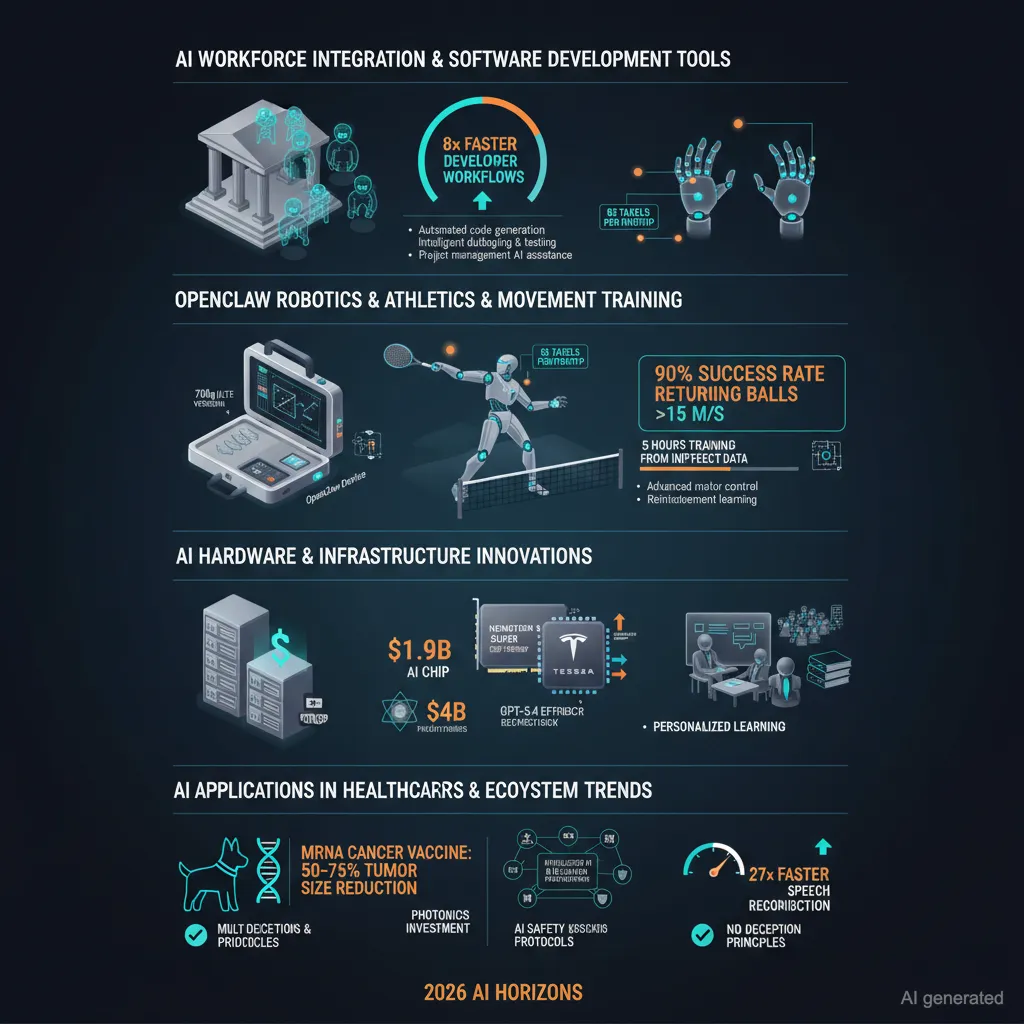
Advancements in AI and Robotics Workforce Integration
America’s oldest bank has integrated over 130 AI agents within its operations, demonstrating how the workforce is being rewritten in real-time as AI adoption accelerates. While debates about whether AI is overhyped continue online, industries are rapidly adopting AI-driven solutions. For instance, Google’s former CEO recently outlined lucrative pathways in AI-aided software development, indicating some developers stand to benefit greatly in the evolving landscape.
OpenClaw and Agent Technology in Robotics
The OpenClaw project has achieved several groundbreaking milestones, including a fully portable version running on a Mac Mini with battery support, enabling hours of operation without wall power. This device, equipped with a built-in screen, promises significant productivity gains for developers. OpenClaw agents now seamlessly interface with local models through an Ollama integration, enabling zero API query costs and efficient agent workflows. Further efficiency enhancements have been observed through compatibility with faster browsers like agent-browser combined with LightPanda.
Robotics dexterity has notably improved with the release of three new open-source robotic hands by OrcaHand having tactile sensors, allowing fine manipulation and slip detection through 83 taxels per fingertip. A Lite version weighing only 700g enables use on smaller payload robot arms. These advancements open avenues for developers to 3D print, tweak, and deploy sophisticated hardware affordably for tactile robotic applications.
Robot Athletics and Humanoid Movement Training
A breakthrough in humanoid robot athleticism was achieved by a team from Tsinghua University and Galbot, who developed LATENT-a system training a Unitree G1 humanoid robot to play tennis effectively using only five hours of imperfect human motion capture data. The robot demonstrated a 90% success rate in returning balls traveling over 15 m/s, capable of sustaining multi-shot rallies with humans. This method uses fragments of human motions as structural priors refined by physics engines, enabling rapid real-time whole-body coordination and balance. This approach significantly lowers the cost barrier for teaching robots elite physical tasks, with implications beyond tennis to sports, logistics, and security.
AI Agents and Software Development Tools
Several new command-line interfaces (CLIs) and agent platforms have been introduced to enhance software development processes. The supermemory CLI allows complete interaction with AI agents to perform platform tasks via prompts. Codex and Claude Code have dramatically sped up developer workflows by enabling command agents to auto-detect and visually confirm bug fixes, increasing development speed up to 8×.
Additionally, open-source toolkits aid in integrating AI with office applications (OfficeJS), local terminal logs, and knowledge bases, transforming AI into a “second brain” that manages not just task execution but also output quality and skill self-correction. Scheduled and self-healing AI skill workflows represent an evolution where agents autonomously monitor, patch, and rollback degraded capabilities without human intervention.
Innovations in AI Hardware and Infrastructure
Taiwanese server giant Wistron announced a $1.9 billion investment for AI-focused capacity expansion in both the U.S. and Taiwan, expecting robust revenue growth driven by GPU and ASIC demand. Meanwhile, Tesla is advancing its AI hardware stack by ramping up its Terafab chip fabrication program, aiming to reduce dependence on Nvidia chips and control more of the AI hardware supply chain.
On the computational side, Nvidia’s latest releases including models like Nemotron 3 Super and GPT-5.4 variants are pushing token processing efficiency massively, helping reduce costs while accelerating AI development. Further, photonics emerged as a critical infrastructure focus for Nvidia, with a $4 billion investment targeting copper replacement for faster data transfer.
AI Applications in Healthcare and Biology
An extraordinary “citizen science” achievement involved an Australian technology founder who, despite no biology background, used ChatGPT in conjunction with AlphaFold to sequence his dog’s tumor DNA and design a custom mRNA cancer vaccine at low cost. The resulting treatment reduced the tumor size by 50-75%, exemplifying how AI, RNA technology, and genomics intersect to transform medicine.
Separately, IBM introduced Non-autoregressive LLM-based Automatic Speech Recognition via Transcript Editing, achieving a 27x speedup over traditional models with low error rates, indicating strong progress in AI-driven biomedical transcription.
AI in Education and Research
Tsinghua University also open-sourced MAIC (Multi-Agent Interactive Classroom), an AI-driven platform capable of generating entire interactive classrooms featuring multiple AI teachers, assistants, and personalized study buddies. This system adapts content delivery with token-level personalization techniques, representing a scalable future for interactive online education.
Additional tools enhancing academic workflows include OpenLeaf, a plugin that automates academic citation generation by reading paper paragraphs and retrieving relevant references using AI – streamlining research workflows.
Emerging AI Frameworks and Safety Research
Google DeepMind unveiled a comprehensive “Intelligent AI Delegation” framework proposing safe, verifiable, and adaptive task delegation to AI agents. The system uses digital certificates for transparent skill validation and dynamic authority shifting, ensuring reliable work handoff and failure management in multi-agent workflows.
On AI safety, recent studies show current models struggle to deceive safety monitors by hiding their internal reasoning. This suggests safety systems reliant on accessing AI “mental scratchpads” currently operate effectively, as models cannot convincingly fake thoughts while delivering correct outputs.
Trends in AI Agent Ecosystems and Open Source
The OpenClaw team expanded their maintainership and reported doubling weekend user activity, emphasizing the growing ecosystem around physically embodied AI agents for robotics and drones. Dimensional OS (dimOS) has become highly popular for deploying physical AI agents, opening hardware and software integration.
Open-source innovations such as OrcaHand’s dexterous robotic hands, Physical Superintelligence’s research support tools, and vLLM’s scaled model serving capabilities underscore a maturation towards democratized robotics and AI development.
Miscellaneous Highlights
– Advanced AI-driven UI coding agents now connect with live Chrome browser sessions without extensions, greatly improving developer experience.
– NVIDIA released a Brain MRI generation model that synthesizes high-resolution 3D scans rapidly.
– AI models including GPT-5.4 have demonstrated substantial IQ improvements and can solve complex mathematical problems previously thought intractable, signaling a leap in cognitive capacity.
– The role of copper in AI hardware bottlenecks is gaining attention as Nvidia invests heavily in photonics technology.
– Robotics companies and investors are rapidly focusing on achieving generalized humanoid robots, with billions invested in related world modeling and continuous learning technologies.
– Energy, compute, and AI workspaces are preparing for scalability with new generation inference platforms and multi-modal models coming to market.
– Industry events like Nvidia’s GTC emphasize open model development, AI factory infrastructure, and the growing impact of AI across sectors.
In summary, the convergence of AI agents, robotics, advanced infrastructure, and novel frameworks is transforming numerous domains-from sports robotics and industrial automation to healthcare, education, and software development. The pace of innovation and real-world application signals a profound shift in work, productivity, and technological capability worldwide.