The latest developments in AI, robotics, and software highlight significant advancements across multiple domains, with a strong focus on enhancing productivity, creativity, and automation, as well as breakthroughs in robotics and hardware.
**AI Agents and Productivity Tools**
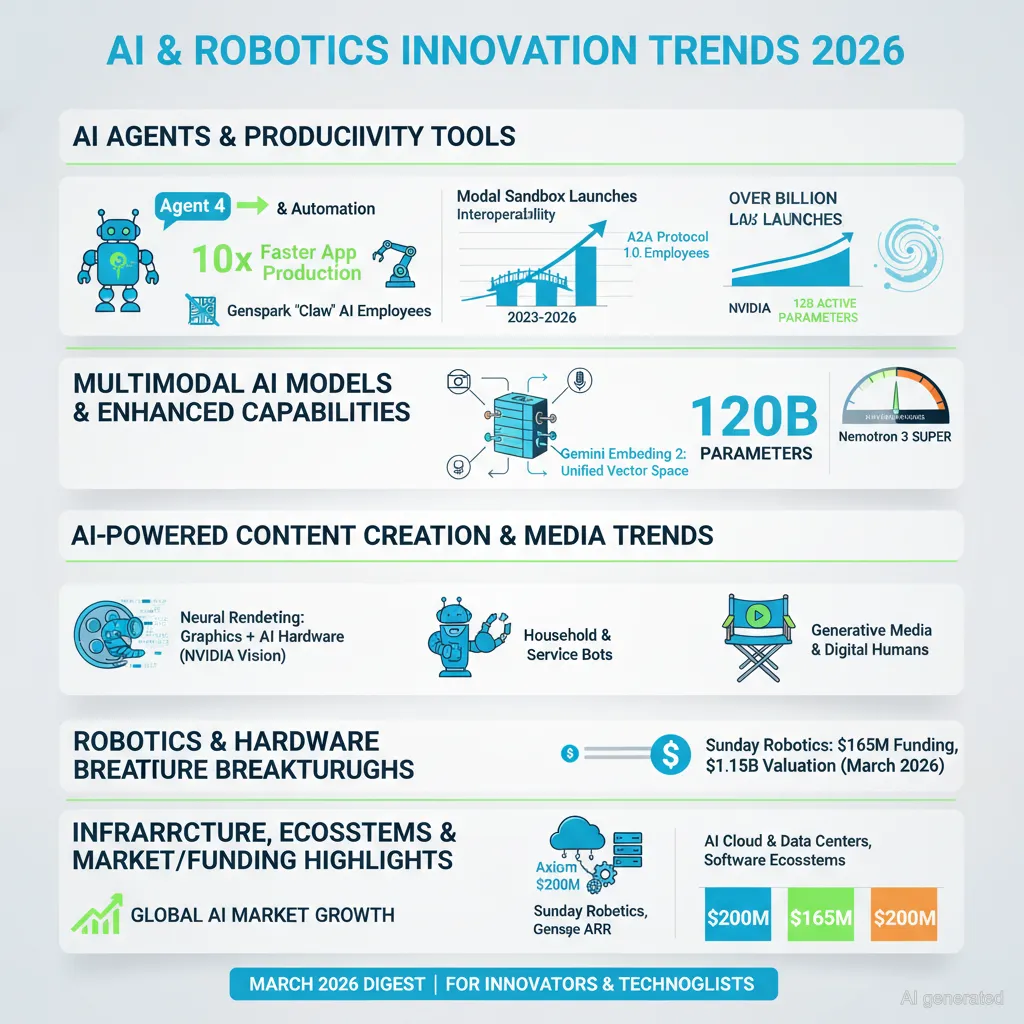
AI agents continue to mature, providing new ways to automate complex workflows and enhance collaboration. Modal Sandboxes have seen over a billion launches in three years, powering diverse applications from coding platforms to reinforcement learning infrastructure. Replit introduced Agent 4, designed to help teams ship production-ready apps ten times faster by automating coordination and parallelizing development tasks. Genspark’s AI Workspace 3.0 features Genspark Claw, an AI “employee” that executes tasks across multiple apps such as Gmail and Slack, reflecting a shift from using AI tools to hiring AI employees. HeyNoahAI bypasses traditional apps by operating seamlessly via SMS, RCS, or WhatsApp, providing busy executives with hands-free scheduling and email coordination.
Innovations in AI agent architectures and tooling are also notable. OpenClaw, a platform with over 127 curated skills, supports agent workflows including devops, web automation, and productivity. Autonomous context compression tools have been added to Deep Agents SDKs, ensuring efficient use of finite context windows. New standards like the A2A Protocol 1.0 for AI agent communication aim to bridge interoperability gaps. The emergence of persistent memory, event-based triggers, and browser sessions in agents like Base44’s Superagent further enhances agent capabilities and ease of deployment.
**Multimodal and Enhanced AI Models**
Claude for Excel and PowerPoint now syncs multiple files, sharing conversation context seamlessly to enable complex workflows without repeated instructions. Claude has also improved communication by adapting response formats beyond text to include interactive charts, flowcharts, maps, and simulations directly inside chats.
NVIDIA launched Nemotron 3 Super, a 120B parameter, hybrid Mamba-transformer mixture-of-experts (MoE) model with only 12B active parameters but supporting a massive 1 million token context window. It excels in agentic reasoning, coding, and tool use, offering open weights with strong throughput efficiency. NVIDIA’s platform also integrates with OpenRouter, Lightning AI, and DGX Spark hardware to facilitate rapid, scalable AI deployment. Hunter Alpha and Healer Alpha have been introduced as stealth, high-context, multimodal models optimized for long-horizon tasks and visual/audio understanding.
Google’s Gemini Embedding 2 unifies embeddings across text, images, video, audio, and PDFs into a single vector space with multilingual capabilities, simplifying retrieval-augmented generation (RAG) and recommendation systems. Google AI offers tiered subscription plans with AI credits for scaling Gemini usage, supporting a wide spectrum of builders and enterprise-scale deployments. These advances aim to improve the precision, scalability, and usability of AI models across creative and analytical workflows.
**AI-Powered Content Creation and Media**
AI’s infiltration into content creation is accelerating. Forecasts indicate that by 2026, every film may employ AI-generated actors designed with granular control over genre, era, physical attributes, dialogue, and voice, enabling fully virtual studio productions and personalized narratives. xAI’s Grok Imagine now supports generation of detailed videos from up to seven reference images, maintaining consistency across clips, and supports R18+ content within legal limits. Netflix notably acquired InterPositive, an AI-driven production tools company, to automate costly post-production tasks such as relighting, color correction, and continuity fixes, potentially recouping the acquisition cost within months through savings. The entertainment industry is bracing for significant disruption from AI-driven personalized content and infinite episodic worlds, driven by audience demand.
**Robotics and Hardware Innovations**
Significant strides in robotics demonstrate enhanced physical capabilities and interaction. South Korean researchers developed a paper-thin soft robot mimicking muscle contractions by sequencing air flows through microscopic chambers, enabling it to squeeze through 3mm gaps and lift objects 70 times its weight. This flexible sheet robot traversed pipes carrying cameras much heavier than itself and integrated with grippers for mid-air object manipulation, hinting at future applications in minimally invasive surgery.
Sunday Robotics raised $165 million at a $1.15 billion valuation to commercialize Memo, a household robot slated for deployment in beta programs within the year. Haptica introduced textile haptic gloves with real-time pressure feedback improving robot teleoperation performance and gentleness, based on Stanford studies. Meanwhile, ChangingTek Robotics unveiled a robotic hand with 6+1 degrees of freedom, capable of dexterous tool manipulation exceeding human ranges.
In AI hardware, Jensen Huang of NVIDIA emphasized the fusion of computer graphics with neural rendering as the future of visuals. The company also revealed BlueField-4, a networking platform enabling extended long-term AI context memory, crucial for agentic systems. Samsung and NVIDIA co-develop a ferroelectric NAND memory with 10,000× faster AI-driven simulation and 96% power reduction, marking a vertical integration in memory design.
**Infrastructure, Tools, and Software Ecosystem**
Infrastructure improvements facilitate faster, reproducible, and uniform developer environments. Flox offers a single declarative file that encompasses packages, tools, environment variables, and services, ensuring consistent setups across OS and architecture differences. OpenJarvis promises personal AI that runs entirely on-device for privacy and control.
Open-source tools and frameworks are advancing rapidly. Lightpanda, a headless browser written in Zig, offers 11× faster rendering than Chrome with 9× less memory usage, tailored for AI agent scraping and automation. Modal’s GPU cloud toolset remains highly praised for enabling efficient scalable AI workflows. OpenClaw’s RL technical report shares advances combining classical reinforcement learning with large language model agents.
New storage solutions target AI data needs with mutable, non-versioned object storage costs three times cheaper than Amazon S3, designed for checkpointing and managing logs and artifacts at scale. Open-source libraries like GeometricKernels now offer stable releases for geometric learning tasks. The MLX Cheatsheet has been updated as a learning tool, illustrating codex skills transferable to Claude Code. AlphaXiv extracts arXiv IDs instantly for machine-readable research summaries, cutting token waste during PDF uploads.
**Education, Communication, and Collaboration**
Applications like Wondering create interactive, bite-sized learning paths akin to Duolingo but for any subject, offering personalized, active learning pathways with long-term mastery in mind. OpenClaw collaborates with reSpeaker to enable voice memo capture and direct conversion to task automation using noise-suppression and beamforming tech, enhancing hands-free workflow.
NVIDIA’s BlueField-4 and context memory platforms invite deeper engagement from the AI community, with multiple roadshows and discussions ongoing. Microsoft Azure partnered with Fireworks AI to host open models for scalable, secure enterprise deployment. Meanwhile, AI is reshaping work culture, with research, content generation, and code reviews increasingly performed autonomously by agents, allowing developers and creators to focus on creative decision-making.
**Market and Funding Highlights**
Noteworthy funding rounds underscore confidence in AI startups pushing boundaries. Axiom secured $200 million at a $1.6 billion-plus valuation to advance formal mathematics and Verified AI, which aims to tighten the generation-verification loop for safety-critical systems. Sunday Robotics’ $165 million Series B and Genspark’s rapid growth to a $200 million annual run rate indicate strong momentum in tangible AI applications.
Executives like Sam Altman and leaders at NVIDIA highlight the exponential trajectory of AI integration into daily life and work, forecasting a future where AI acts as proactive senior employees with deep context. Elon Musk predicts humanoid robots providing universal medical care superior to current surgical standards. Industry leaders also emphasize the importance of verified AI to prevent hallucinations and ensure superintelligence safety.
**Summary**
Overall, the news reflects a vibrant and rapidly evolving AI ecosystem transforming software development, robotics, media production, and enterprise workflows. The key trends include AI agents becoming increasingly autonomous and collaborative; multimodal foundation models powering unified and efficient applications; hardware innovations extending AI capabilities at scale; and emerging standards and platforms fostering interoperability and reproducibility. Meanwhile, investments and strategic partnerships illustrate growing market confidence. These innovations collectively signal a forthcoming era where AI not only augments but increasingly executes complex human tasks across industries.