
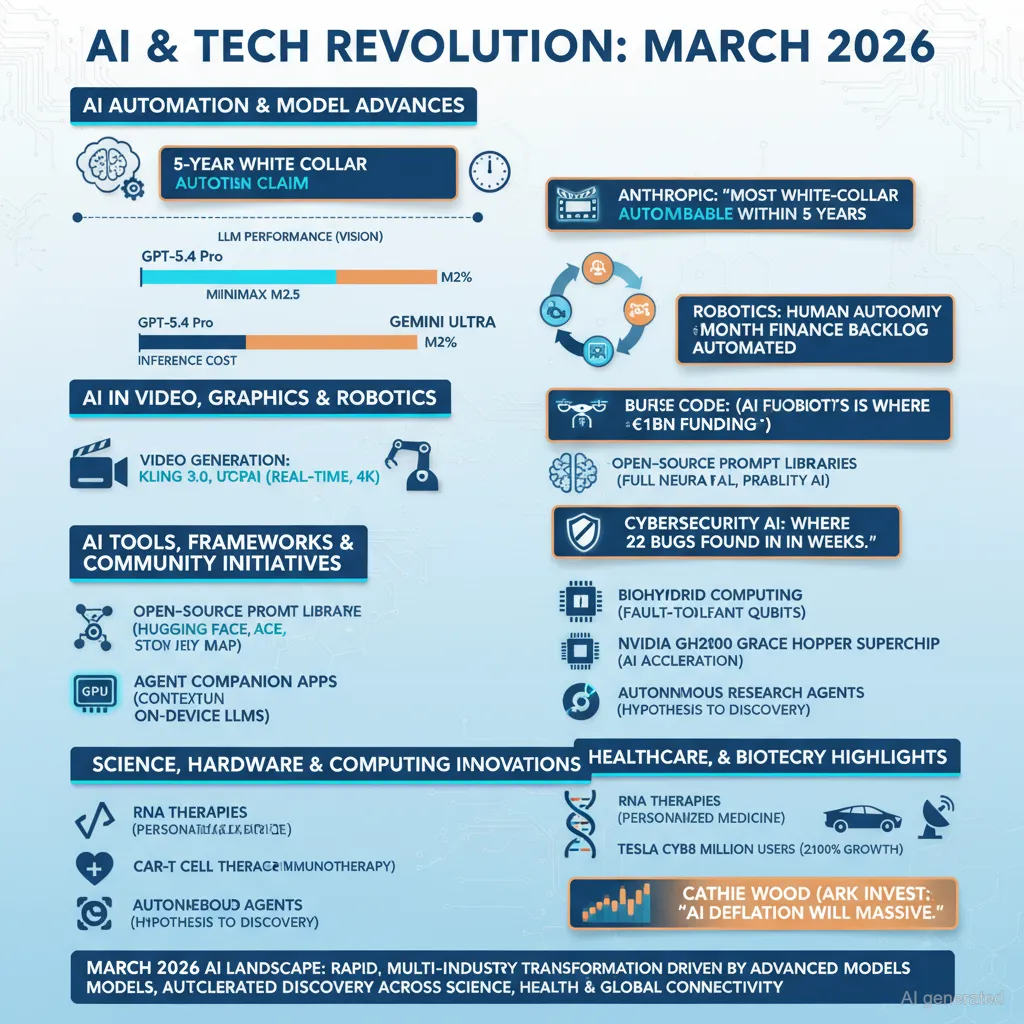
The latest developments in artificial intelligence and adjacent technologies reveal rapid advancements reshaping numerous industries, from automation and robotics to healthcare and creative media.
AI Automation and Model Advances
Anthropic researchers assert that current AI models already possess the capability to automate most white-collar jobs within five years, even if progress in algorithms were to halt immediately. Feeding tasks manually into AI models has become more economically viable than human labor. Notably, Claude Code recently enabled Ark Invest to automate a six-month finance backlog, with plans to integrate further AI capabilities into its Palantir platform. This marks what Ark Invest’s founder Cathie Wood describes as a “1980 PC moment” in AI.
Several large-language models (LLMs) have shown remarkable performance breakthroughs: GPT-5.4 Pro nearly reaches human parity on vision benchmarks and is considered the best deep reasoning AI model to date, excelling in coding, knowledge work, and research tasks. It supports autonomous agent workflows running fully hands-off overnight, automating software development tasks like PR reviews, dependency audits, and error logs. Meanwhile, the open-source Kimi K2.5 and MiniMax M2.5 MoE models achieve performance comparable to proprietary Claude Opus 4.6 at dramatically lower inference costs, enabling potential local hardware deployment on personal machines.
Google recently open-sourced the Agent Development Kit, enabling always-on AI Agents running 24/7 at negligible cost integrated with Gemini 3.1 Flash-Lite. Additional new tools include PaperBanana, an agentic framework generating publication-ready academic illustrations from methodology text, and the powerful /loop command for scheduling recurring tasks in AI workflows.
A new paradigm emerging is using consensus model councils-running tasks through multiple LLMs like Claude, GPT, and Gemini, then combining their reasoning to improve answer quality and reliability. This model consensus approach helps uncover reasoning disagreements while boosting confidence in agreements.
Boris Cherny, creator of Claude Code, emphasizes the importance of giving AI tools freedom and a set of capabilities instead of rigid workflows, as general learning systems scale better. Further innovations include introducing task verifiers that check AI’s own work, as demonstrated by Opus 4.6’s groundbreaking performance in cybersecurity. It identified 22 bugs-including 14 high severity-in two weeks, created verified patches, and earned praise from the Firefox team for the quality and trustworthiness of reports, indicating AI can now perform the equivalent of an annual cybersecurity engineer’s workload in just days.
AI for Video, Graphics, and Robotics
AI video generation is reaching new levels of sophistication. The Kling 3.0 video generation system, released globally with motion control features, is designed for commercial advertising and professional film, capable of producing full 1080p outputs. Long-form video generation is evolving with models like Utopai Studios’ PAI, which maintains narrative continuity, consistent characters, and story worlds across live-action sequences-a novel capability in AI video storytelling.
Open-source video generation tools like LTX-2.3 push the boundaries of text-to-video and image-to-video synthesis with audio synchronization powered by a single 22-billion-parameter model. The QVGen model family demonstrates that quantized video generative models can maintain high-quality scene consistency and motion even at 4-bit compression, making video AI efficient enough for practical use.
In robotics, major events include the launch of the LeHome Challenge inviting teams to develop AI-driven clothes-folding policies using NVIDIA Omniverse physics simulation, with significant prize money and in-person competition. The startup Neura Robotics is scaling production of their cognitive humanoid robot and has raised around €1 billion, with ambitions for global rollout powered by their Neuraverse AI ecosystem.
In a scientific milestone, a full digital emulation of a fruit fly brain, neuron by neuron, has been connected to a physics-simulated body exhibiting natural behaviors without explicit training. This marks a notable step toward whole-brain emulations for larger organisms.
AI Tools, Frameworks, and Community Initiatives
The community continues to build impressive tools and frameworks. For example, the OpenClaw system supports real-time multi-robot control across different platforms and hardware, with open source interfaces. Large open-source prompt libraries have emerged, such as “prompts chat” with over 150,000 stars on GitHub, compatible with a wide array of LLMs for privacy-conscious users and organizations.
On the personal productivity side, innovations like Agent Companion allow users to control AI agents remotely from their phones, maintaining workflows even when away from the computer. Context management is emphasized as a key for effective AI usage; platforms like Notion and Obsidian support AI-native personal knowledge bases that serve as persistent context for agents, significantly improving output quality.
Replit’s first Mobile Buildathon showcased diverse mobile apps combining AR, AI, and practical utilities, highlighting rapid adoption of mobile AI stacks. Winners included a multiplayer AR ghost hunting game and a room cleaning planner built collaboratively by a family.
To accelerate AI adoption, curated learning paths cover prompt engineering, context management, model stacking, and automation frameworks like OpenClaw and Manus. Practical AI skills such as security auditing-made easy through optimized Claude Code prompts-and code verification with structured checklist templates have drastically reduced errors and boosted reliability.
Several companies, including Hugging Face, have published synthetic data generation playbooks covering over 90 experiments and a trillion generated tokens to enhance downstream model training with high-quality synthetic phrases. Papers on continual learning in robotics show pretrained vision-language-action models maintain old knowledge better than traditional behavior cloning when learning new tasks.
Science, Hardware, and Computing Innovations
Researchers have made strides in combining biological and computational systems: human brain cells grown on microchips learned to play DOOM, demonstrating biological tissue can process digital input and exhibit learned behavior without a full brain or body, opening paths to bio-hybrid processors vastly more energy-efficient than silicon.
Quantum computing research shows fragile quantum data can be stored longer by encoding it into microscopic sound vibrations rather than electrical signals, offering a new hardware paradigm based on sound.
IBM-led scientists synthesized a molecule with half-Möbius electronic topology-a molecular structure with twisted electron paths-using atom-by-atom construction and quantum simulations, pioneering new quantum materials and molecular electronics.
On the hardware front, NVIDIA RTX 3090 GPUs continue to perform well on large LLMs such as Qwen3.5 27B models, demonstrating linear performance scaling versus newer GPUs. Developments in Apple’s CoreML include new profilers to optimize neural engine model performance.
Karpathy open-sourced an “autoresearch” system where an AI agent autonomously designs and runs ML experiments overnight, systematically improving model architectures without human intervention, accelerating AI research democratization.
Healthcare and Biotech Progress
In biomedical innovation, new RNA-based therapies show promise for heart attack recovery by delivering the Nppa gene via lipid nanoparticles to muscle cells, which produce hormones supporting cardiac repair for weeks after a single injection. This minimally invasive approach may reduce fibrosis and prevent long-term heart failure.
In autoimmune disease treatment, manufacturing costs for CAR-T cell therapy-a highly effective but expensive cancer treatment-are the bottleneck for scaling to millions of patients. Research on in vivo CAR-T involves injecting lipid nanoparticles to reprogram T cells inside the body, potentially transforming a $500,000 manufacturing challenge into a vaccine-like scalable therapy. This could disrupt the $200 billion addressable market with dramatically lower costs.
Industry and Market Highlights
Tesla plans to initiate production of its Cybercab, touted as one of its most beautiful designs yet, signaling a future with widespread autonomous robotaxi fleets. Meanwhile, Starlink has surged past rural DSL and legacy satellite broadband in the US, growing 2,100% in five years to 2.68 million users by providing faster speeds at lower costs.
Neura Robotics, valued at about $4 billion, secured major funding with crypto backing to mass-produce humanoid robots. These developments underscore the intersection of AI, robotics, blockchain, and advanced manufacturing.
On the content and media front, platforms such as X (formerly Twitter) have grown articles 18x in recent months and recently launched a Listen feature powered by Grok Voice for audio consumption on mobile.
The AI content ecosystem is rapidly expanding, with open-source repositories offering comprehensive resources for AI engineering and machine learning education, including foundational mathematical concepts, tutorials, and hands-on guides.
Summary
Overall, the AI landscape is advancing at an unprecedented pace, marked by model capability leaps, emergent autonomous workflows, broader adoption of agentic AI, and new commercial applications in video, robotics, healthcare, and software engineering. Open-source projects are closing gaps with proprietary systems while drastically reducing costs, enabling researchers and developers to run powerful models on personal hardware. Simultaneously, novel interfaces like brain-computer devices and biohybrid computing are paving new paths for future computational paradigms. This convergence signals a paradigm shift in how AI integrates into daily work, research, and industrial innovation.