
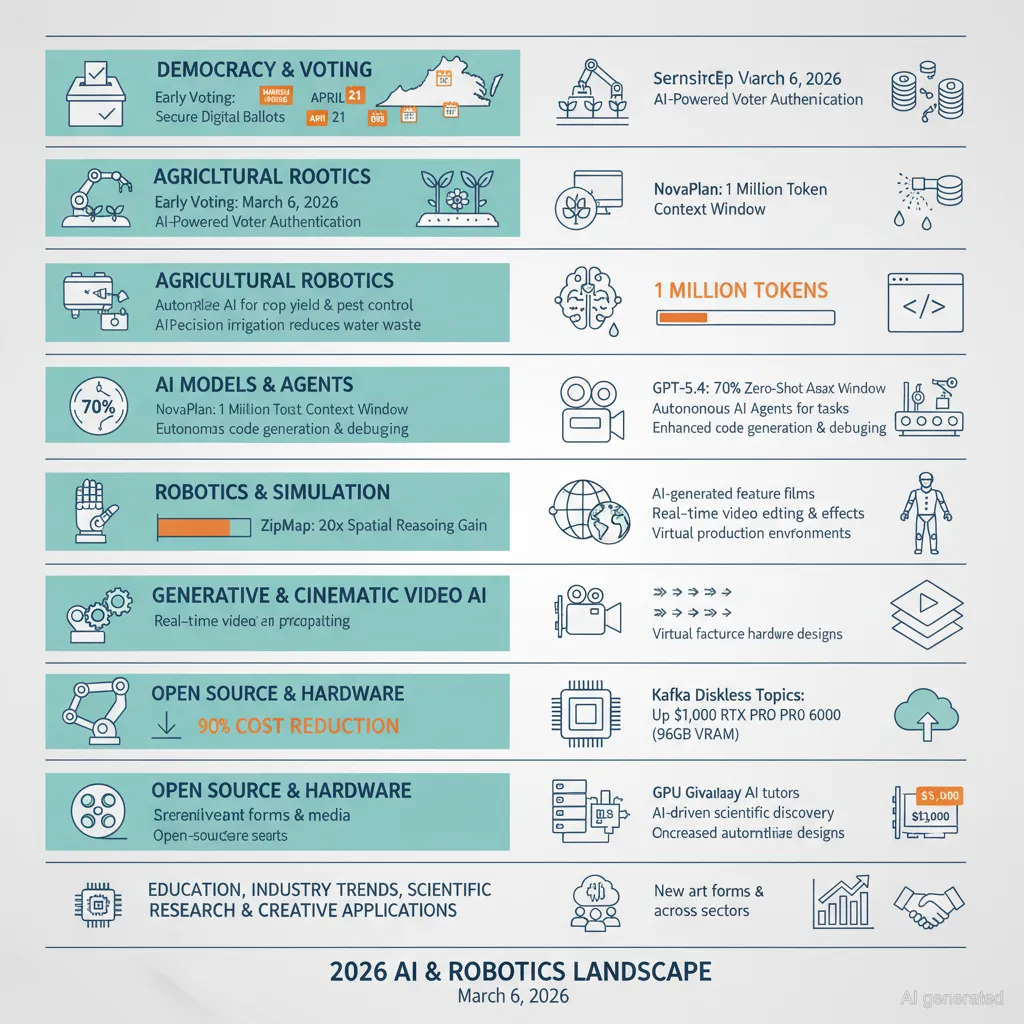
Several recent developments highlight major advances and applications in AI, robotics, and technology, alongside ongoing societal challenges.
Democracy and Voting
Concerns were raised over the fairness of midterm elections, emphasizing that free and fair elections are foundational to democracy but currently under threat. Several Republican-controlled states have allegedly redrawn congressional maps to gain an unfair advantage. Virginia presents a timely opportunity to promote electoral fairness, with early voting starting March 6 and Election Day on April 21. Residents are urged to vote YES to help level the playing field.
Agricultural Robotics
Robotics in agriculture has transitioned from experimentation to profitable deployment. Robots are actively working in orchards, vineyards, and vegetable fields to address labor shortages with precision spraying and reducing chemical usage at scale. These developments position robotics as a key element of next-generation agriculture.
Advancements in AI Models and Agents
OpenAI’s GPT-5.4 model has been released, showcasing substantial improvements in factual accuracy, efficiency, and agentic capabilities. It supports up to 1 million tokens of context and native computer-use abilities, enabling the AI to directly operate software, browse the web, and plan complex workflows. The model improves deep web research and context retention, allowing users to steer responses mid-generation. GPT-5.4 is integrated across ChatGPT, Codex, APIs, Microsoft Foundry, and various platforms, reinforcing its use for professional work including spreadsheet and document creation.
Anthropic’s Claude suite continues to gain traction, with users highlighting the importance of using its various models (Haiku, Sonnet, Opus) appropriately to reduce token usage efficiently. Claude Code, an advanced coding agent, now supports features like simulating physical environments and building simulated workflows. Skills and Model Context Protocol (MCP) further empower AI agents to connect seamlessly to external tools and execute complex tasks reliably. Innovations like LangSmith Skills and CLIs enhance agent engineering lifecycles.
In parallel, the community sees growing enthusiasm for agentic AI-the shift from simple generative models to autonomous AI agents capable of planning, executing multi-step tasks, adapting, and self-improving. Comprehensive explanations clarify distinctions between generative AI, agentic AI, and AI agents, highlighting practical implications for product development.
Robotics and Simulation
Multiple breakthroughs in robotics highlight progress toward robust, autonomous systems:
– The release of Interactive World Simulator enables long-horizon, real-time interactive world modeling crucial for scalable policy training and evaluation in robotics.
– NovaPlan, a system developed by researchers at Boston Dynamics AI Institute, CMU, and Brown University, achieves 70% zero-shot success on assembly tasks by employing closed-loop, video-based planning with dynamic recovery. It addresses challenges like depth estimation error and tracking drift by synchronizing multi-modal sensor data.
– AutoFAB introduces the world’s first Robotic Desktop Factory targeted at labs and farms for real-world testing.
– Open-source platforms such as OpenArm 02, ART (Agent Reinforcement Trainer), and Origami Robotics advance reproducible policy evaluation, training agents with automatic reward functions, and building high-DOF robotic hands, respectively.
– Advances in tactile simulation and co-training on simulated and real data support reinforcement learning policies for real-world robotics.
– Breakthroughs in compliance control and estimation enable safer contact-rich manipulation without force sensors or complex reinforcement learning setups.
– Emergency autoland AI features for helicopters promise life-saving capabilities during pilot incapacitation.
Generative and Cinematic Video AI
Significant strides in AI-generated video content transformation have been documented:
– Utopai Studios’ PAI model supports minutes-long, continuous cinematic video generation featuring character and scene consistency across multiple shots, with natural language editing capabilities for story-level refinement.
– Kling AI rolled out Kling 3.0 and variants with professional Mocap-level motion and expression control, enabling creators to produce cinematic 1080p videos with precise performance capture, multi-character swaps, and video editing workflows.
– Helios, a 14B parameter autoregressive diffusion model, generates up to 60 seconds of coherent video from single prompts, achieving near real-time speeds.
– Google’s NotebookLM Studio introduced Cinematic Video Overviews that produce immersive, bespoke videos.
– Other tools like LTX Desktop and Diffusers 0.37.0 enhance local video editing and support novel model backends.
Open Source and Ecosystem Developments
The open-source AI and machine learning ecosystem continues thriving with notable releases:
– Qwen3.5 GGUF updates improve chat, coding, and tool use capabilities, offering open models that perform well on clinical benchmarks such as EURORAD for radiology diagnosis, narrowing the gap with top-tier private models.
– Alibaba open-sourced OpenSandbox, a secure containerized environment for AI agent code execution.
– Molmo2 codebase from Allen AI was published with full infrastructure for vision-language models supporting image and video understanding.
– Greptile Agent v4 advances code review capabilities by catching tricky bugs reliably with fewer false positives.
– FlexAttention added FlashAttention-4 backend for significant speedups on custom attention variants.
– ZipMap innovation enables linear-time, stateful 3D reconstruction via test-time training, improving spatial reasoning efficiency by 20x+ over previous state-of-the-art models.
– Diskless Topics introduced for Kafka promise up to 90% cost reduction by writing data directly to S3, improving scalability and operational simplicity.
– Inclusion of Qdrant vector search into Google’s Agent Development Kit ecosystem supports scalable semantic memory and retrieval in AI agents.
Hardware and Facilities
Companies like NVIDIA, xAI, and OpenAI expand infrastructure to support next-gen AI workloads:
– NVIDIA CEO Jensen Huang praised Elon Musk’s projects-Grok, Tesla’s self-driving, and Optimus robots-as revolutionary, noting close collaboration and high expectations for Optimus as a multitrillion-dollar industry.
– xAI is expanding its data center footprint with a $659M permit for a new 312,000 sq ft facility in Memphis to support Grok and Colossus supercomputer.
– OpenAI and partners conducted GPU giveaways, such as a $15,000 RTX PRO 6000 Blackwell GPU with 96GB VRAM, aiming to empower community AI research and builders.
– The Illinois Quantum and Microelectronics Park represents a full-circle moment as it replaces the former U.S. Steel South Works site, hosting the first utility-scale quantum computer deployment by PsiQuantum.
Education, Community, and Industry Trends
Efforts to democratize AI education and community participation have been highlighted:
– Anthropic launched 13 free AI courses offering real certificates ranging from beginner to advanced levels, covering Claude’s usage, model context protocol, skills building, fluency in AI, and integration with cloud platforms.
– Hackathons with Google DeepMind, open-source contributions, and community projects like n8n-claw (a self-hosted AI agent framework) continue fostering collaboration.
– Industry leaders emphasize AI’s transformative potential in finance, software engineering, healthcare, and creative arts.
– The shift from human-centric work to AI-driven “factories” or autonomous systems is underscored, where configuring automations overtakes pure coding in efficiency and impact.
– Discussions on AI ethics, agency, and effectiveness stress the importance of robust guardrails to avoid chaos and to fully realize AI agents’ potential.
Scientific and Applied AI Research
Several noteworthy research contributions include:
– High proficiency of AI models like GPT-5.4 Pro on complex benchmarks such as FrontierMath Tier 4.
– Flow-matching decoding algorithms addressing continual learning plasticity.
– RL frameworks enabling multi-agent collaboration with reduced rollout costs.
– AI systems that convert complex brain scans into “movies,” facilitating better understanding and treatment of diseases.
– Advances in quantum computing applied to molecular design and electronic topology.
– Emergence of continuous learning vision-language-action models supporting autonomous robot skill acquisition.
Creative Applications and Media
Creative workflows benefit from emerging AI tools:
– Filmmaking platforms like InterPositive employ ComfyUI for AI-assisted creative control, enhancing cinematography and direction without replacing human judgment.
– AI models such as Luma Agents collaborate visually with human creators to boost productivity.
– AI-powered game development and prototyping tools (Nano Banana 2, Unity upcoming natural language prompts for casual games) promise democratization of game creation.
– The first AI influencer reality show, Bot House by OpenArt Studios, explores AI-driven storytelling and social dynamics.
In summary, the technological landscape in early 2026 is marked by transformative advancements in AI models, robotics, video generation, and open-source frameworks, alongside vibrant community engagement and ecosystem growth. These developments promise new capabilities across industries including healthcare, creative arts, agriculture, and finance while also raising critical discussions on fairness, safety, and responsible adoption.