
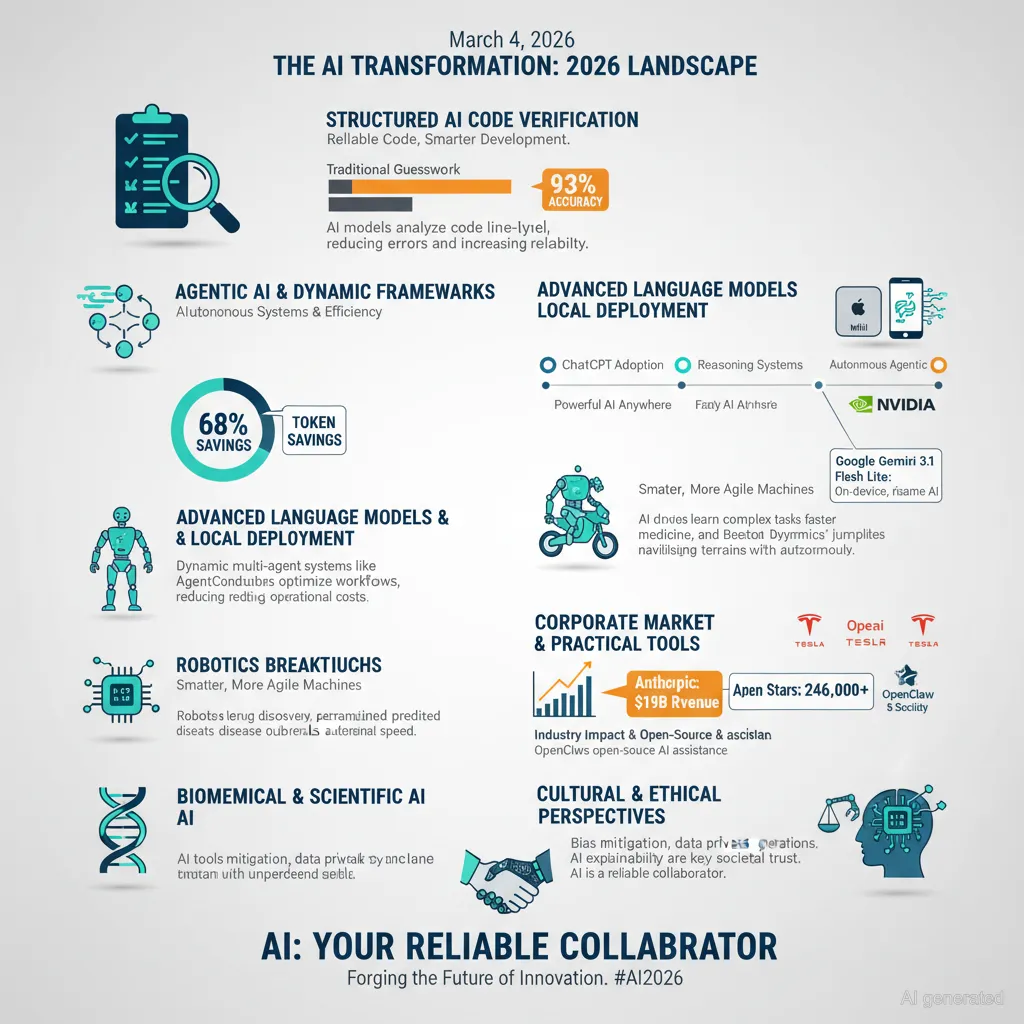
Meta researchers have developed a mandatory checklist approach compelling AI to trace software code line-by-line instead of making blind guesses, drastically improving accuracy in verifying software updates. This structured template forces AI to document the exact code execution path and provide evidence for every assertion, boosting accuracy to 93% when reviewing real-world code changes. Traditionally, AI tools assess updates by analyzing function names and guessing confidently, but ensuring full correctness typically requires human developers to run expensive, time-consuming tests on dedicated servers. This new method allows companies to automatically and reliably validate millions of lines of code without incurring high computational costs, revolutionizing software verification workflows.
In related AI development news, several innovations are emerging in agentic AI, robotics, language models, and open-source AI ecosystems. NVIDIA’s CEO Jensen Huang outlined the AI boom progressing through phases: mass adoption via ChatGPT, a surge in reasoning systems driving token and compute consumption, and now autonomous agentic AI capable of planning and execution. This evolution exponentially increases computational demand and reshapes competitive advantages around speed and cost efficiency. Industry leaders like Larry Ellison emphasize that as AI models become commoditized through shared internet data training, the critical differentiator will be dynamic routing of model usage optimized by latency, pricing, and success metrics rather than brand loyalty.
Agent frameworks continue to advance. Chinese researchers introduced AgentConductor, a multi-agent system that dynamically adjusts agent team structures based on task difficulty, replacing fixed workflows with flexible management that improves coding accuracy and reduces token consumption by 68%. Other projects, like OpenClaw, have gained massive community adoption with over 246,000 GitHub stars, providing open-source personal AI assistants that automate workflows locally without subscription or data leaving users’ machines. The demand for running such agents locally has driven increased hardware sales such as Mac Minis, reflecting growing interest in privacy-preserving AI.
Large language models (LLMs) are growing more powerful and accessible. Google’s Gemini 3.1 Flash Lite offers faster, more cost-efficient inference at high-volume scale, now available via Google AI Studio and Vertex AI. Meanwhile, the Qwen 3.5 series from Alibaba continues pushing open-source innovation, supporting dynamic skills plugins and running efficiently even on limited GPU devices or local machines like iPhones and Mac Minis. The integration of agentic reasoning, dynamic memory architectures separating long- and short-term knowledge, and enhanced debugging assistants in platforms like Claude Code indicates a maturation from chatbots toward reliable AI “operators” that meaningfully augment software development and knowledge work.
Robotics and physical AI are also receiving breakthroughs. Physical Intelligence’s Multi-Scale Embodied Memory (MEM) system equips humanoid robots with short- and long-term visual and semantic memory enabling complex multi-stage tasks like kitchen cleaning and meal preparation to be performed adaptively without repetitive errors. Reinforcement learning is improving robot agility, exemplified by small jumping bicycles and simulated-to-real deployment of visual policies within minutes. Companies like Noble Machines and JetStream are advancing industrial physical AI and AI governance respectively, enabling safer adoption of autonomous systems in real-world settings.
On the biomedical and scientific front, AI co-scientists are accelerating discovery workflows, such as the Eubiota project validating linked biological data and the BioGPT-Large model specialized in biomedical literature analysis. Formalization and automated checking of mathematical theorems, as well as modular frameworks for evolutionary algorithms like SkyDiscover, are bringing rigorous machine verification and adaptive optimization to research domains. Lab-grown neuron clusters connected to large language models via silicon chips mark a novel intersection of biological neural systems and AI.
In corporate and market perspectives, Anthropic’s rapid revenue growth to $19 billion highlights its competitive streak against rivals like OpenAI. Industry leaders caution that AI will disrupt many entry-level professions, urging individuals to reskill as “AI specialists” in their sectors. Tesla’s cultural DNA is influencing critical mineral extraction industries powering AI hardware, emphasizing risk appetite and speed of execution as key competitive advantages.
Practical AI tools are proliferating: OpenAI’s recent rollout of GPT-5.3 Instant improves answer accuracy and reduces unnecessary refusals; Google-developed ActionEngine enables AI agents to automate web navigation efficiently via programmatic scripts rather than costly stepwise browsing; and Postman revolutionized API development by integrating collections and specs directly into Git workflows with automatic spec migration and AI-driven discovery.
The AI landscape is also shaped by open-source projects and frameworks facilitating agent orchestration, personalized AI assistants, programming tools, and robotics control. OpenFang and NullClaw exemplify minimalistic, high-performance implementations in Rust and Zig, respectively. Courses from top AI organizations are offered free to democratize skills. With desktops and laptops increasingly capable of running advanced LLMs locally on Apple Silicon or via lightweight models, the promise of privacy, speed, and cost-effectiveness grows stronger.
Finally, the cultural and philosophical dimension reminds that AI adoption will redefine creativity, knowledge, and work, stressing traits like curiosity, storytelling, rapid adaptation, and relationship-building as critical human skills. Alongside rapid technological progress, there is a call for ethical governance and democratic oversight to ensure AI’s safe, equitable deployment.
In conclusion, the confluence of structured code reasoning, scalable agent systems, advanced robotics, accessible language models, and open-source momentum propels AI’s integration into software development, research, and physical environments. These developments herald a new era where AI no longer guesses blindly but operates as a reliable collaborator and autonomous operator, reshaping industries and empowering individuals with unprecedented tools.