
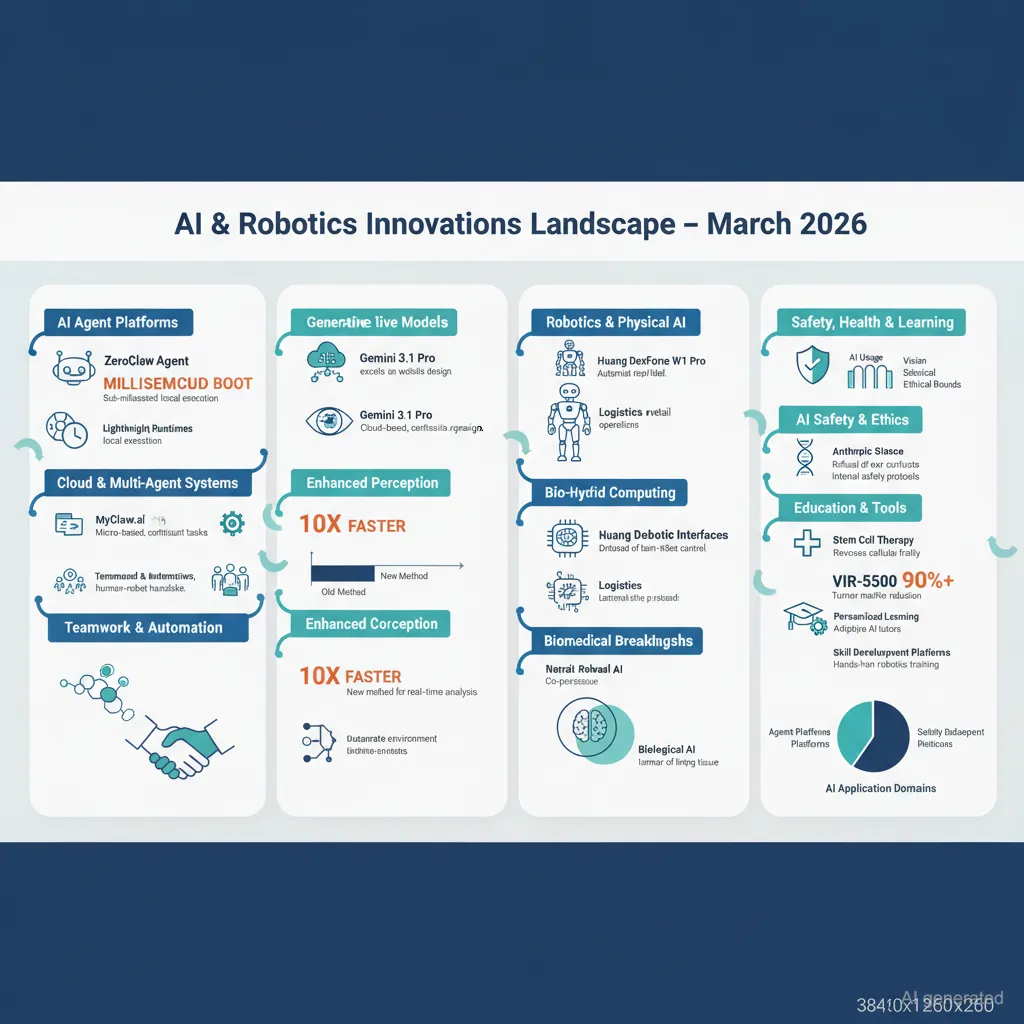
The latest developments in AI and robotics continue to reshape industries and workflows, pushing the frontiers of technology and its integration into daily life and work.
**AI Agent Technologies and Platforms**
ZeroClaw introduces a Rust-native AI agent runtime notable for its lightweight, local execution with millisecond boot times, avoiding the usual cloud dependencies and hefty runtimes common in agent frameworks. MyClaw.ai complements this by offering a fully managed cloud-hosted OpenClaw instance, enabling continuous 24/7 operation without local setup challenges. Similarly, emerging AI agent frameworks such as Agent Zero and Openfang are focusing on stability, autonomy, and privacy, operating fully locally without API calls or cloud reliance. Alibaba’s OpenSandbox provides a production-ready environment for running untrusted agent code securely with features like browser automation and Kubernetes integration, supplying a much-needed agent infrastructure for real-world applications.
Platforms like Claude have evolved beyond chatbots to become digital coworkers capable of executing complex workflows autonomously; recent updates include multi-agent teamwork to build software components collaboratively, command-line skill forcing, and automatic code simplification and review. Anthropic’s Claude Code and the associated Claude Cookbooks enable developers to build advanced AI-powered coding workflows, while offerings like Antigravity Awesome Skills aggregate hundreds of reusable skills for AI agent workflows, shifting AI use from mere prompt-answering to full execution layers.
Microsoft’s Copilot has advanced into an AI agent embedded in everyday tools like Outlook and Word, capable of planning weeks, browsing, and automating document creation. This marks a shift from AI as assistant to AI as integrated employee. Google AI Studio 2.0 similarly revolutionizes app development by integrating AI components with server-side persistence and real databases, enhancing stability and coherence for longer sessions.
**Advances in AI Models and Vision Technologies**
Several new AI models have surfaced with notable claims. Gemini 3.1 Pro excels at website design through high-fidelity, prompt-guided generation. Nano Banana Pro 2 introduces faster, more detailed image-generation with improved text coherence. Vision Transformer (ViT) architectures continue to gain traction for image classification, bringing transformer-style attention to vision tasks previously dominated by CNNs.
In video and multimodal AI, prominent achievements include the Kling 3.0 model’s top ranking across text-to-video benchmarks and a new video segmentation approach that boosts speed tenfold with a simplified architecture. UI-Venus-1.5 by Ant Group presents a unified GUI agent capable of navigating complex mobile and web interfaces, setting new state-of-the-art records in multi-step task execution.
Open-source projects such as Evolver achieve GPT-5.2-level performance on advanced benchmarks by mimicking natural selection principles for code and prompt optimization, while LMCache addresses GPU compute inefficiencies by persisting KV caches for large language model inferences.
**Robotics and Physical AI**
Schaeffler’s new robotics entity in Taicang, China, emphasizes “Physical AI” that integrates hardware and software stacks targeting robotics applications. The DEXFORCE Robotics DexForce W1 Pro wheeled humanoid operates autonomously in a convenience store environment, personalizing meal preparation and delivery, presaging broader acceptance of humanoid helpers.
Developments in bio-hybrid computing by Cortical Labs demonstrate living neural tissue learning to play games like DOOM, highlighting promising advances in synthetic biological intelligence with potential applications in neuroprosthetics and energy-efficient computing.
NVIDIA and other research groups provide robust frameworks for robot simulation and hardware-in-the-loop deployment, reducing iteration time by enabling direct import and control of URDF robot models.
**AI Safety, Ethics, and Industry Dynamics**
Anthropic gains attention for principled stands on AI safety, notably refusing Department of War contracts for autonomous weapons and mass surveillance. Their internal engineering aligns with organic agent alignment approaches emphasizing shared goals over micromanagement, a philosophy influential in recent agent team architectures.
OpenAI’s agreement with the DoD clarifies limits on AI systems usage concerning autonomous weapons and domestic mass surveillance, tying compliance to existing laws and policies, with contract termination provisions for violations. This highlights the ongoing tension in balancing AI innovation with ethical and legal constraints.
**Education, Developer Tools, and Community Resources**
Educational initiatives abound, including the Reinforcement Learning Summer School in Milan, free courses on distributed computing with Ray, and comprehensive mathematical foundations of machine learning essential for deeper understanding beyond superficial tutorials.
Open-source tools such as Scrapy empower users to extract structured data locally from websites, bypassing SaaS dependencies, while repositories like Antigravity Awesome Skills and Claude Cookbooks offer reusable AI workflows and agent capabilities to developers.
Productivity enhancements include tools like TheORQL, which brings vision-enabled debugging to frontend development by recognizing UI components visually rather than relying solely on code inspection, addressing the known “blindness” of AI coding assistants to UI correctness.
**Notable Industry and Societal Insights**
Elon Musk’s philosophy on iterating through experimentation and accepting failure as a measure of risk-taking is highlighted as essential for radical innovation, exemplified by Starship development-a testament to pushing biological intelligence limits.
Discussions on prompt engineering emphasize controlled context over isolated queries for unlocking AI potential, with advanced prompting techniques such as Socratic prompting and Atom of Thought prompting dramatically improving AI reasoning accuracy by decomposing problems into independent validated units.
Economic shifts driven by AI are evident, with individuals leveraging tools like Claude to generate significant income without traditional degrees or offices, while coding teams use autonomous agents to accelerate tedious tasks such as code migrations, turning multi-month projects into afternoon reviews.
**Biomedical and Scientific Breakthroughs**
Recent biomedical research reports promising stem cell therapy results for frailty in older adults, demonstrating potential to reverse aspects of biological aging and improve physical endurance.
Anti-cancer progress with the experimental VIR-5500 immunotherapy indicates significant tumor marker reductions in advanced prostate cancer patients, suggesting a new potent therapeutic avenue.
Immunological studies have unveiled mechanisms by which human immune cells detect viral RNA rapidly, advancing potential antiviral strategies.
**Final Remarks**
The fast pace of AI progress in 2026, from local agent runtimes, sophisticated agent teams, and improved visual AI, to robotics and bio-computing, reflects an era where AI integration fundamentally transforms industries and human workflows. The increasing focus on safety, ethics, and execution fidelity coupled with open-source movement and educational efforts underscore a maturing ecosystem poised to redefine human-machine collaboration and digital productivity in the near future.