
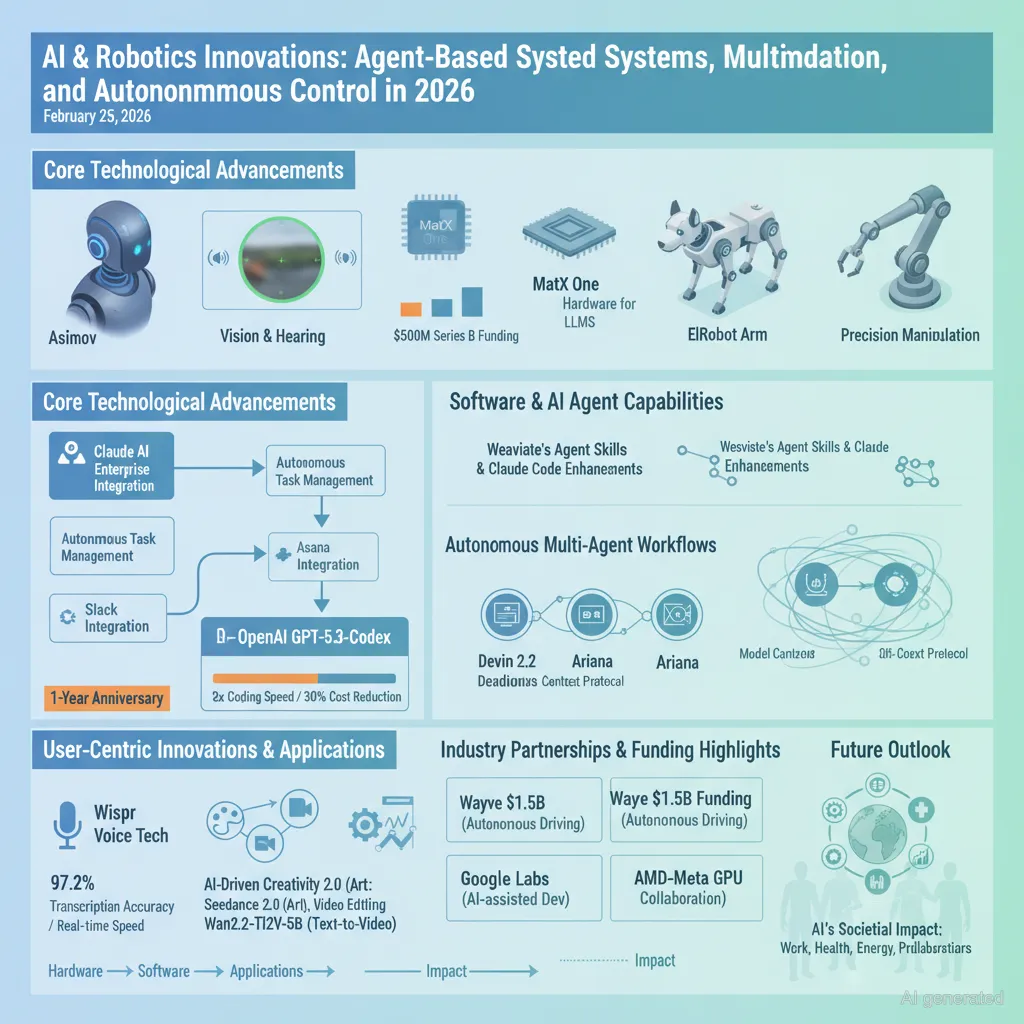
The recent developments in AI and robotics demonstrate rapid advancements in agent-based systems, multimodal perception, and autonomous control, with strong emphasis on making AI capabilities accessible, efficient, and integrated into real-world workflows.
OpenAI has appointed Arvind KC as Chief People Officer to guide its growth and responsible leadership during the AI-enabled transformation of work. The company has also been quietly developing Asimov, an AI agent embodied in a humanoid robot that perceives the environment through vision and hearing, able to localize and orient to sounds, marking significant progress toward embodied AI agents capable of rich spatial understanding. A first-person visual glimpse from Asimov’s perspective illustrates how this embodied agent perceives its surroundings.
Anthropic has enhanced its Claude AI platform notably, introducing enterprise features that enable deeper integrations across workflow tools such as Excel and PowerPoint, which allow Claude to autonomously perform multi-step financial tasks while synchronizing data across applications via plugins and connectors linked to institutional market data sources like FactSet and MSCI. They also demonstrated a remarkable use case where Claude autonomously managed software development tasks over a weekend, dividing work into Asana tickets and coordinating with human engineers via Slack to deliver a plugin. Additionally, Claude Code celebrates one year, having revolutionized software development by enabling faster coding and empowering non-technical users to build solutions. Their Remote Control feature now allows users to operate Claude Code from mobile devices seamlessly.
OpenAI recently released GPT-5.3-Codex through OpenRouter, delivering faster, more efficient, and steerable agentic coding capabilities, with pricing competitive enough to encourage widespread adoption. This release underscores the continuous acceleration in AI coding capabilities and their profound impact on productivity.
Significant progress in robotics is highlighted by announcements such as Unitree Robotics’ new quadruped robot, featuring a strong torque system, long battery life, and capabilities under challenging environmental conditions, aimed at inspection and companion applications. The open-source release of ElRobot, a fully 3D-printed robotic arm optimized for research and imitation learning without custom hardware, adds an accessible platform for physical AI experimentation.
Innovations addressing real-time and efficient AI inference were presented by MatX, which is developing the MatX One chip-a novel LLM-optimized chip designed with a splittable systolic array architecture to combine the low latency of SRAM-first designs with the large context capacity of HBM memory, targeting unmatched throughput and latency for large language models. Backed by a $500M Series B funding round including investors like Jane Street and industry leaders, MatX’s approach aims to disrupt Nvidia’s dominance in AI training hardware with a focus on training workloads where Nvidia currently leads.
In the software ecosystem, Weaviate unveiled its Agent Skills repository, bridging AI coding agents to Weaviate’s vector database infrastructure, offering specialized scripts and project blueprints to enhance accuracy in working with semantic search and RAG pipelines. Similarly, new tools like Claude Code’s Claude skill allow retrieval of structured, real-time data from websites with normalized tables, enhancing web data integration for AI agents beyond simple text search.
Voice technology continues to evolve with innovations like Wispr, which claims 97.2% transcription accuracy and high naturalness by adapting output style to application contexts, enabling users to dictate text up to 170 words per minute with minimal editing required, revolutionizing human-computer interaction for code and communication.
AI-powered creativity and media generation have advanced significantly, highlighted by tools like Seedance 2.0 and Kling 3.0 for cinematic-quality video production at scale, and text-to-video models like Wan2.2-TI2V-5B capable of generating coherent multi-second dynamic video from text prompts. These breakthroughs extend creative possibilities beyond traditional production constraints.
In terms of AI agent workflows and development, there is a clear trend toward autonomously operating, multi-agent systems. Innovations such as Devin 2.2 provide self-verifying and auto-fixing autonomous agents, while platforms like Ariana and methodologies like Model Context Protocol enable advanced agent orchestration across tools and data. Karpathy’s perspective emphasizes that future software discovery relies on agent-accessible interfaces (CLIs, MCP servers), signifying a paradigm shift from human-centric web navigation to agent-driven engagement.
Industry events and partnerships underscore the growing integration of AI across sectors, from Wayve’s $1.5 billion Series D funding to license AI driving technology globally, to Google Labs incorporating ProducerAI as its official music creation platform, and AMD’s strategic GPU deployment partnership with Meta. Advances in quantum sensing, nuclear waste recycling, and foundational robotics research further illustrate AI’s expanding role in solving complex scientific and industrial challenges.
Lastly, the outlook for AI includes substantial improvements in human health and biology understanding, projection of fusion and renewable energy abundance, and societal transformations in work and creativity driven by agentic AI systems. The consensus among experts is that AI agents will greatly increase deep domain expertise demand, create new automation opportunities, and redefine productivity across industries.
In summary, the AI ecosystem is accelerating on multiple fronts: from embodied AI in robotics and multimodal perception, through powerful coding and reasoning agents, to new hardware architectures tailored for large model workloads, and user-centric tools enhancing productivity and creativity. These developments collectively suggest a rapidly approaching future where AI agents operate seamlessly as autonomous collaborators, with impacts spanning technology, economy, and society.