
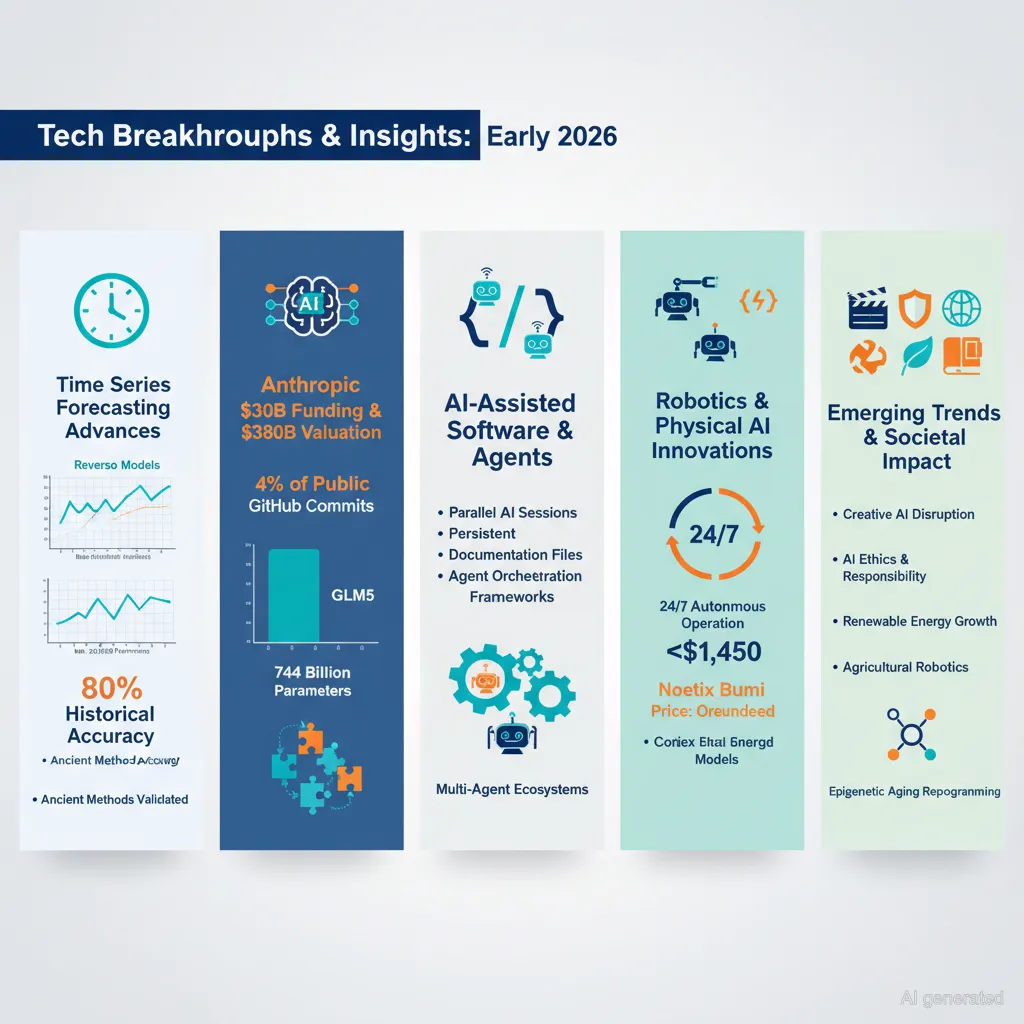
Several notable developments and insights have emerged across AI, robotics, time series forecasting, and related technological fields in early 2026, highlighting rapid innovation and transformative shifts.
Advances in Time Series Forecasting
A groundbreaking approach called Reverso has demonstrated that effective time series foundation models can be constructed with far fewer parameters-under 3 million and as small as 200,000-challenging the prevailing belief that billion-parameter transformers are necessary for accuracy. This innovation pushes the Pareto frontier in zero-shot forecasting, offering lightweight alternatives that significantly reduce computational overhead without sacrificing performance. Complementing this, scholarly research has revisited ancient forecasting methods from civilizations such as Mesopotamia, Egypt, India, and the Maya, confirming historical accuracy rates of up to 80%, and provides interactive tools for comparing these ancient techniques with modern statistical methods, reinforcing the foundational knowledge required for building robust predictive models.
AI Model Progress and Competitive Ecosystems
Anthropic has solidified its position with a recent $30 billion funding round valuing the company at $380 billion, closely tied to the commercial success of its Claude Code product, which now accounts for approximately 4% of all public GitHub commits. Claude models are praised for producing consistent, polished deliverables across domains, outperforming other labs’ models which often present disjointed capabilities. Concurrently, Google continues to build a comprehensive AI agent ecosystem with integrated tools spanning modeling (e.g., Gemini Pro), design, research, video, coding, and agent frameworks, enabling faster prototyping and end-to-end AI workflows that surpass competition based on single model strength. Open-source AI models, such as GLM5 with 744 billion parameters and Kimi K2.5, demonstrate high benchmark performance, parallel multi-agent operation, and open accessibility, signaling a new era of democratized AI innovation and breaking dependence on proprietary hardware and platforms. Lightweight conversational models like CPPO-7B-GGUF and local runtimes such as AirLLM running large models on modest GPUs further expand accessibility.
AI-Assisted Software Development and Agent Engineering
There is a notable shift toward AI-augmented development workflows, exemplified by Claude Code’s advanced usage where multiple parallel AI sessions are routine, and errors are systematically corrected via persistent documentation (e.g., the http://CLAUDE.md file), reinforcing continuous learning and improved accuracy. Tools like OpenClaw, which integrates deep functionalities including email and message handling with persistent memory and proactive task management, provide a versatile personal assistant experience. Automated autonomous financial analyst agents like Dexter perform complex tasks such as discounted cash flow valuations entirely without human intervention, illustrating AI’s growing role in sophisticated business functions. Software-defined factories and agents using programmatic tool calling advance industrial AI from pilots to scalable operations, while agent orchestration frameworks are seen as the core value driver beyond individual model capabilities.
Robotics and Physical AI Innovations
Robotics gains momentum with startups like Figure Robotics deploying fully autonomous robots capable of uninterrupted 24/7 operation with wireless charging and unit swapping. German firm SereactAI’s Cortex 2.0 system introduces production robotics with decision-grounded world models that anticipate long-term outcomes, significantly improving reliability and operational safety. China’s agricultural robots deploying vision models for continuous harvest illustrate practical automation scaling. Industry trends also favor vertical integration in robotics hardware development, accelerating iteration and reducing lead times. NVIDIA’s free comprehensive hands-on robotics course covers building robots from physics to hardware deployment, supporting workforce skill growth. Entry-level humanoid robots like Noetix’s Bumi under $1,450 mark the shift from research to consumer-grade products.
AI in Creative and Media Production
Seedance 2.0, a text-to-video and animation AI model, enables unprecedented quality, consistency, and creative possibilities, streamlining animation workflows and significantly reducing production costs and times that previously required large teams and budgets. Hollywood professionals and indie creators alike are adapting to this disruption, which enables blockbuster-quality content production at zero cost for certain tasks. Additionally, new text-to-video models such as Wan2.1-T2V-1.3B transform textual descriptions into moving scenes, expanding storytelling tools.
AI Ethics, Workforce, and Education
There is rising emphasis on safe and responsible AI development, including equitable gender representation in AI leadership, protecting vulnerable populations from exploitation by AI, and ethical guardrails to preserve human agency. The importance of soft skills such as discernment, empathy, and moral reasoning is stressed in the era of AI commoditization, highlighting that uniquely human traits will become more valuable. Skill-building in AI, robotics, and software engineering benefits from accessible resources like free courses from NVIDIA and curated AI agent learning roadmaps. Talent shortages in critical industries such as data center operations are being addressed through innovative solutions like simulation games to develop intuition and practical skills quickly.
Emerging Technologies and Economic Implications
Significant breakthroughs outside AI include 3D printed functional electromagnetic motors at minimal cost and within hours, pointing to distributed manufacturing’s potential. Harvard scientists report epigenetic reprogramming techniques capable of reversing biological aging markers substantially in animals, with human trials forthcoming, potentially revolutionizing healthcare and generating trillions in economic value. Renewable energy is now recognized as the cheapest and fastest-growing electricity source worldwide, urging accelerated investments for a fair transition. Space-based AI data centers, as advocated by Elon Musk, promise unparalleled solar power access and natural cooling, potentially redefining AI infrastructure economics.
DevOps, Open Source, and Infrastructure Trends
The industry observes growing production-ready DevOps pipelines leveraged exclusively with free tools such as GitHub Actions, Terraform, and Prometheus, making robust infrastructure accessible without heavy costs. Open source software is increasingly positioned as industry’s long-term competitor to proprietary AI, with competitive performance and price advantages. Companies optimize cloud infrastructure amid chip supply constraints; major cloud providers like Meta, Alphabet, Microsoft, and Amazon report demand exceeding supply for AI compute resources, underscoring the critical importance of semiconductor manufacturing capacity.
Noteworthy Cultural and Social Contributions
Efforts to preserve indigenous languages include distributing books like “What Makes Us Human” in Mayan native languages across several Guatemalan communities, reinforcing cultural heritage and literacy. Public engagement initiatives highlight AI’s role in societal progress, dignity, and economic development. Celebrations of sports and creative accomplishments underscore human achievement alongside technological progress.
In summary, the early months of 2026 reveal dynamic innovation across AI modeling, robotics, software engineering, and related domains. Lightweight foundational models challenge traditional computational norms; AI agents reach unprecedented utility and scale; robotics moves from controlled settings into autonomous industrial deployments; creative industries face AI-driven disruption; and infrastructure and ethical imperatives gain prominence. These trends define an era of accelerated transformation where human and machine collaboration, ecosystem integration, and open-source momentum shape the future of technology and society.