
News Highlights: AI Developments, Space Missions, and Technological Innovations
NASA Artemis II Moon Mission Update
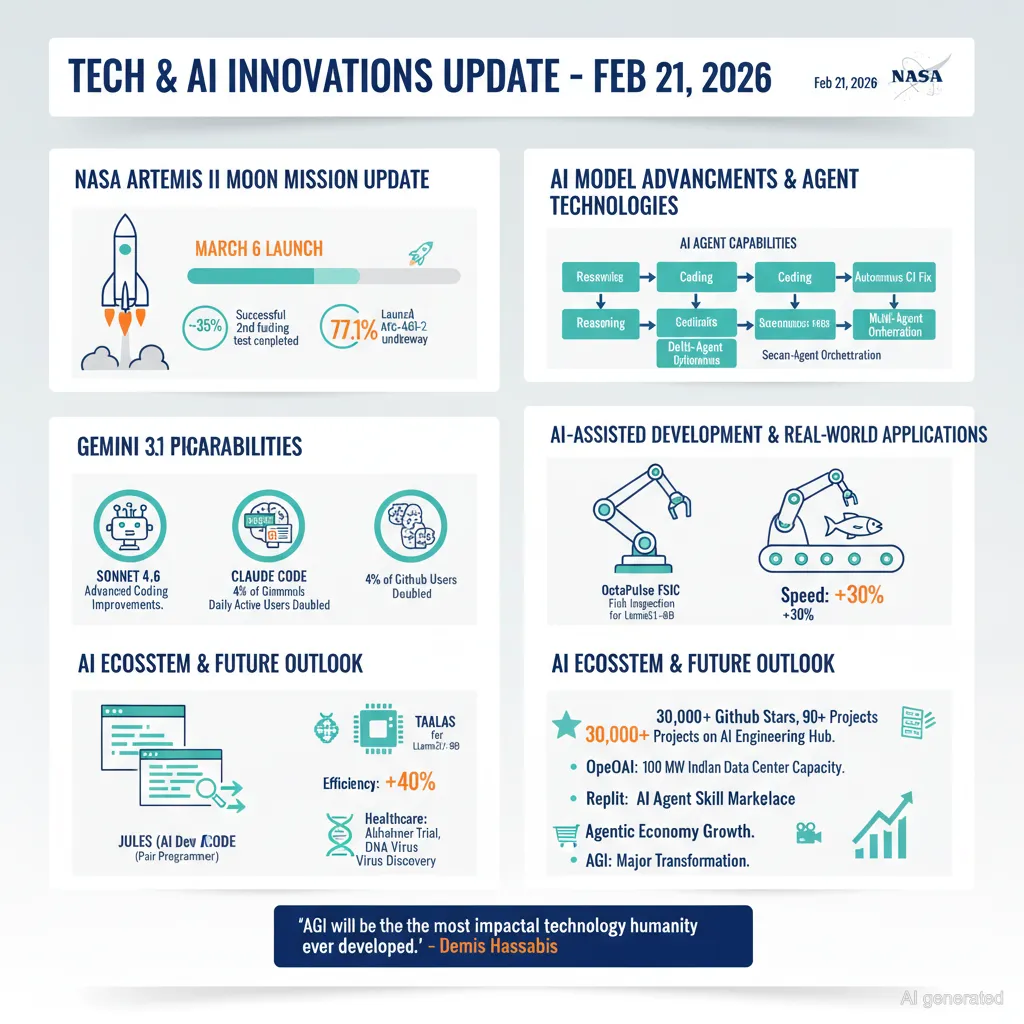
Agency leaders have announced progress on the Artemis II mission, targeting March 6 as the earliest launch date following a successful second fueling test. The Artemis II wet dress rehearsal, where the rocket was fueled for the lunar mission, concluded successfully with related launch pad operations beginning shortly thereafter. The team is preparing for a briefing on the milestone and next steps.
Source: NASA blog
Advancements in AI Models and Agent Technologies
Google DeepMind has released Gemini 3.1 Pro, an improved AI model that demonstrates significant advances in complex reasoning, achieving 77.1% accuracy on the ARC-AGI-2 benchmark-more than twice the previous model’s performance. This model excels at agentic tasks, intricate coding, and data synthesis, showing fewer errors and strong problem-solving capabilities. It is rolling out on platforms such as AI Studio, Gemini app, and NotebookLM, with developer workflows benefiting from its reasoning and coding skills.
Anthropic released Sonnet 4.6, their most capable model yet, which enhances strengths in coding, long-context reasoning, and even desktop-level computer use, priced comparably to Opus models. Claude Code, an AI coding assistant launched a year ago, now contributes to 4% of all GitHub commits and doubled daily active users last month. New features include abilities to autonomously fix CI failures and provide second opinions on code changes, resembling a full engineering team working continuously.
Several researchers and startups alike are refining AI agents further, including the development of multi-agent orchestration platforms such as Spine Swarm, which runs hundreds of AI agents in parallel to perform complex research and analysis tasks. Additionally, tools for prompt caching, controlled A/B testing of agent configurations, skill graph concepts for AI agent knowledge, and reinforcement learning enhancements in real-world robotics are topics of current exploration.
Open-source AI advancements continue with model fine-tuning using platforms like Unsloth and Hugging Face, and local AI runtime improvements exemplified by projects such as ggml and llama.cpp. Notably, OpenRouter has recently processed over 1 trillion tokens with strong adoption.
AI-Assisted Development and Productivity Gains
Deployments of AI coding assistants across developer workflows have improved iteration speed, error detection, and merge automation. Autonomous agents like Jules and Claude Code monitor, review, and fix coding issues continuously, enabling developers to focus on higher-level tasks. New marketplaces have emerged to distribute ready-to-use configurations and skills for such AI coding assistants, simplifying their adoption. Visual debugging and observability tools like Raindrop AI and Hodoscope have been launched to help developers understand agent behaviors and improve performance.
AI in Real-World and Specialized Applications
AI is increasingly integrated into physical and industrial domains: OctaPulse uses robotics and computer vision to automate fish inspection in aquaculture, whereas Taalas unveiled a specialized ASIC chip optimized for AI inference, providing extreme speed and power efficiency compared to GPUs. The chip ‘bakes in’ a specific model, Meta’s Llama3.1-8B, allowing rapid inference at low energy cost, albeit at limited programmability.
In healthcare, remarkable clinical trial results on creatine monohydrate’s effects on Alzheimer’s patients were announced, showing extraordinary improvements in memory and cognition. Another breakthrough from Harvard researchers revealed that giant DNA viruses carry their own eukaryotic-style protein translation machinery, challenging established biology paradigms.
In entertainment, AI’s transformative impact on creativity and productivity was discussed by actor Matthew McConaughey, emphasizing the importance of self-ownership of one’s identity as AI reshapes the industry. AI tools for generating original music from text descriptions and realistic image generation experiences are also gaining traction.
AI Ecosystem Growth and Community Building
The AI engineering community reports increased participation, exemplified by milestones such as 30,000 stars on the AI Engineering Hub GitHub repository, which offers over 90 hands-on projects covering topics like retrieval-augmented generation (RAG), fine-tuning, and AI memory. Educational initiatives and cohorts focused on practical AI engineering skills are recruiting new participants.
Corporate commitments to AI adoption are evident, with OpenAI securing 100 MW of AI-ready data center capacity in India and plans for expansion, enabling local processing and compliance with data residency policies. The Indian AI market shows rapid growth, with weekly users of AI tools quadrupling recently. Prominent speakers like Qualcomm executives emphasize public-private partnerships to accelerate AI innovation and adoption.
New platforms and tools are democratizing AI agent deployment; for instance, Replit announces extensive availability of AI Agent skills with security reviews and support for custom skills on its platform.
Upcoming Technologies and Future Outlook
Research suggests that predicting “Next Concept” tokens rather than next tokens could allow more efficient model scaling, potentially reducing parameter counts and training costs. Visualization tools like Raindrop AI and Spine Swarm enable detailed monitoring and orchestration of large, multi-agent AI deployments, improving understanding of agent workflows.
A significant AI paradigm shift is predicted, with the agentic economy poised to multiply global productivity dramatically, likened to a tenfold increase of the human population’s productivity virtually overnight. This revolution will coincide with other transformative technologies such as aging reversal, space colonization, quantum advancements, and gene editing.
Prominent AI figures, including Demis Hassabis of DeepMind, forecast the emergence of Artificial General Intelligence (AGI) as one of humanity’s most momentous events, potentially delivering ten times the impact of the Industrial Revolution within a compressed timescale. The conversation around managing job displacement and redesigning social contracts is gaining prominence to harness AI-driven prosperity responsibly.
Additional News and Innovations
– The first clinical use of AI agents in voice-based customer service shows agents outperforming humans in customer satisfaction during complex emotional calls, with deployments handling over one million calls daily.
– Open-source projects for speech synthesis and image rendering have reached new heights in quality and performance, running efficiently even on CPUs.
– New tools enhance AI-powered slide deck creation and content revisions, integrating daily tool contexts into presentations.
– Noteworthy breakthroughs in cancer treatment using nano-machines that mechanically destroy cancer cells without drugs or DNA damage were reported.
– AI-assisted real-time meeting coaching applications, AI-powered multiplayer game development via single prompts, and smart speaker kits enabling fully local AI voice agents without vendor lock-in have been introduced.
– The era of paying for AI software access is transitioning toward outcome-based pricing in AI-native companies, changing the software business model landscape.
This review synthesizes a broad array of recent advancements, products, and perspectives across artificial intelligence, robotics, space exploration, biomedical research, and software development, highlighting a dynamic and rapidly evolving technological frontier in early 2026.