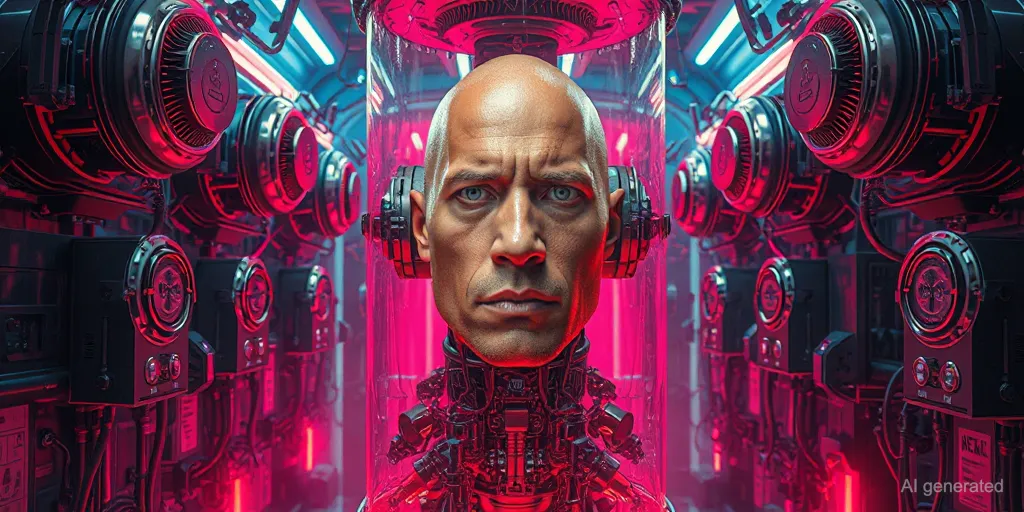
The recent wave of AI innovations marks a profound shift in technology, creativity, and productivity across multiple domains. A showcase short movie entirely created by AI demonstrates blockbuster-level quality in cinematography, pacing, and atmosphere, signaling that AI-generated media has moved beyond experimental stages. This breakthrough suggests a future where film and video production could be significantly democratized, enabling independent creators to flood the market with diverse intellectual properties while challenging traditional studios. As Hollywood experiences legal pushback against AI-generated content, the landscape is evolving rapidly toward an indie-driven creative economy, similar to trends seen on platforms like YouTube and Kindle Direct Publishing.
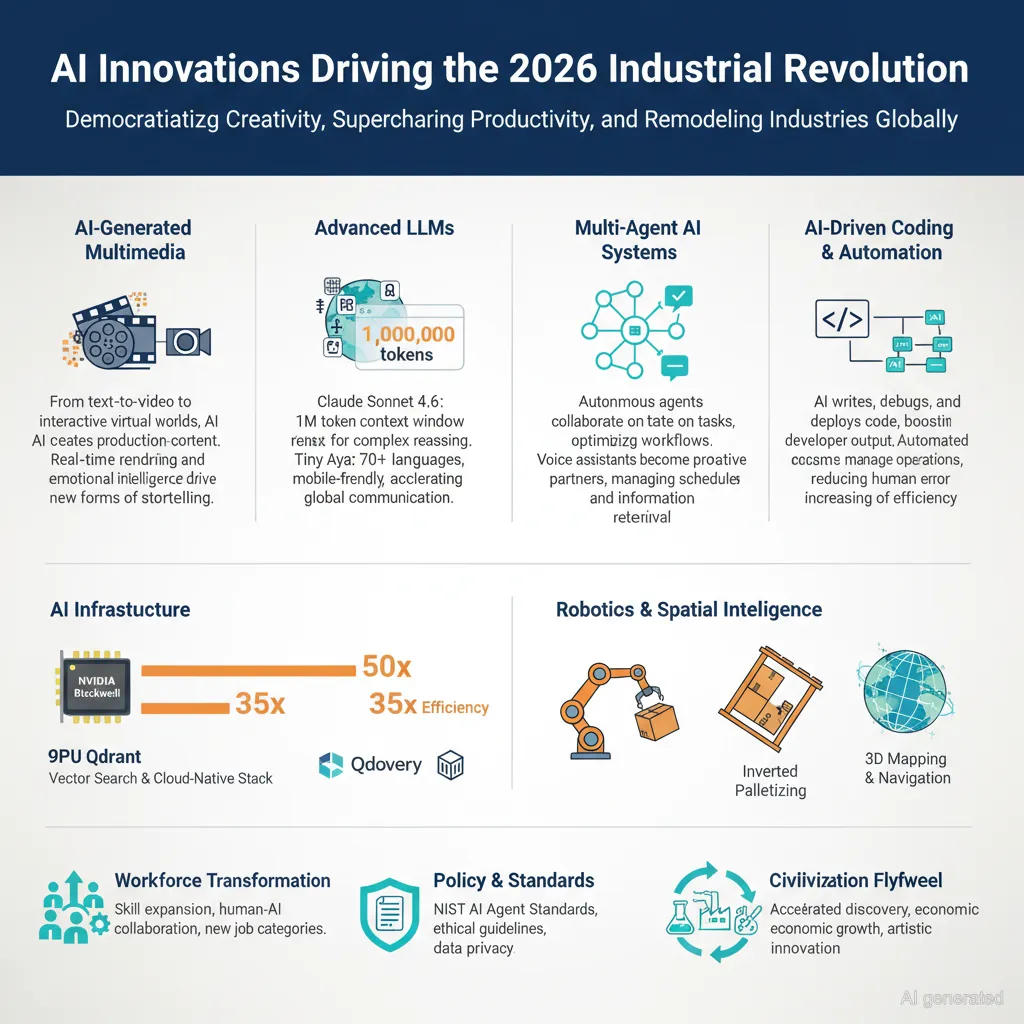
In the realm of large language models (LLMs), several important developments have emerged. Tools such as Anthropic’s Claude Sonnet 4.6 now offer up to a 1 million token context window and strong performance nearly matching their higher-cost Opus 4.6 model but at a fraction of the price, making advanced AI capabilities more accessible. MiniMax M2.5 and Cohere Labs’ Tiny Aya models bring high-quality, open-weight multilingual AI to the market, with Tiny Aya supporting over 70 languages and running efficiently even on mobile devices and browsers. These advancements underscore a trend favoring efficiency and accessibility over sheer model size. Additionally, cutting-edge models like Grok 4.20 from xAI employ multi-agent reasoning systems to enhance response quality and transparency.
AI agents are becoming more capable and practical. The OpenClaw framework, recently acquired by OpenAI, exemplifies this by enabling autonomous agents that manage complex tasks-from email monitoring to website coding-through subagents and recursive workflows. Voice-to-action assistants like Lemon and PolyAI demonstrate how speech interfaces can seamlessly execute tasks and handle customer interactions across multiple languages, dramatically boosting productivity in office and service environments. Developer tools such as Claude Code integrate smoothly with design tools like Figma, enabling rapid design-to-code workflows that shorten product development cycles from weeks to days. Advances in AI-driven automation in coding, testing, and debugging herald a new era of “agentic coding,” where AI agents self-improve, run concurrent workflows, and enhance software engineering standards with measurable metrics.
On the infrastructure side, improvements in vector search technology (like Qdrant’s integration with platforms such as Qovery) and cloud-native architectures are facilitating low-latency, scalable AI deployments. NVIDIA’s Blackwell Ultra GPU platform delivers up to 50 times better performance and 35 times lower cost per token, accelerating agentic AI workloads including extensive coding assistance. Meanwhile, open source projects and SDKs-ranging from agent development kits (Cloudflare Agents SDK, LangSmith integrations) to comprehensive AI skill repositories-are empowering developers to build more intelligent, reliable, and customizable AI agents.
Robotics and industrial AI are also advancing quickly, with new robotic dexterity breakthroughs, autonomous operations reducing offshore platform costs, and innovative palletizing systems that maximize floorspace by enabling upside-down robot operation. Real-time world modeling systems and spatial intelligence technologies are set to improve not only gaming and simulation but also industrial applications that require precise interaction with physical environments.
On the research front, novel training methods such as Training-Free GRPO demonstrate that models can improve performance through iterative prompt-based learning without fine-tuning, drastically reducing costs and enabling greater generalization. Multimodal AI that processes text, images, audio, and video natively is increasingly mainstream, with models like Alibaba’s Qwen3.5 excelling at GUI interaction and agentic tasks. Vision-language models, interactive AI avatars like Anam’s Cara 3, and real-time speech recognition systems are increasingly enabling natural, multimodal AI-human interactions.
In the social and economic context, AI progress is reshaping workforce dynamics, with non-engineering roles increasingly empowered by AI coding and analysis tools, compressing timelines, and expanding skill sets. The shift demands entrepreneurial, agile workers who adapt quickly to AI-enhanced workflows rather than relying solely on pedigree or tenure. Policy and standards efforts, such as the AI Agent Standards Initiative at NIST, are underway to ensure responsible and interoperable agent ecosystems.
Notably, the convergence of AI progress with expansions in digital infrastructure and commercial applications is creating a “civilizational flywheel” where AI accelerates scientific discovery, industrial transformation, and creative production. This transformation is repositioning AI as a new industrial revolution with broad socio-economic impacts.
In summary, the AI landscape in early 2026 is characterized by:
– Breakthrough multimedia content generation at cinematic quality done entirely by AI.
– Efficient, open-weight, multilingual LLMs accessible on mobile and local devices.
– Powerful, multi-agent AI systems capable of complex reasoning, memory, and tool use.
– Broad adoption of voice-driven task execution, reducing friction in human-machine interfaces.
– Integration of AI agents into software engineering, product design, and operational automation.
– Advances in AI infrastructure with highly performant, low-cost hardware and vector search.
– Expanding autonomous robotics and real-time spatial intelligence technologies.
– New training approaches eliminating traditional fine-tuning costs and broadening generality.
– Growing focus on AI standards, economics of autonomous agents, and workforce transformation.
– Emergence of AI as a foundational industrial technology reshaping sectors worldwide.
These trends collectively indicate a rapidly accelerating shift toward a future driven by open, highly capable, and widely accessible AI agent technologies that promise unprecedented gains in creative output, productivity, and automation across all industries.