
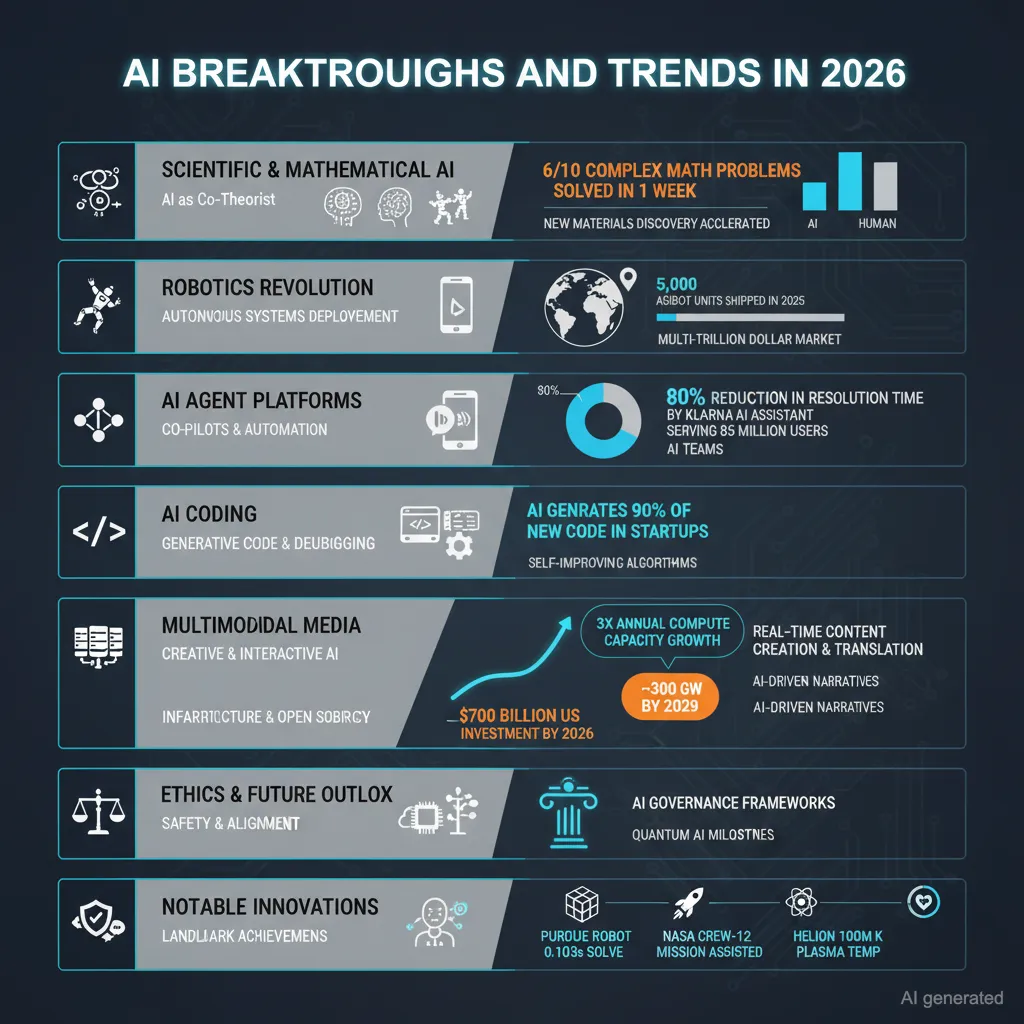
The AI landscape in 2026 is witnessing historic breakthroughs across multiple domains, from math and science to robotics, media, and infrastructure, signaling a transformative era of technological progress.
Scientific and Mathematical AI Advances
There has been remarkable progress in AI’s ability to solve advanced mathematical problems. Next-generation AI models, including the GPT-5.2 Pro and internal OpenAI systems, have tackled unsolved, frontier research problems in mathematics with minimal human guidance, producing solutions to at least six of ten complex challenges in just one week. Physicists have also confirmed significant AI contributions to theoretical physics, with AI deriving new results about fundamental forces that were previously unproven by human researchers. This milestone signals the arrival of AI as a co-theorist in STEM fields and demonstrates its emerging role in creating genuinely new knowledge.
Robotics and Physical AI
Robotics is entering a new phase driven by AI integration. The rapid development of humanoid robots capable of complex movements, including backflips and coordinated dance routines with humans, has been demonstrated notably by China’s AGIBOT, which shipped over 5,000 units in 2025. Partnerships between MIT and Toyota have produced tools like SceneSmith, enabling simple natural language prompts to generate detailed 3D scenes for robot training. Leaders envision robotics revolutionizing industries such as manufacturing, logistics, agriculture, and healthcare, estimating the sector’s valuation to go into the multi-trillions. AI models controlling robots with human-like learning and simulation training promise to accelerate this transformation within a few years.
AI Agent Platforms and Autonomous Tooling
The proliferation of AI-powered agents is reshaping personal productivity, software development, and enterprise workflows. Open-source projects such as OpenClaw, MiniMax M2.5, Kimi K2.5, and Claude Code are enabling advanced reasoning, tool-assisted coding, and multimodal interactions with minimal setup. OpenClaw is notable for running securely on low-cost devices and even mobile hardware, while integrated platforms like LangSmith and LangGraph power large-scale enterprise assistants, exemplified by Klarna’s AI assistant, which handles customer support for 85 million users with an 80% reduction in resolution times. Additionally, new protocols like Model Context Protocol (MCP) streamline tool integration, enabling efficient agent workflows without brittle scripting or extensive custom development.
Software Development and AI Coding
AI coding assistants are advancing rapidly. Models like GPT-5.3 Codex Spark and Claude Opus 4.6 exemplify fast, reliable prototyping, with tools such as Cline CLI 2.0 allowing multiple parallel coding agents to run entirely in terminal environments. Platforms now incorporate reinforcement learning mechanisms (e.g., IterX) where AI agents autonomously test and optimize code, surpassing human benchmarks in complex engineering tasks. Developers are increasingly leveraging AI to iterate rapidly on projects, automate complex debugging, and produce production-ready code, with a focus on architectural decisions and system design rather than manual coding.
Multimodal AI and Media Generation
Significant strides have been made in AI-driven content creation across text, speech, images, and video. Commercially available text-to-speech models like KaniTTS2 run efficiently on limited hardware and support voice cloning, empowering multilingual and low-resource language usage. Seedance 2.0 and the upcoming Seedance 3.0 from ByteDance set new standards for AI video generation with features like unlimited continuous generation, narrative memory, multilingual emotional dubbing, and cinema-grade directing tools, drastically reducing cost and complexity compared to traditional production. AI is also merging with the arts, as seen in collaborations such as the Chinese dancer Yang Liping who uses AI for creative inspiration rather than replacement, and AI-generated short films showcasing emotional and visual fidelity achieved entirely through AI.
Infrastructure, Compute, and Open Source Ecosystem
The underlying infrastructure powering AI is growing exponentially. Leading figures predict compute capacity will triple annually through 2029, potentially reaching up to 300 gigawatts of AI-specific hardware. US hyperscalers alone plan to invest approximately $700 billion in AI-related capital expenditures by 2026. Open-source tools are reshaping the development landscape, with models like MiniMax M2.5 offering state-of-the-art performance at a fraction of the cost, and open ecosystems like the partnership between LangChain, Hugging Face, and Lancedb enhancing data storage and retrieval for AI applications. The increased availability of open-source frameworks reduces barriers to entry and promotes innovation across academia and industry.
Ethics, Alignment, and Future Outlook
Anthropic and other leading AI research organizations emphasize the importance of embedding moral reasoning at the foundation of AI systems, moving beyond simple content filtering toward constitutional AI principles. These frameworks aim to instill ethical cognition within AI, preparing for a future where superintelligent agents will independently make consequential decisions. Experts warn that the choices made today in AI alignment and value encoding will influence the long-term fate of intelligent systems and humanity. Furthermore, the economic impact of AI is reshaping labor markets by automating not just routine tasks but also high-leverage executive roles, potentially leading to unprecedented growth rates in developed economies and a rethinking of employment dynamics.
Other Notable Innovations and Initiatives
– Purdue undergraduates set a Guinness world record with “Purdubik’s Cube,” a Rubik’s Cube-solving robot that completes the puzzle in 0.103 seconds.
– NASA’s SpaceX Crew-12 mission continues advancing human spaceflight and research aboard the International Space Station.
– Apple is poised to dominate AI adoption through the upcoming M5 Ultra chip, enabling powerful local AI computations.
– Sweden is investing over €100 million in shifting classroom learning back to printed textbooks, responding to concerns about the cognitive impact of screens.
– Fusion energy research is advancing, with startups like Helion Energy achieving milestone plasma temperatures, aiming for commercial power generation by 2028.
– Quantum physics breakthroughs include the production of a light-based supersolid and the development of living cells as quantum sensors.
– The software engineering community benefits from new tools such as Harness Engineering for automated testing and pipelines.
– AI-enabled agent marketplaces for human task outsourcing are emerging, blending AI capabilities with manual work to optimize cost and reliability.
Summary
The first half of 2026 has seen breathtaking progress in AI research and deployment, demonstrating capabilities from automating research-level scientific proofs to revolutionizing entertainment production. Autonomous AI agents are becoming ubiquitous tools for professionals and businesses, while hardware and cloud infrastructure expansion facilitate scaling these innovations worldwide. Ethical considerations and alignment remain at the forefront as intelligence surpasses human capabilities. This historic acceleration invites both excitement and caution as society prepares for the profound changes ahead.