
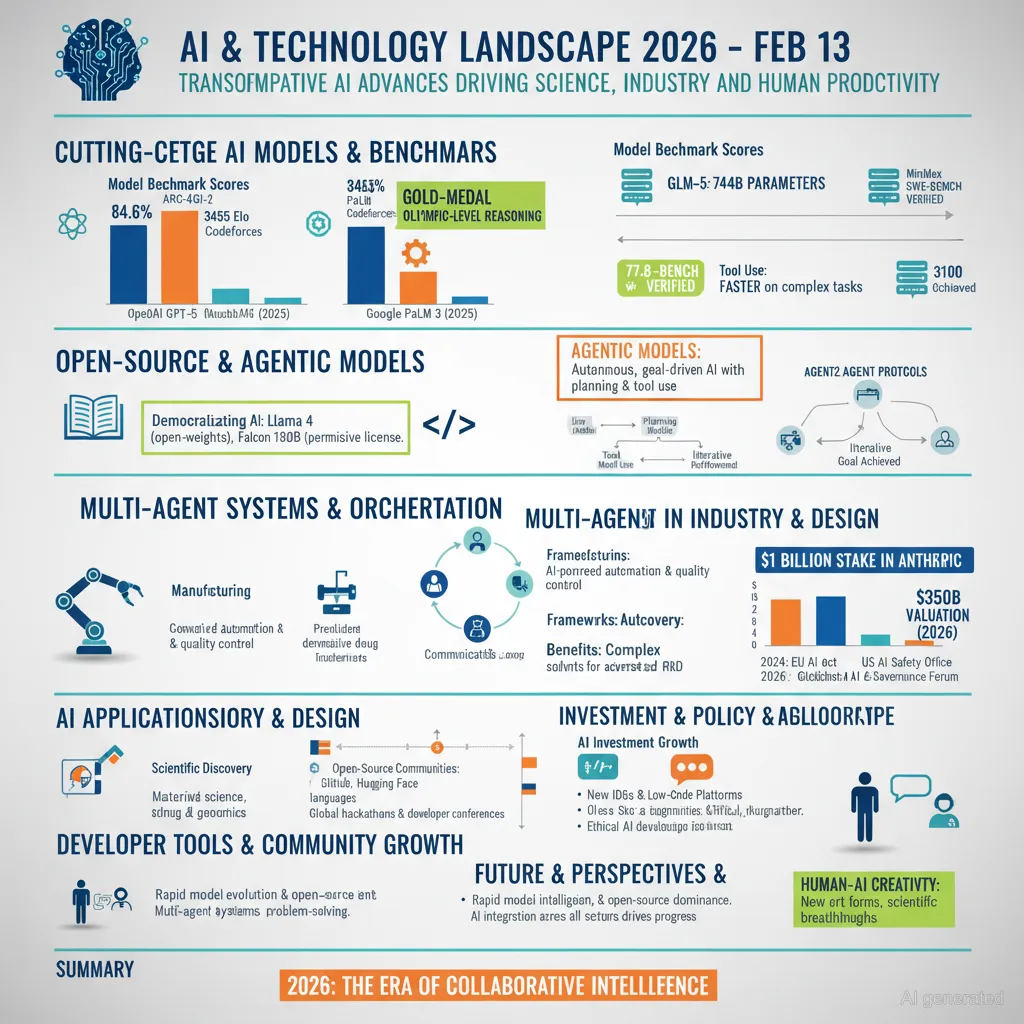
The AI and technology landscape is witnessing rapid, transformative progress marked by significant model advancements, innovative applications, and expanding adoption across industries. Several cutting-edge models-such as Google’s Gemini 3 Deep Think, Anthropic’s Claude Code, Zhipu AI’s GLM-5, and MiniMax M2.5-are pushing the frontier of AI capabilities in reasoning, coding, multi-agent orchestration, and domain-specific problem solving.
—
Gemini 3 Deep Think and Scientific Breakthroughs
Google’s Gemini 3 Deep Think has received a major upgrade to tackle modern science, research, and engineering challenges. The specialized reasoning mode achieves exceptional milestones, including 84.6% on the ARC-AGI-2 benchmark (a test for abstract reasoning with novel problems), gold-medal level performance on International Math, Physics, and Chemistry Olympiads, and a 3455 Elo score on Codeforces, a competitive programming platform. This marks a remarkable leap beyond previous models such as Gemini 3 Pro Preview, Claude Opus 4.6, and GPT-5.2.
Distinctively, Gemini 3 Deep Think uses enhanced reasoning chains and parallel hypothesis exploration to avoid fixation on incorrect conclusions, enabling it to better handle complex, multi-step scientific reasoning. It has already been employed by researchers and engineers-for instance, at Duke University’s Wang Lab-to accelerate semiconductor material design and turbine blade prototyping up to 10 times faster.
Access to Gemini 3 Deep Think is currently available to Ultra users within the Gemini app and through early-access API programs for select researchers and enterprises. Its cost-efficiency is impressive compared to prior high-performance runs, driving optimism about AI’s role in advancing real-world scientific discovery and industrial innovation.
—
Open-Source and Agentic Models Accelerating AI Adoption
The open-source AI model ecosystem is surging with high-performing, cost-effective models that complement frontier commercial offerings. Among these, Zhipu AI’s GLM-5 stands out with 744 billion parameters utilizing DeepSeek Sparse Attention for efficient long-context processing. It achieves state-of-the-art open-source performance on coding benchmarks (SWE-bench Verified score of 77.8) and complex agentic reasoning, rivaling proprietary systems like Gemini and Claude Code. The model supports agentic long-range planning and deep backend reasoning, suitable for complex system engineering tasks.
MiniMax M2.5, an open-source model optimized for productivity, delivers state-of-the-art performance in coding, search, and agentic tool-calling tasks, while running 37% faster on complex workloads. Its affordability and efficiency make it a candidate for widespread use, including home labs and smaller-scale deployments.
OpenClaw, an AI agent platform with local runtime capabilities, has become the most used model on OpenRouter by incorporating Kimi K2.5, valued for cost-effectiveness and faster response via agent swarm technology. These developments highlight increasing adoption of local models for privacy, security, and cost savings without sacrificing intelligence.
Additionally, Anthropic’s Claude Code and Claude Opus 4.6 continue rapid growth in enterprise usage, with features enabling advanced customization, orchestration of AI swarms, and a strong developer community. OpenBenchmarks grants and ecosystem collaboration efforts aim to close the evaluation gap by fostering open standards and robust testing.
—
Agentic and Multi-Agent Systems: Collaboration and Orchestration
A significant shift is underway from isolated AI queries toward orchestrated multi-agent workflows. Teams can now run multiple AI agent instances in parallel to break down complex tasks, leading to exponential productivity gains-for example, completing in hours what used to take days.
Frameworks like Acontext are emerging to simplify “context engineering,” enabling agents built on diverse platforms to share memory, files, workflows, and skills seamlessly. This reduces weeks of custom integration to mere hours and facilitates task tracking and debugging in multi-step agent pipelines.
Also, protocols such as Agent2Agent (A2A) standardize communication between AI agents built on different frameworks, supporting domain-specific multi-agent collaboration in healthcare and industry. Complementary advances in tool-call optimization, browsing agents with native WebMCP support for legal website interaction, and task automation platforms empower agents to work more effectively within real-world environments.
—
AI in Industry, Robotics, and Design
AI’s impact extends into multiple domains. Robotics plays a growing role, with new frameworks like APPLE (a reinforcement learning system for active perception) and ExtremControl delivering breakthroughs in control latency and teleoperation. Integration of AI with physics simulators such as AI2 THOR enables realistic, scalable robotics research.
In the design and engineering space, Google Gemini 3 Deep Think and allied modes help engineers convert sketches into 3D-printable designs rapidly, embedding AI directly into the building process. Design systems frameworks allow users to maintain visual consistency across applications with reusable style libraries and instant apply features.
ElevenLabs is showcasing enterprise-grade AI agents delivering seamless multilingual voice support with document retrieval for customer service workflows, reflecting AI’s growing role in communication and operations.
—
Industry Investment, Ecosystem Growth, and Policy
The AI market is soaring as enterprises embrace intelligence platforms that drive revenue growth at unprecedented rates, with Anthropic noted as the fastest-growing software business in history. Funding rounds include significant investments such as Blackstone’s nearly $1 billion stake in Anthropic at an estimated $350 billion valuation, underscoring confidence in AI’s commercial trajectory.
Governments and organizations recognize the urgency of AI policy frameworks to ensure safety, public benefit, and secure development. The UN’s Independent International Scientific Panel on AI includes leading experts to guide global standards, while bipartisan initiatives and public-private partnerships like Public First Action mobilize policy responses and societal understanding.
—
Tools, Tutorials, and Community Developments
The AI developer ecosystem is gaining momentum with tutorials, courses, and open-source tools facilitating the learning curve and adoption of agentic AI. For instance, the LangChain ecosystem has exploded in popularity with educational resources leading community growth. Platforms such as Claude Code offer advanced customization to suit individual workflows, while tools like MCP integration simplify deployment straight from coding environments.
Cutting-edge model deployments on platforms like Warp, Jan Desktop, and ZenMux advance accessibility to high-performing models, integrating them into user-friendly interfaces or terminal-based workflows.
Additionally, AI is augmenting creative domains-models like Seedance 2.0 enable ultra-realistic video generation, compressing creative work from hours to minutes, bringing near-future content creation capabilities to creators.
—
Perspectives on AI’s Future and Human Roles
Thought leaders foresee a profound shift in human work, from task execution to managing and orchestrating AI agents. The critical skill will become problem structuring, decision making, and directing fleets of AI assistants. Mustafa Suleyman (Microsoft AI CEO) predicts full automation of many professional tasks within 12 to 18 months, while Marc Andreessen highlights an imminent surge in productivity growth driving economic expansion.
Authors and researchers stress that AI complements human scholarship, urging mastery of goal specification and clear writing to harness AI effectively in research. Meanwhile, the rise of human-AI symbiotic platforms, such as Teamily AI-the world’s first human-plus-AI social network-exemplifies collaboration beyond traditional boundaries.
—
Summary
Overall, the current AI terrain is characterized by rapid acceleration in model capabilities, orchestration frameworks, and practical applications tackling complex scientific, engineering, and business challenges. Open-source innovations are democratizing access and adopting local execution to enhance privacy and cost savings. Agentic AI technologies are transforming developer productivity and industry workflows, backed by record-breaking benchmarks and investments. At the same time, policymakers, developers, and thought leaders emphasize the need to balance innovation with safety and societal impact, preparing for a future where human intelligence is augmented and amplified through AI collaborations.