
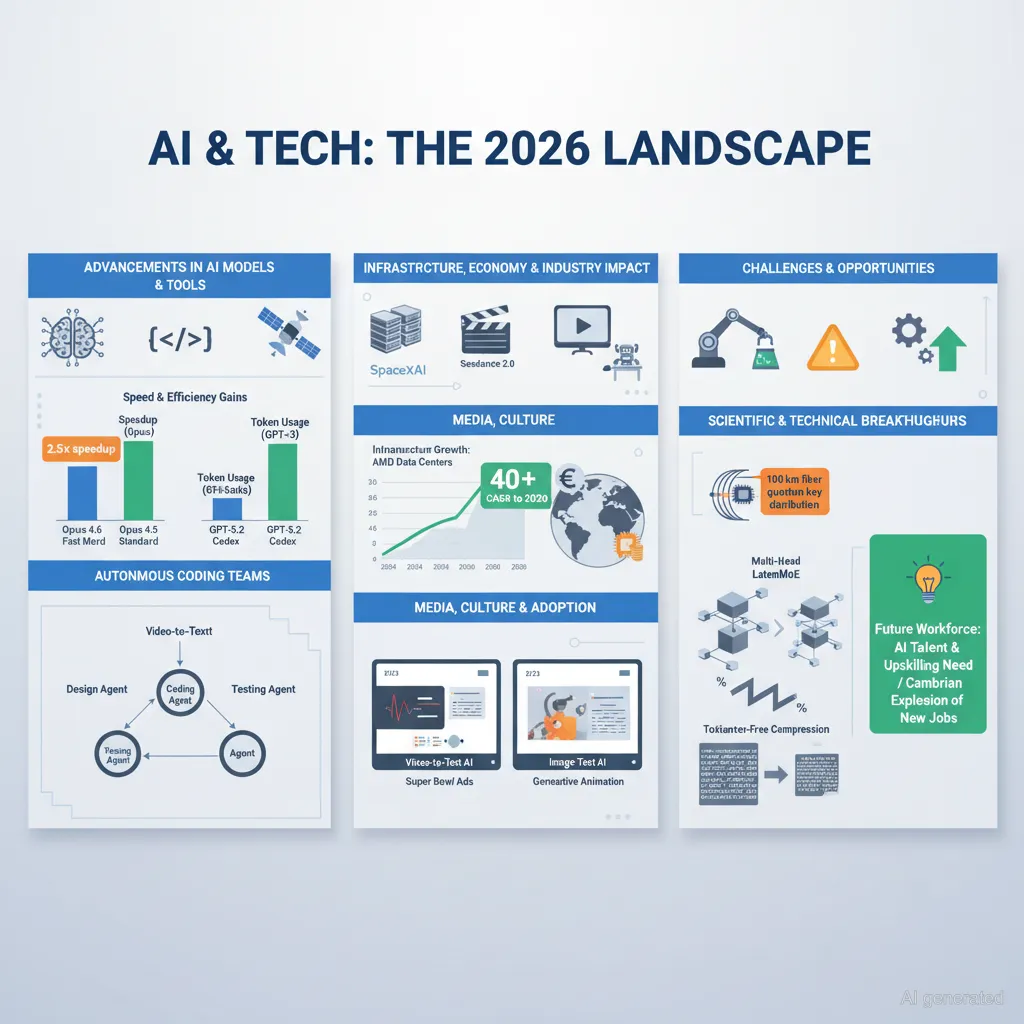
The AI and tech landscape is experiencing a period of rapid and transformative progress across multiple fronts, signaling a profound shift in capabilities, infrastructure, and cultural acceptance.
Advancements in AI Models and Tools
Recent releases from major AI labs demonstrate significant improvements in language and multimodal models. Google’s Gemini 3.0 general access model is expected soon, aiming to compete with Anthropic’s Opus 4.6 and OpenAI’s GPT-5.3. GPT-5.3 Codex notably improved coding efficiency and token usage, exemplified by its state-of-the-art performance on Terminal-Bench 2.0. Anthropic introduced a fast mode for Opus 4.6, yielding a 2.5x speedup with a modest increase in token cost, which users have found revolutionary for productivity.
Open-source AI developments are also thriving. Models like Meta’s upcoming Avocado, Alibaba’s Qwen 3.5 variants, and specialized models for Turkish NLP and vulnerability detection (VulnLLM-R-7B) highlight growing diversity and specialization in AI capabilities. The open-source community continues to shrink the gap with proprietary models through frequent releases and high-quality specialized datasets.
Agent-based AI programming is breaking new ground, with multi-agent teams autonomously coding complex applications like Tetris, complete with automated testing. “Agent teams” coupled with utilities like tmux have accelerated feature development. Compound engineering approaches enable iterative improvement of AI code-generation agents, enhancing their robustness and reducing errors.
Integration technologies such as OpenClaw enable AI assistants to autonomously manage social media and workflows, albeit with some setup complexity. Managed solutions like MyClaw simplify deployment, making personal AI assistants more accessible. New programming and orchestration paradigms, such as reflective language models (RLMs) and recursion-focused architectures, promise efficiency gains in AI inference and context management.
In robotics, Boston Dynamics and others released impressive demonstrations of humanoid robots performing advanced backflips and skateboarding, while research advances in reinforcement learning using world models foreshadow a shift in robotics from hardware-limited to data- and compute-limited development.
Infrastructure, Economy, and Industry Implications
The global AI infrastructure buildout is underway at historic scale. NVIDIA’s CEO Jensen Huang forecasts that AI data centers will be a primary global infrastructure over the next seven to eight years, symbolizing a pivot where compute becomes the “operating system” of the economy. Europe is reviving its AI ambitions with major investments in talent and data centers, potentially accelerating its position in the global race.
Significant data center revenue growth is projected for AMD, with sustained compound annual growth rates exceeding 40% into 2030. Space-based data center concepts by SpaceXAI aim to overcome terrestrial regulatory and supply chain limitations through solar-powered satellite constellations, representing an audacious bet on the future of compute infrastructure.
On the labor front, AI is reshaping jobs and industries. Leaders foresee a Cambrian explosion of new jobs rather than AI-induced unemployment. The rise of AI-native, “vibe coding” workflows enhances personal productivity, enabling solo entrepreneurs to build $1 billion companies with minimalist teams of AI agents.
Taiwan passed progressive AI legislation that includes labor protections for workers displaced by AI, setting a benchmark in AI governance by incorporating sustainability, privacy, fairness, and accountability along with human-centric principles. This contrasts with critiques of the EU AI Act as less comprehensive.
AI integration in manufacturing is seen as essential to reclaiming domestic competitiveness, with factories becoming more productive through AI augmentation even if employment scales down.
Media, Culture, and Adoption
AI entered mainstream culture strongly in 2026, marked by the first AI companies airing Super Bowl commercials, reflecting broad societal acceptance. Cutting-edge AI tools now enable creative endeavors such as Seedance 2.0, which produces professional-grade film-quality animation at a fraction of traditional costs, and advanced video and image models that merge text and visual understanding seamlessly.
Educational outreach brings “Physical AI” and robotics to students, demystifying complex systems through hands-on teleoperation and autonomous demonstrations. The democratization of AI tools enables individuals to build personalized applications, such as financial strategy assistants and tech news sites free from ad clutter, fostering new forms of digital entrepreneurship.
The AI developer and user community emphasize the importance of continuous learning, system design understanding, and prompt engineering sophistication to fully leverage AI capabilities.
Scientific and Technical Breakthroughs
AI-driven scientific discovery accelerates as autonomous laboratories compress decades of experimentation into months, evidenced by breakthroughs in molecular energy storage and cardiac ultrasound analysis. Theoretical advances in efficient AI architectures-such as Multi-Head LatentMoE and tokenizer-free token compression-highlight the ongoing evolution of AI efficiency and scalability.
Quantum communication achieved a major milestone in China with tamper-proof, device-independent quantum key distribution over 100 km of fiber, advancing secure quantum networks closer to practical deployment.
Fundamental AI research advances include new understanding of reinforcement learning strategies, recursive language models, and the development of any-to-any multimodal models capable of unified vision and language reasoning.
Challenges and Opportunities
Despite the excitement, practical challenges remain: the coordination of agent swarms, reliable automation of interface design, prompt engineering intricacies, and the complexity of deploying AI assistants still demand skilled expertise. Nonetheless, the rapid pace of developments and emerging ecosystems suggest that these hurdles are surmountable.
Demand for extraordinary talent with AI literacy remains intense, creating strong incentives for individuals to upskill, build AI portfolios, and engage in public sharing and networking.
Overall, 2026 is poised to be a landmark year for AI, marked by exponential growth in capability, widespread real-world impact, and the birth of a new economic and technological era driven by intelligent systems at scale.