
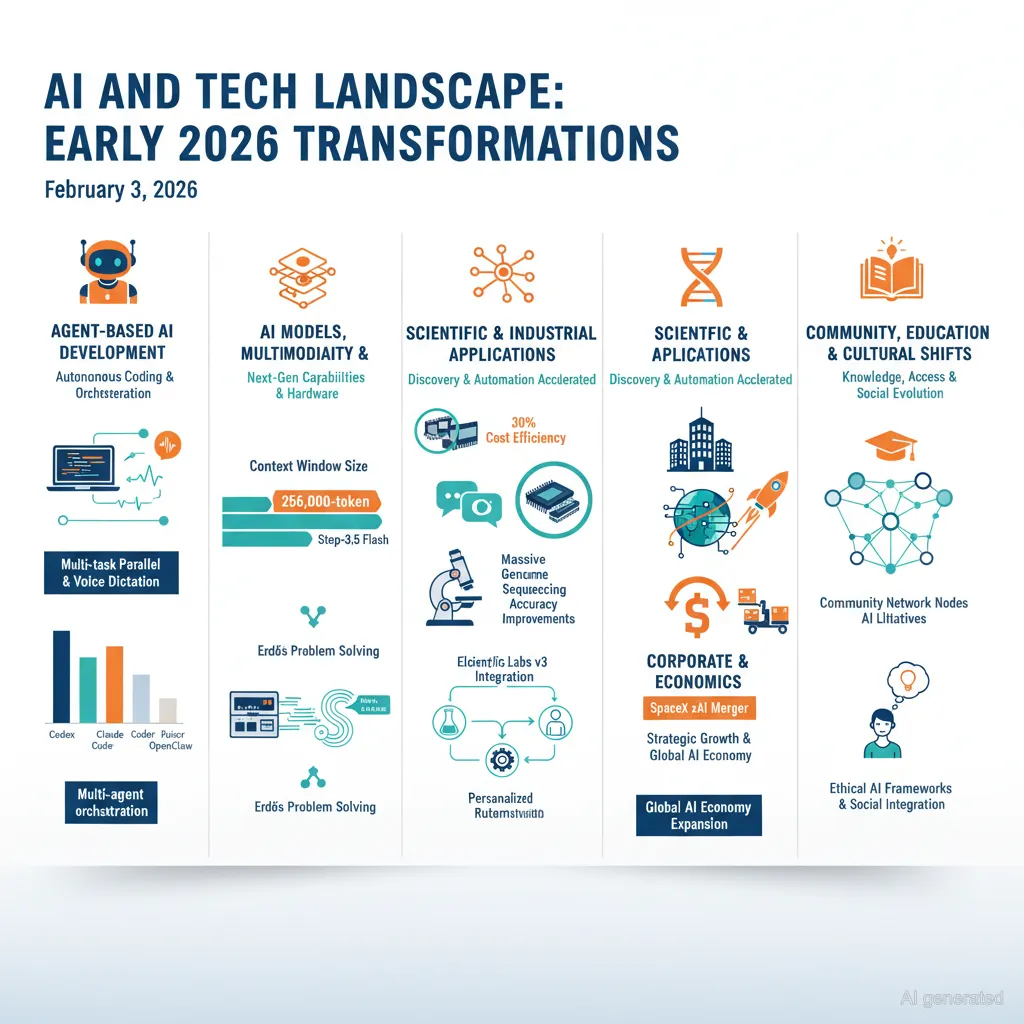
The current AI and tech landscape is witnessing rapid and transformative developments across various domains, from agentic coding platforms and autonomous AI assistants to scientific discovery and industry-specific automation.
Agent-Based AI Development and Tools
There has been a surge in the creation and deployment of AI agents that function autonomously or collaboratively, significantly accelerating software development and workflow automation. Notably, the launch of the Codex app by OpenAI offers a powerful coding environment enabling users to run multiple parallel tasks with skills libraries, automations, and native Git integrations, expanding access even to those without coding experience. This platform emphasizes ease of use with features like voice dictation and worktree modes for isolated parallel development, positioning it as a strong competitor to established tools like Claude Code and Cursor.
Anthropic’s Claude Code team continues innovating with agent swarms, hierarchical team structures, and a robust skills system enabling agents to self-improve, coordinate, and execute complex projects efficiently. Their incoming Sonnet 5 model promises superior coding performance at lower cost, enhancing large-context memory and enabling multi-agent orchestration. Complementary open-source efforts, such as OpenClaw (formerly ClawdBot or Moltbot), demonstrate the power of autonomous agents that interact deeply with users’ environments, from handling GitHub PRs to managing communications and workflows, running safely on local devices like Mac Minis or Raspberry Pi with secure setups.
Lightweight versions, such as nanobot, offer accessible, open-source, minimalist AI assistants requiring minimal resources, capable of tasks including continuous market analysis and personal knowledge management. These AI systems are increasingly integrated with productivity tools (e.g., n8n for workflow automation, matrix for secure chat) and expanded with agent networks and social platforms, enabling personal AI workforces.
Advances in AI Models, Multimodality, and Infrastructure
The development of high-performance AI models and inference infrastructure is advancing. Step-3.5 Flash from StepFun presents a fast, sparse mixture-of-experts (MoE) architecture supporting extremely large context windows (up to 256k tokens) and efficient local deployment, targeting Macs and GPUs. NVIDIA announced new networking-accelerated inference context memory storage with BlueField-4 hardware, enhancing token throughput and power efficiency, enabling scalable multi-turn agentic AI workflows.
ElevenLabs released its v3 text-to-speech model with significantly improved accuracy in numbers, formulas, URLs, and multilingual dialogue, ready for commercial deployment. Google Gemini 3 integrates multimodal capabilities supporting reasoning across vision, video, and text, emphasizing the importance of one intelligent system capable of understanding and planning across modalities. Related open-source multimodal projects like PaperBanana automate academic diagram generation, enhancing research productivity.
China’s AI ecosystem is contributing robust open-source large language models (LLMs), such as GLM 4.7, Kimi K2.5, DeepSeek v3.2, and Minimax M2.1, propelling global open AI development alongside commercial leaders like OpenAI and Anthropic, the latter maintaining enterprise-focused closed models.
Scientific and Industrial Applications
AI is playing a pivotal role in accelerating scientific discovery, especially in domains like mathematics, genomics, and medicine. Researchers used Gemini to autonomously evaluate and solve open problems in Erdős’ conjectures. Google Research and collaborators are leveraging AI tools to massively accelerate sequencing and analysis of endangered species’ genomes, supporting conservation efforts. In medicine, AI-powered dataset releases such as the OpenMed Medical Reasoning Dataset enable enhanced reasoning and model training for healthcare applications.
Industrial automation progresses with robots increasingly deployed for food service, warehouse logistics, and manufacturing, including fully automated restaurants in China and agile humanoid robots with dual world models for preplanning and real-time action control. Robotics hubs in London exemplify ecosystems bridging AI, robotics, engineering, and venture capital.
Corporate and Economic Impacts
Investors and enterprises are accelerating adoption of AI-powered platforms. VC activity benefits from AI-driven decision-making tools, while enterprise integration includes partnerships such as Snowflake and OpenAI for embedding advanced AI analytics into data workflows. Companies like Waymo and XPENG drastically increase AI capabilities in transportation and robotics.
Several companies disrupt traditional market segments with AI-first or AI-native products, including Cursor’s AI-native IDE and Day AI aiming to revolutionize CRM systems by re-architecting data models for agent use. Content creation and marketing are shifting to quality-focused AI tools optimized for understanding customer intent, surpassing mere volume-based strategies.
Notably, Elon Musk’s SpaceX and xAI merger integrates satellite-based compute infrastructure with AI model development, promising unprecedented scale and cost efficiency for AI compute delivered globally via Starlink’s network, potentially transforming AI distribution and resource availability. Concurrently, Tesla’s shift toward humanoid robots signals an ambitious future blending robotics and AI.
Community, Education, and Cultural Shifts
Significant educational resources are made freely available, including Harvard’s comprehensive open-source ML systems curriculum covering theory, hardware, and practical coding frameworks. Community-driven model development and infrastructure projects emphasize accessibility and democratization of AI tools, while content creators experiment with novel formats like handwritten whiteboard-style instructional videos.
There is growing discussion around AI’s societal impact, including the transformation of work, identity, and economics as autonomous agents take over white-collar tasks. Thought leaders emphasize strategic focus, mental discipline, and deep, honest content creation as keys to thriving in this new era.
Overall, the landscape in early 2026 is characterized by a rapid transition from siloed AI tools toward integrated, agentic systems capable of complex autonomous workflows, accelerated scientific discovery, and pervasive industrial automation, powered by an expanding model and infrastructure ecosystem, with tangible impacts across industries and society.