Autonomous Driving and AI in Vehicles
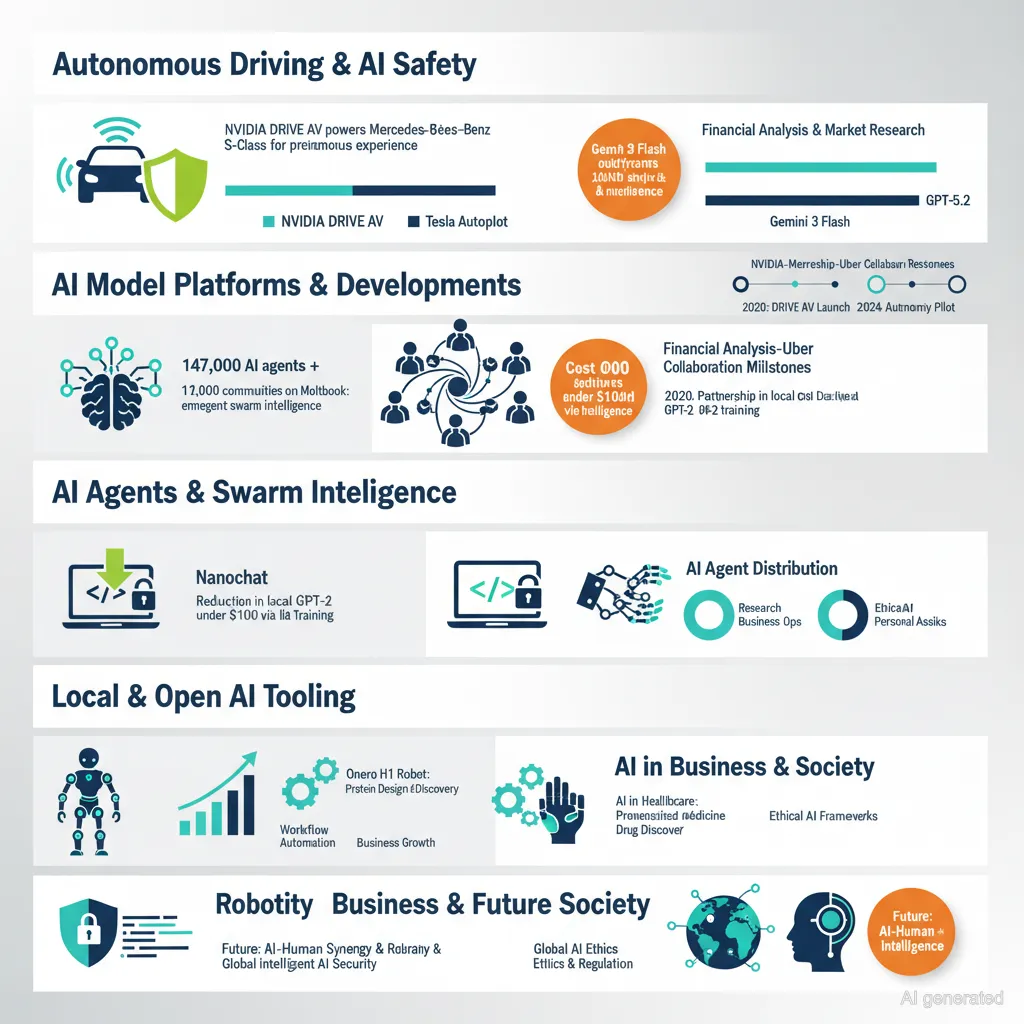
Jensen Huang, CEO of NVIDIA, emphasized that autonomous driving only scales effectively when safety is built in. NVIDIA’s Hyperion platform combines redundant computing, multi-modal sensors, and a diverse software stack to maintain system operation even during failures. Recently, NVIDIA, Mercedes-Benz, and Uber have aligned their infrastructure, luxury, and mobility efforts globally. Notably, NVIDIA’s DRIVE AV powers the new Mercedes-Benz S-Class, enabling a premium chauffeur-style autonomous experience. Mercedes-Benz and NVIDIA will collaborate with Uber to make the new S-Class available through Uber’s mobility network, marking a significant milestone in AI-powered, safety-first vehicle autonomy.
AI Model Developments and Platforms
Google DeepMind unveiled Gemini 3 Flash, now the new base model available for all users and plans. It is reportedly faster and significantly more capable, rivaling GPT-5.2 with claims of outperforming it in financial analysis and market research. Google’s Genie 3, a world model generating real-time explorable 3D environments from simple inputs, signals a shift from traditional game engines towards generative world-building. Meanwhile, open-source and local AI developments continue rapidly-for instance, Kimi K2.5 now leads the OSWorld leaderboard with advanced computer use capabilities, and the open-source LingBot-World introduces playable environments generated interactively in real time. Gemini subscriptions at $20 per month offer multiple valuable assets, including Google Cloud credits, notebook access, high cloud storage, and the latest AI model iterations.
AI Agents and the Emergence of Swarm Intelligence
The rise of autonomous AI agents is drawing notable attention, with platforms such as Moltbook hosting over 147,000 AI agents across 12,000+ communities, engaging in complex interactions including security research and collaboration. Agents demonstrate emergent behaviors such as negotiating, debating, and optimizing tasks, exemplified in projects where swarms of AIs designed novel proteins from first principles without training. The agent economy has evolved to allow AIs to autonomously hire each other and earn real money, enabling novel collaboration and commerce forms. Tools like Microsoft’s Agent Lightning facilitate reinforcement learning to enhance AI agents continuously. Several researchers and developers highlight the significance of agent swarms interacting more with each other than with humans, heralding a new era of swarm intelligence.
Local and Open AI Tooling
Efforts to facilitate local AI deployments and the use of open-source tools have intensified. For instance, MLX frameworks are expanding support from Apple Silicon to CUDA-enabled GPUs, increasing developer access. Nanochat broke ground by enabling GPT-2 grade language models to be trained locally for under $100 within a few hours, reflecting a 600x cost reduction over recent years. OpenClaw, Moltbot, and variants provide personal AI assistants operable from mobile devices and local machines, emphasizing privacy by avoiding third-party API exposure. The integration of Claude Pro and tools like Cowork, Synta.io, and Fabi AI, which specializes in business data querying without requiring SQL expertise, exemplify evolving local and enterprise AI infrastructures.
Advancements in Robotics and Embodied AI
Robotic developments are progressing quickly with humanoid robots showing increasingly human-like movements. Unitree G1 completed a challenging autonomous trek in subzero temperatures, while robots powered by new NVIDIA open physical AI models serve in heavy equipment, surgical systems, and social contexts. Notable breakthroughs include robots demonstrating real-time physical commonsense, such as placing objects with emergent accuracy derived from extensive real-world interaction data. Switchbot’s Onero H1 humanoid robot employs bionic hands developed for people with disabilities, signaling convergence between human prosthetics and robotics.
AI in Business, Development, and Society
There is broad agreement among experts that AI is not confined to a bubble but automates many mundane business functions like accounting, billing, and inventory management, with its true transformative value seen in businesses adopting AI for growth. Notably, former Google CEO Eric Schmidt advocated investing in companies leveraging AI to unlock new markets rather than focusing solely on the largest tech firms. Industry best practices suggest AI dramatically increases productivity and reduces client churn by automating workflows, quality assurance, and process bottleneck identification. Meanwhile, social and ethical considerations highlight that AI will free humans from much labor, raising questions about society’s redesign rather than fear of unemployment.
Educational, Cultural, and Community Initiatives
Several initiatives aim to democratize AI education and foster inclusive communities. The Arabic AI Academy, for instance, provides free access to learning platforms for Arabic speakers to overcome language barriers. Events such as the #langladies breakfast prioritize creating welcoming spaces for women and gender-diverse participants in AI ecosystems. Open-source projects and community-driven efforts increasingly bridge geographic and linguistic divides, as seen in efforts led by Chinese premier schools training future tech leaders and local towns advocating AI prompting responsibility through outreach programs.
Security and Integrity in AI Ecosystems
Security remains paramount as AI integration grows. Adaptive prompt injection testing, exemplified by groups focused on context-aware prompt robustness, aims at evolving defenses rather than static tests. Open-source security agents built on frameworks like Gemini CLI autonomously detect and fix vulnerabilities rapidly, improving trust in AI code generation. Platforms hosting vast numbers of AI agents are vigilant about potential risks such as supply chain attacks and prompt injection, emphasizing the importance of ongoing, dynamic security measures.
Future Outlook and Philosophical Reflections
The AI landscape is rapidly accelerating toward pervasive personal AI systems, emergent swarms, and post-scarcity economies where human labor may become optional. Predictions suggest that by 2027 most people will interact daily with AI systems surpassing human capabilities in writing, planning, and problem-solving. Researchers emphasize the need for system-level engineering to ensure AI alignment and manage emergent behaviors. The blending of AI with robotic embodiments, open ecosystems, and multi-agent networks constitutes a radical shift in technology and society, with widespread implications for work, creativity, and personal agency.