
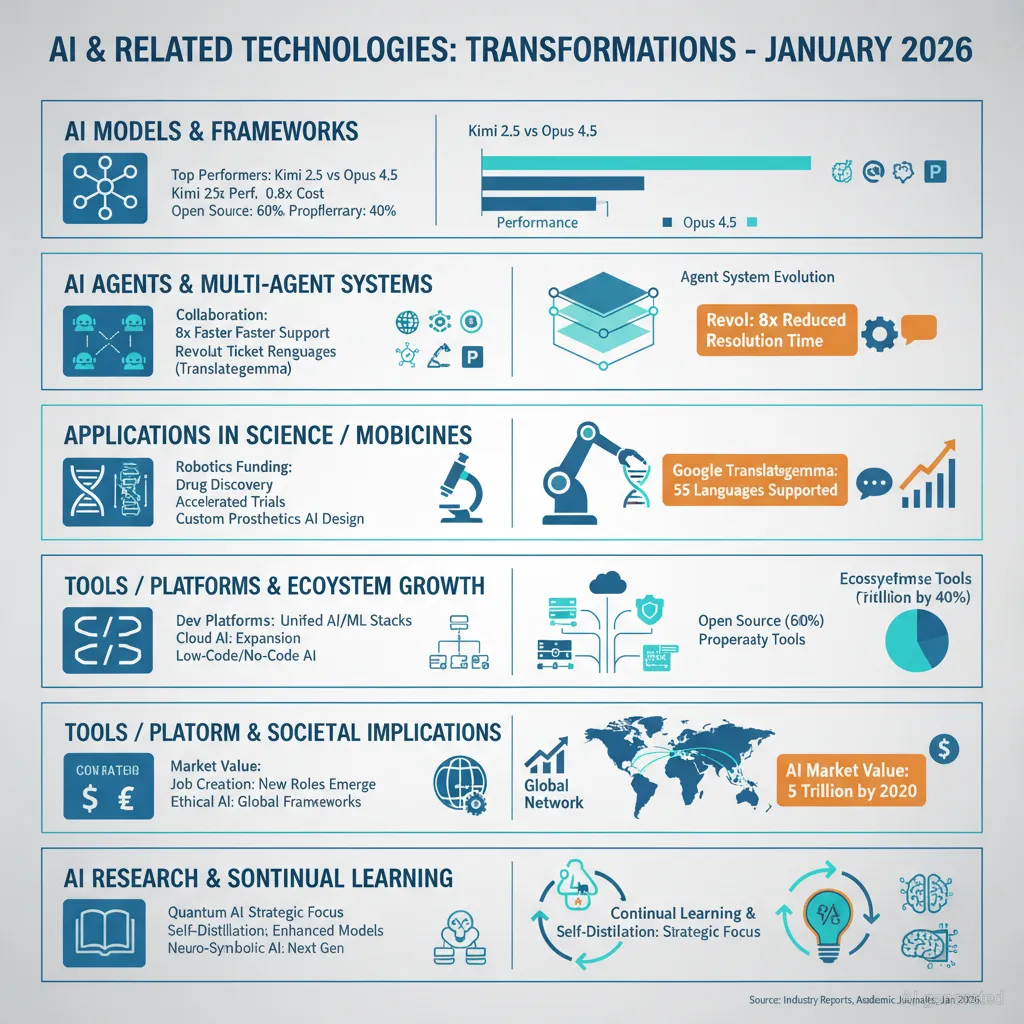
The recent developments in artificial intelligence (AI) and related technologies illustrate a transformative period marked by rapid advancements, broadening applications, and expanding accessibility.
Advances in AI Models and Frameworks
Several new AI models and frameworks have been released or announced, pushing the boundaries of performance, efficiency, and multimodal capabilities. Notably, Kimi 2.5 gained attention as a state-of-the-art open source reasoning and vision model, noted for surpassing competitors like Opus 4.5 while being significantly more cost-effective. Models such as DeepSeek V4, MiniMax-M3, GLM-5, Nemotron Ultra, Qwen 3.5, and Kimi K3 are expected to set new standards in local and open source large language models (LLMs) by 2026. Additionally, Google released translategemma, supporting 55 languages, and medgemma 1.5 for medical text and image analysis. Blackforest Labs introduced flux.2 [klein], an image generation model achieving high quality with sub-second rendering times, while other teams delivered notable open source models for speech recognition (Qwen3-ASR) and document understanding (DeepSeek OCR 2).
OpenAI’s Codex remains a leading model for complex software development tasks, praised for accuracy and support for exploratory questions, surpassing competitors in certain respects. Meanwhile, Google’s Gemini series has gained capabilities for vision, browsing, and integration across productivity suites, demonstrating strong multimodal performance. Companies including Anthropic, xAI, and NVIDIA also continue pushing AI research and deployment, with innovations in robotics, agent orchestration, and inference optimizations such as NVFP4 quantization that promise faster, more efficient local AI operation.
AI Agents and Multi-Agent Systems
An emergent trend is the increasing sophistication of AI agents that collaborate, self-improve, and contribute in multi-agent communities. Platforms like Moltbook have become social networks inhabited exclusively by thousands of AI agents-each with unique personalities, memories, and roles-debating topics, sharing projects, and self-managing bugs, highlighting new dimensions of AI sociability and collaboration. AI agent workflows, orchestration frameworks, and tool integrations (e.g., LangChain-based conferences, LlamaAgents Builder) facilitate automation of complex business, research, and creative processes.
Innovations in agent architectures include hierarchical conductor models that coordinate small specialized models to outperform single large models, achieving higher efficiency and performance on complex tasks, as demonstrated in recent research. Tools like FlashLabs’ SuperAgent provide secure, hosted AI workforces that automate operational and revenue-driving tasks across CRM, invoicing, and content creation. AI memories, skills, and calibration methods further empower agents to learn long-term and adapt dynamically.
Applications in Science, Medicine, and Robotics
AI’s impact on scientific research and healthcare accelerates with models like AlphaGenome, capable of analyzing one million DNA letters at once to pinpoint variants linked to rare diseases and cancer, potentially speeding diagnostics and drug discovery. Novel CAR T-cell therapies have demonstrated unprecedented tumor reduction in aggressive brain cancers, offering hope for curative approaches.
Robotics benefits from AI-driven advances, including LingBot-VA and similar vision-language-action models that enable physical robots to perform complex manipulation tasks by predicting future video frames and corresponding motor actions. European company RobCo Robotics raised $100 million to scale full-stack robotics platforms that integrate perception, planning, and self-learning for industrial automation. Humanoid robot developments like Galbot’s S1 showcase autonomous dual-arm payload handling up to 50 kg, marking a shift from simple logistics to intelligent physical operation.
Quantum computing and AI convergence remains a strategic focus, with renewed emphasis on national initiatives to maintain technological leadership and develop quantum-accelerated applications.
Tools, Platforms, and Ecosystem Growth
Open sourcing and local AI deployment frameworks receive substantial momentum. Microsoft open-sourced bitnet.cpp, a 1-bit low-precision inference framework enabling 100-billion parameter LLMs to run efficiently on CPUs without GPUs, achieving major speed and energy benefits.
In software development, frameworks like Daggr (built on Gradio) are simplifying AI workflow creation by combining models and programmatic functions with visual pipeline inspection, addressing reliability challenges inherent in using simple models for complex apps. The release of GitHub’s Copilot SDK empowers developers to embed AI agents seamlessly into any application with minimal code.
In the creative and entertainment sectors, platforms like Google Project Genie have launched immersive text-to-world interactive environments, and xAI’s Grok Imagine API leads in fast cinematic video and audio generation, integrated into creative workflows with partners such as HeyGen and Invideo.
Commercial deployments include Revolut’s use of multilingual conversational AI agents from ElevenLabs to reduce support ticket resolution time eightfold. AI-powered family assistants tailored to household needs and calendar management further demonstrate AI’s expansion beyond traditional office workflows.
Economic and Societal Implications
Industry leaders anticipate a paradigm shift enabled by AI where an individual can build complex software products with minimal investment and technical staff. Sam Altman highlighted the looming efficiency explosion driving down the cost and barriers for innovation, potentially democratizing opportunity but also raising concerns about wealth concentration without careful system design.
Financial services report substantial measurable ROI and cost savings from AI adoption, accelerated by open source models and agentic systems automating back-office tasks. Marketing and sales strategies increasingly rely on AI-generated content and workflows optimized for scale and personalization.
At the corporate and government level, programs to attract leading technologists to agencies like NASA support innovation leadership. Meanwhile, SpaceX and xAI plan a merger to create a trillion-dollar entity leveraging orbital compute infrastructure to reduce AI training costs and execute large-scale intelligence operations, reflecting the intensifying intersection of aerospace and AI.
AI Research and Continual Learning
Recent academic work emphasizes on-policy self-distillation, reinforcement learning via self-distillation, and recursive language models-techniques that promise continual learning capabilities, reducing catastrophic forgetting and enabling more efficient adaptation in deployed models.
New approaches to multitask coordination, context engineering, and code context graphs foster better tooling and agent collaboration.
Open data repositories and community contributions enrich resources for developers and researchers, with thousands of models made available on platforms like Hugging Face.
Summary
The AI landscape in early 2026 is characterized by rapid model improvements, sophisticated multi-agent ecosystems, expansion into physical AI and scientific domains, and practical tools accelerating adoption. Open source efforts and local deployment frameworks challenge proprietary dominance and reduce barriers to entry. The economic impact is poised to be profound, reshaping innovation, business operations, and creative industries globally. However, embedded risks and challenges remain regarding equitable distribution, safety, interoperability, and sustained human-centered design.
Overall, the convergence of AI, robotics, quantum computing, and advanced software ecosystems signals a disruptive era where intelligence augmentation and automation will redefine work, science, and society on an unprecedented scale.