
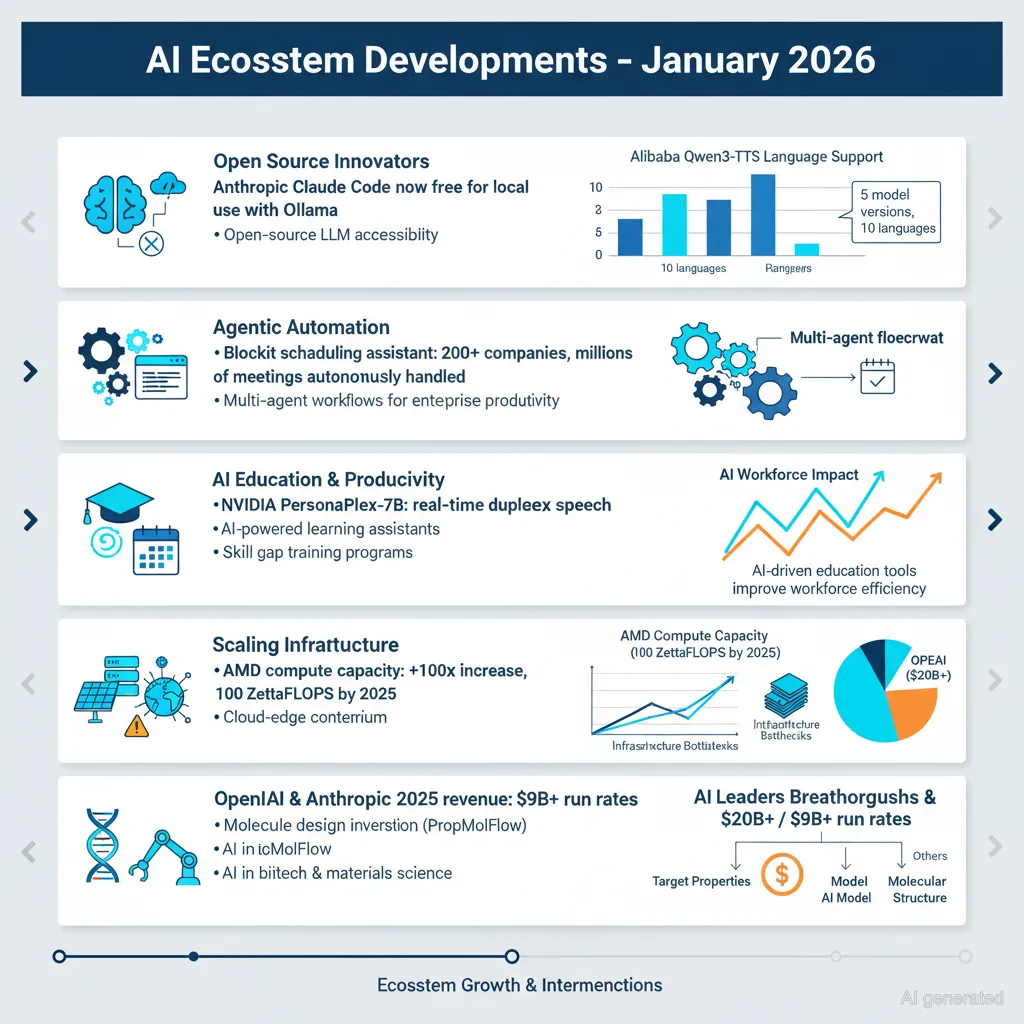
The AI ecosystem has seen remarkable developments in January 2026, spanning open-source projects, AI agent innovations, breakthroughs in voice and video models, and industry shifts toward more efficient infrastructure and tooling.
Open-Source AI Models and Tools
Anthropic’s Claude Code is now officially free to use and supports local execution via Ollama, which enables running the Messages API with strong open-source coding models like qwen2.5-coder. A simple five-step guide facilitates installation and setup for macOS, Linux, WSL, and Windows environments, allowing users to connect Claude Code to local servers to avoid cloud usage. This move removes barriers between proprietary and open-source AI tools.
Similarly, Alibaba released the full Qwen3-TTS family including VoiceDesign, CustomVoice, and Base models totaling 5 versions, supporting 10 languages with state-of-the-art speech tokenization for high-fidelity, low-latency audio synthesis. NVIDIA open-sourced PersonaPlex-7B, a full-duplex conversational speech model that processes and generates speech simultaneously enabling natural dialogue flow without the traditional turn-taking constraints. This model emphasizes real-time responsiveness with open access to weights and code, facilitating innovation in voice AI.
For video AI, LTX-2 presents a powerful open-source audio-driven video generation model capable of synchronizing complex lip-sync and movement, runnable locally on consumer GPUs. Additionally, Gen-4.5, regarded as the world’s best video model, now supports Image-to-Video generation enabling longer story narratives with consistent characters and precise camera control.
Framework improvements also include the release of pg_textsearch, an open-source Postgres extension implementing BM25 ranking to bring industry-standard search quality directly within databases, simplifying hybrid keyword and semantic RAG (Retrieval-Augmented Generation) applications without external infrastructure.
The vLLM open-source inference engine continues to evolve with increased throughput and community support, positioning itself as a key infrastructure component in fast, cheap open model deployments.
Advancements in AI Agents and Tooling
Agent builders and frameworks are progressing rapidly. LangChain launched a Generally Available Agent Builder Template Library offering ready-to-deploy agents tailored to domains like competitor intelligence, on-call triage, and document review with extensive app integrations (e.g., Gmail, Slack, GitHub).
Multi-agent workflows have improved with the addition of parallel subagents, enabling AI systems to execute complex tasks such as debugging production outages by orchestrating multiple agents concurrently, improving speed and contextual reasoning.
Open-source MCP-Apps frameworks like CopilotKit and AG-UI middleware bring interactive mini-apps into copilots, enabling richer user interactions beyond text, supporting agentic applications across frameworks like LangChain, Pydantic, and Strands.
Claude Code’s new task management system supports full dependency tracking and collaborative task sharing across sessions and subagents, fostering more complex, long-term agentic workflows.
For developers, Codex is now integrated into Jetbrains IDEs with GPT-5.2 Codex powering coding assistance, completing partial prompts, and supporting interactive, background, and review features within CLI environments.
Other tools such as Gemini CLI facilitate creative UI design and automation workflows from terminals, emphasizing open-source architectures and community contributions.
AI Education, Productivity, and Workforce Impact
Practical AI education is expanding; for instance, the Gemini app started offering full practice SAT tests for free with immediate feedback, leveraging vetted content to support student preparation.
A new course on agentic coding assistants teaches developers how to integrate open-source agents with local tools and cloud services, focusing on real-world automation without complex dependencies.
The emergence of tools like Blockit, an AI scheduling assistant now available for 200+ companies with millions of meetings handled autonomously, exemplifies how AI is transforming office productivity by handling complex scheduling multi-party coordination without human intervention.
Industry experts highlight that the rise of AI coders will shift the software development focus from writing code to exercising judgment on what features to build and change, emphasizing the value of human decision-making alongside automation.
In robotics, Microsoft unveiled Rho-alpha, a physical AI model foundation allowing partners to fine-tune bimanual robotic manipulation with tactile and force feedback, pushing physical AI integration forward.
Infrastructure, Compute, and Energy Considerations
AI infrastructure continues to scale massively. AMD projects a 100-fold increase in global compute capacity from 2022 to 2025, reaching over 100 ZettaFLOPS to meet rising AI demands, though even this may not suffice for full economic automation.
Memory and storage are becoming critical bottlenecks; TrendForce forecasts substantial growth in global DRAM and NAND flash revenue driven mainly by AI servers requiring more memory bandwidth and capacity, highlighting the importance of optimizing storage to prevent idling expensive GPUs.
Europe’s industrial manufacturing base is viewed as a strategic advantage for robotics and AI development, with leaders calling for reduction of bureaucratic hurdles to foster innovation.
Solar-powered AI data centers and orbital infrastructure are discussed as the ultimate scalable energy sources to bypass terrestrial power limits, positioning data centers as energy-harvesting platforms rather than mere real estate.
Scientific and Application Innovations
AI-driven scientific breakthroughs are prominent, including an oral cartilage regrowth treatment shown to reverse age-related degradation, potentially disrupting joint replacement therapies.
AI systems like PropMolFlow invert traditional molecule design by generating new molecules from desired properties, increasing speed and validity, accelerating pharmaceutical and materials research.
PolyCLOVER, a new framework combining graph transformers and active learning, discovered new polymeric antibiotics effective against drug-resistant bacteria in mere minutes, showcasing the power of domain-specific AI for materials discovery.
In AI safety and alignment, Anthropic published a publicly available constitution for Claude focusing on principled behavior rather than prescriptive rules, increasing transparency and ethical guidance.
Community and Industry Developments
AI companies like openAI and Anthropic saw massive revenue growth in 2025-exceeding $20B and $9B run rates respectively-reflecting strong enterprise adoption despite ongoing profitability challenges.
Numerous startups raised significant funding rounds focused on inference engines, AI agents, and agentic SaaS platforms, signaling robust ecosystem expansion.
Several influential voices emphasized consistent deep technical mastery, focus on debugging, infrastructure, and domain expertise as keys to thriving in the AI era, with AI complementing rather than replacing human skills.
Finally, emerging trends highlight the rise of AI-driven creator economies, digital influencers powered by synthetic avatars, and automation of traditional tasks like quoting and invoicing in niche verticals, underscoring AI’s broad societal impact.
—
In summary, the current AI landscape is marked by the democratization of powerful models through open-source releases, innovative agent frameworks enabling complex automation, and an urgent need for corresponding infrastructure and energy solutions. Scientific advancements and practical applications illustrate AI’s transformative potential across medicine, robotics, software, and daily productivity, while the human element-expertise, judgment, and sustained effort-remains crucial for success in this new paradigm.