The latest developments in artificial intelligence and robotics reveal remarkable progress across multiple fronts, underlining rapid advances in technology, enterprise adoption, and practical applications.
AI Enhancements and Language Model Updates
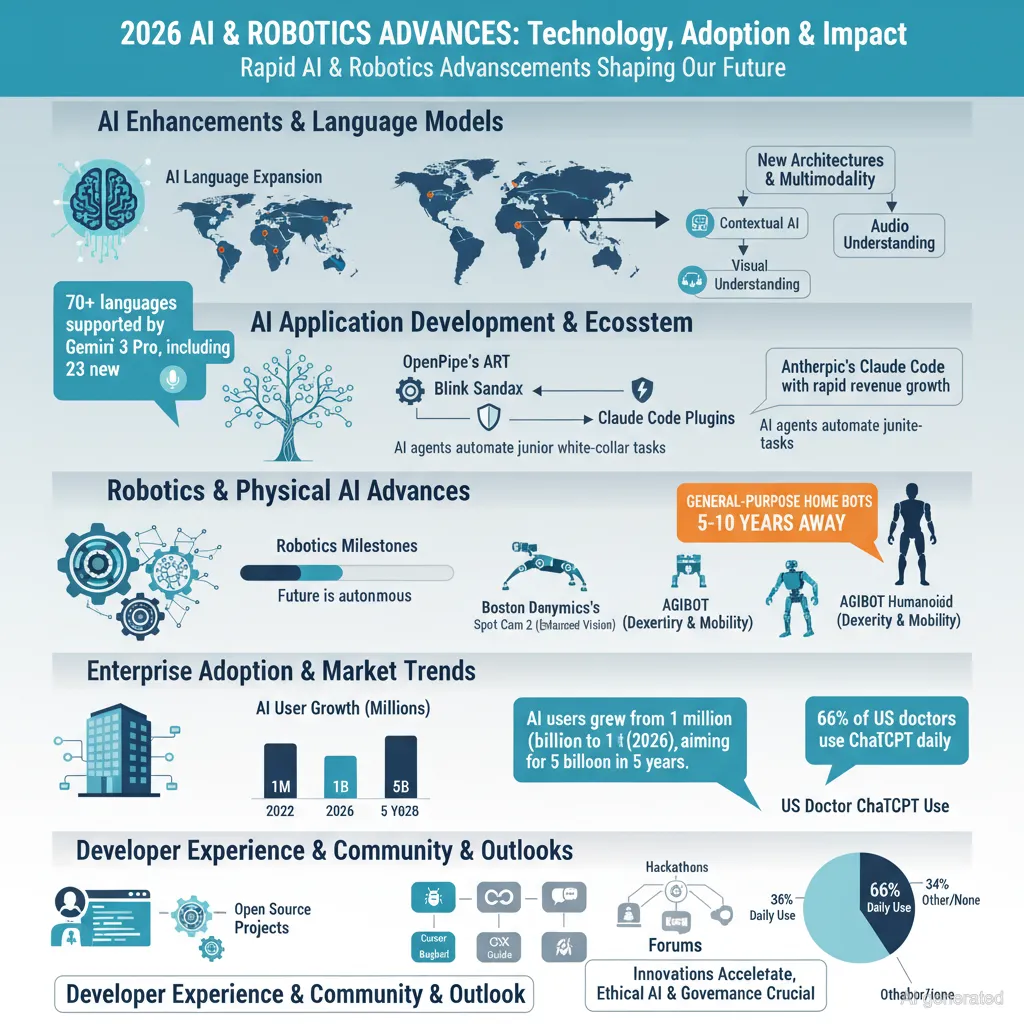
Google’s Gemini 3 Pro integration into Google Search now offers dynamic visual responses in AI Mode, exemplified by interactive simulations for planning optimal travel times to Japan considering temperature and crowd trade-offs. Gemini’s language capabilities have expanded to support over 70 languages, with 23 new additions, enhancing accessibility for global users in content creation and complex task assistance.
Anthropic has focused on vertical AI infrastructure for regulated industries, ceasing competition with OpenAI in chatbot domains as of late 2024. Their Claude Code platform generates substantial revenue with rapid growth, and they have embedded AI deeply into life sciences workflows and national laboratory research. Google DeepMind’s CEO emphasized the scientific rigor behind Google’s AI culture, highlighting their commitment to responsible research.
Predictions from AI leaders indicate profound transformations soon: Anthropic’s CEO expects AI to automate junior white-collar jobs within 6 to 12 months, while Demis Hassabis foresees agentic systems reshaping work by 2026, including advances in robotics and world modeling on edge devices. Models such as LFM2.5-1.2B-Thinking and STEP3-VL-10B present efficient on-device reasoning with high performance, making complex AI tasks viable on consumer-grade hardware.
Open-source initiatives like Claude Cowork, DeepTutor, and LLM integration with Ollama further expand capabilities for developers, educators, and enterprises alike. Tools such as Guide provide real-time open-source intelligence to reduce vulnerabilities in AI-generated code, and LangChain’s Agent Builder enables no-code creation of AI agents for routine tasks.
AI Application Development and Ecosystem Growth
Multiple platforms and marketplaces are rapidly growing. Claude Code plugins and Skills marketplaces offer flexible distribution channels, serving diverse user needs from open-source flexibility to enterprise-grade private plugins. Emergent Labs leads in reliable AI app deployment, supporting millions of users and real-world applications with cost savings in construction, microbiology, and energy sectors.
The AI agent ecosystem is evolving towards infinite time horizon agents capable of extensive information digestion. Frameworks like OpenPipe’s ART with RULER skip manual reward definition, using LLMs as judges to enhance agent training on benchmark tasks. Developer tooling is enriched through extensions for VS Code, Cursor, and Antigravity, enabling advanced agent coding with error capturing and automated fixes.
Platforms like Blink lower barriers to building agentic applications without coding, offering sandboxed cloud environments. AI-assisted marketing automation, content repurposing, and data analysis workflows demonstrate significant time savings and increased productivity through deep integration of AI models like GPT-5 and Claude variants.
Robotics and Physical AI Advances
Robotics continue advancing, with reports highlighting that general-purpose safe home robots remain 5 to 10 years away, yet specialized industrial applications are expanding this year. Companies and labs worldwide develop robots specializing in logistics, inspection (e.g., Boston Dynamics’ Spot Cam 2 with advanced sensing and autonomous security features), exoskeletons, and humanoids, supported by strong research and funding hubs such as Paris.
AGIBOT’s mass production of humanoids and robotics startups focused on modular automation and AI-guided control are redefining industry collaboration and efficiency. Research breakthroughs in neuromorphic intelligence, such as Peking University’s BrainTrace system for spiking neural networks with scalable memory, provide important building blocks toward brain-like computing for robotic control.
Notable projects include enhanced physical AI environments via simulation tools accelerating photorealistic robot training with Gaussian Splatting, and integration of 3D modeling tools within AI workflows to streamline game development and creative production.
Enterprise Adoption, Market Trends, and Societal Implications
AI’s impact on enterprise workflows is accelerating, illustrated by large adoption in healthcare where 66% of US doctors utilize ChatGPT daily for research and drug interaction insights. Sovereign AI deployments on compliant infrastructures enable tens of thousands of employees to integrate GenAI tools securely.
Market data shows AI users soaring from one million in 2022 to one billion, aiming for five billion within five years, supported by a surge in compute infrastructure from one to over 100 zettaflops projected by 2025.
OpenAI’s latest reports demonstrate that deep, integrated AI use yields nonlinear productivity improvements, with heavy users gaining significant time savings. Similarly, platform improvements like Firestore’s advanced query engine, new VS Code clients for Weaviate, and robust enterprise AI agent capabilities attest to the maturing ecosystem.
Debates on AI’s societal impact emphasize questions on ownership of productivity gains, with proposals for Social Wealth Funds to distribute automation profits broadly as a counterbalance to tech feudalism.
AI governance is highlighted as critical, with DeepMind’s small activation probes significantly reducing costs of misuse detection, exemplifying the growing sophistication of safety mechanisms.
Developer Experience and Productivity
The programming landscape is transforming, with the era of humans manually writing most code ending as LLMs increasingly automate syntax and boilerplate. Instead, developers focus on problem-solving and guiding AI tools, enabled by sophisticated code review bots (Cursor Bugbot), reinforcement learning-based code optimization (IterX), and intelligent dependency management (Guide).
The importance of feedback loops and rapid iteration is highlighted as essential to startup success in the AI era, alongside expert advice on mastering foundational data structures and algorithms for scalable development.
Developer tools are enhanced with AI-powered markdown editors, real-time synced views combining table, kanban, and gantt displays, and frameworks supporting multi-paradigm data and code workflows.
Noteworthy AI Product Demonstrations and Community Engagement
Creative AI applications proliferate, from interactive AI-driven storytelling apps for families to AI-generated cinematic music models and sci-fi animation leveraging multiple imaging styles.
Open competitions celebrate AI capabilities, including autonomous AI Dungeon Master systems for tabletop RPG gaming built on multi-agent orchestration frameworks, and AI-powered chess arenas supporting multiple LLMs.
Community-driven open source projects continue to gain traction, with massive adoption of visualization tools for physical AI (Rerun), and large-scale datasets provided by Meta for fine-grained video action understanding to drive future research.
Outlook and Predictions
Experts like Ray Kurzweil and Dario Amodei forecast AGI by 2029 and anticipate rapid AI-driven leaps in intelligence and human-AI integration. Concerns remain regarding the pace of robotics achieving home-use generality, but specialized applications will proliferate soon.
The coming years are expected to witness the rise of agentic AI platforms transforming workflows, the embedding of AI into every aspect of regulated industries, and the continued expansion of on-device reasoning capabilities unlocking new edge-device potentials.
AI adoption is moving beyond demos into substantial enterprise revenue generation and vertical-specific integration, marking a pivotal shift in how technology will shape society, business, and human work.
—
This synthesis highlights the breadth and depth of recent AI and robotics developments, from fundamental technical advances to ecosystem maturation and societal implications, underscoring the rapid pace and profound impact of current innovations.