
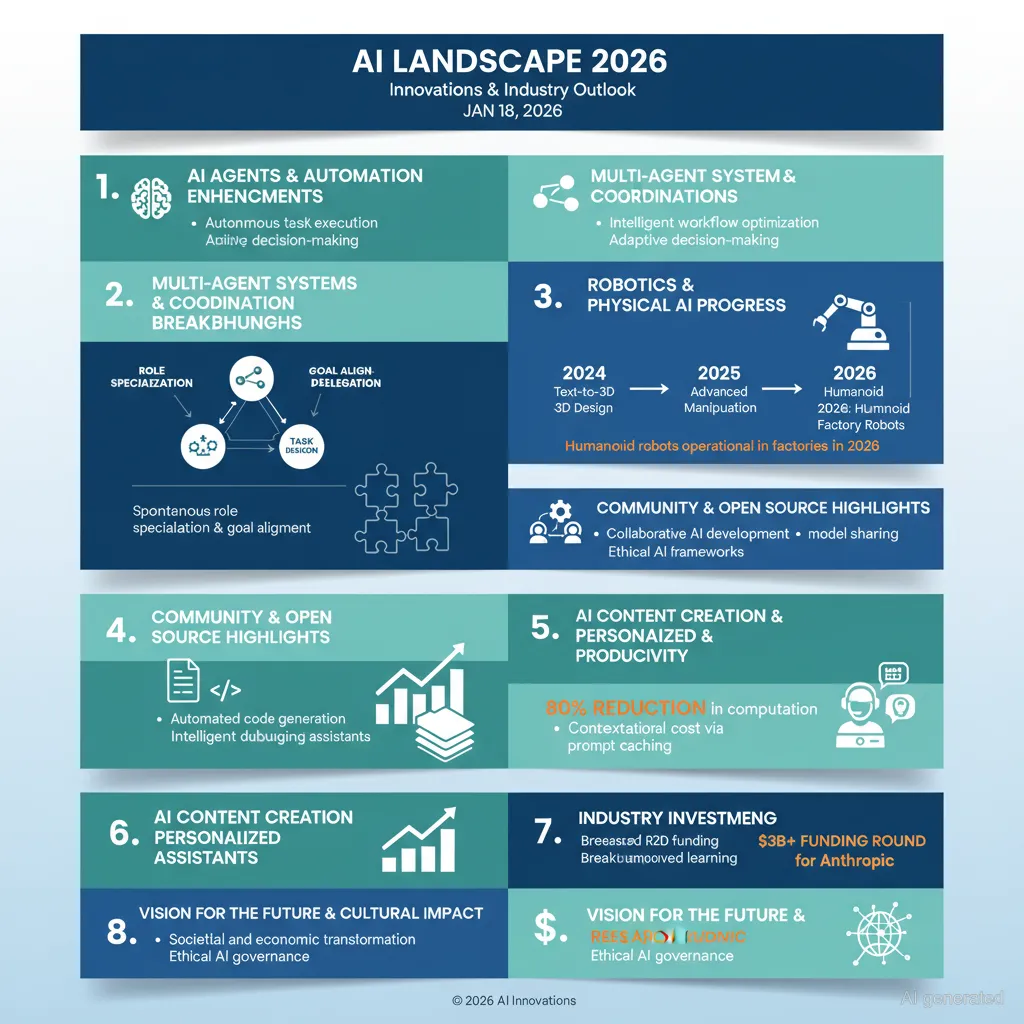
The latest developments in AI and related technologies reveal a dynamic landscape, with multiple innovations, tools, and community projects shaping the future of human-computer interaction and automation.
AI Agents and Automation Improvements
Claude Code has introduced a feature where accepting a plan automatically clears the AI’s context, providing a fresh workspace that helps maintain focus and improves adherence to plans. Users can opt out of this clearing if they prefer. The tool is evolving rapidly with new features that enhance workflow integration, such as always requesting explicit permission before deletions, adding folders mid-conversation, smarter connector suggestions, more stable VM connections, and fixes for oversized images breaking chats. Additionally, Claude Cowork recently demonstrated remarkable digital organization capabilities, impressively arranging thousands of files for users, showcasing the potential for AI coworkers to assist extensively in daily tasks.
Emergence of Multi-Agent Systems and Coordination
A new research paper titled “Emergent Coordination in Multi-Agent Language Models” highlights that connecting multiple large language models (LLMs) with light feedback enables spontaneous role development, synergy, and goal alignment without direct communication. Agents adopt identity-linked specialization and goal-oriented complementarity, evolving from mere aggregates into coordinated collectives through prompt design. This indicates that multi-agent AI systems may soon handle complex tasks more efficiently by leveraging distributed cognition.
2026: The Year AI Becomes Unmissable in Real Work
Industry leaders anticipate 2026 as a landmark year when AI transitions from hype to concrete impact. Beyond chatbots, agentic AI systems will autonomously run end-to-end tasks; humanoid robots will actively work in factories; AI-driven assistants will operate more robustly on-device; and world models will allow AI to plan effectively in real physical environments. This combination, confirmed by DeepMind’s Demis Hassabis, is expected to transform labor markets and erase public disbelief in AI’s capabilities.
Community and Open Source Highlights
The AI community celebrates releases such as Lightning Pose 3D, a production-ready pose estimation tool optimized for multi-camera, real-world data scenarios, boasting calibration-aware labeling and advanced multiview transformers. Another important open-source development is Microsoft’s Agent Lightning framework, which enables applying reinforcement learning (RL) to existing AI agents on any stack with minimal integration effort, helping agents learn from experience and improve over time.
Other noteworthy community contributions include documents parsing models like dots-ocr that handle diverse content (text, tables, formulas, images) across 100+ languages with a single system, and open-source “Smart Turn” models that detect conversational turns using audio and video data.
Developers also benefit from tools such as Google’s MCP Toolbox for Databases, simplifying AI agent access to databases with minimal code while automating connection and security handling.
AI in Software Engineering and Productivity
Claude Code continues to gain traction as a powerful platform that replicates how data scientists think, facilitating complex workflows involving data querying, context integration, and real-time monitoring. Interviews with leaders in enterprise data analytics reveal Claude Code’s effectiveness as both a startup and enterprise coding tool, capable of comprehending various data sources and generating meaningful insights and alerts.
Numerous productivity workflows now incorporate AI for rapid prototyping, coding assistance, testing, debugging, and iteration, often structured as multi-agent systems coordinating specialized roles to optimize success, latency, and compute costs. These multi-agent architectures have been demonstrated to outperform monolithic models, using far less computing power by delegating simpler tasks to smaller models under orchestration by a controller trained through reinforcement learning.
Several community members emphasize the importance of simplicity and efficiency, advocating for minimalistic web development approaches and cautioning against hype-driven adoption in favor of value-driven AI usage.
AI in Robotics and Physical AI
Robotics research is advancing incrementally with a focus on real-world, paying users providing continuous feedback for iteration. Technologies now enable direct text-to-3D design and automated physical assembly, moving robotics from instruction-based execution to creative autonomous construction.
Humanoid robots are anticipated to become operational in factories and greenhouses by 2026, contributing to labor automation and sustainable agriculture. Industry voices underscore that robotics progress is driven by persistent bug fixing and data collection rather than intermittent breakthroughs.
Personalized and Context-Aware AI Assistants
AI personal assistants like Gemini have demonstrated practical utility by analyzing dietary ingredients based on user health context, proactively managing schedules, and creating interactive widgets linked to tools such as Google Maps. This reflects a growing trend toward contextually aware, personalized AI that supports everyday decision-making seamlessly.
AI Content Creation and Media Production
Authentic Brands Group launched “Authentic Intelligence,” featuring specialized AI agents generating marketing materials rapidly for brands such as Reebok and Juicy Couture. Video production workflows benefit from new tools capable of writing, researching, and editing content autonomously, reducing dependency on large external production teams.
Google AI Studio has been praised for its PDF editing capabilities, including summarization, grammar correction, translation, and data extraction, available in an easy-to-use interface requiring no coding expertise.
Community Growth and AI Career Insights
Prominent AI enthusiasts have reflected on personal milestones, such as crossing 100,000 followers and transitioning from academia to AI research labs focused heavily on infrastructure for faster iteration and testing rather than purely novel models. The industry shift to scaling data and compute is now considered the norm, with innovation stemming from improving developer tools, workflows, and speed rather than radical new algorithms.
The self-taught AI engineer’s roadmap highlights domain arbitrage as a pathway into AI careers, emphasizing leveraging existing expertise with technology to transition into AI roles. Communities stress the significance of open source contributions, responsible AI usage, and the continuous learning loop essential for success.
Investment and Industry Moves
Sequoia Capital plans a major investment round in Anthropic alongside GIC and Coatue, aiming for combined funding exceeding $3 billion. Anthropic is expanding its leadership, naming a Managing Director for India to connect with one of Claude’s largest user bases. The industry recognizes talent acquisition as a key competitive factor, with companies like OpenAI noted for strategic team hires rather than IP purchases.
Emerging Technologies and Research Papers
Notable research includes a prompt caching technique evaluated across OpenAI, Anthropic, and Google LLMs that significantly reduces computational costs (up to 80%) and latency by reusing previously processed system prompts in long agentic tasks. This optimization is critical for the efficiency of long-running AI workflows.
Another breakthrough system replaced a monolithic large model with a hierarchy of specialized smaller models controlled by a learned conductor, achieving better task success, faster execution, and lower costs. This approach highlights the growing importance of coordinated AI collaboration over sheer model scale.
Vision for the Future and Cultural Observations
There is widespread optimism about AI’s eventual benefits, including self-driving cars with improved safety, accelerated drug and material discovery, and new living paradigms enhancing humanity’s wellbeing. However, responsible stewardship and societal adaptation are emphasized to mitigate adverse effects, such as job displacement.
Many industry voices urge humanity to embrace future technologies, reduce resistance to change, and collectively steer AI development towards positive outcomes. The trending ethos is to encourage global participation in building and creating with AI to unlock its full potential.
Summary
The AI ecosystem in early 2026 is marked by rapid tool enhancements, evolving multi-agent systems, practical adoption of robotics, and broad community engagement. Research and open source developments lower barriers, enabling increasingly sophisticated automation accessible to both developers and end-users. Industry investment and talent focus continue to fuel growth, while visionary leaders anticipate transformative changes that will redefine work, creativity, and daily living in the near future.