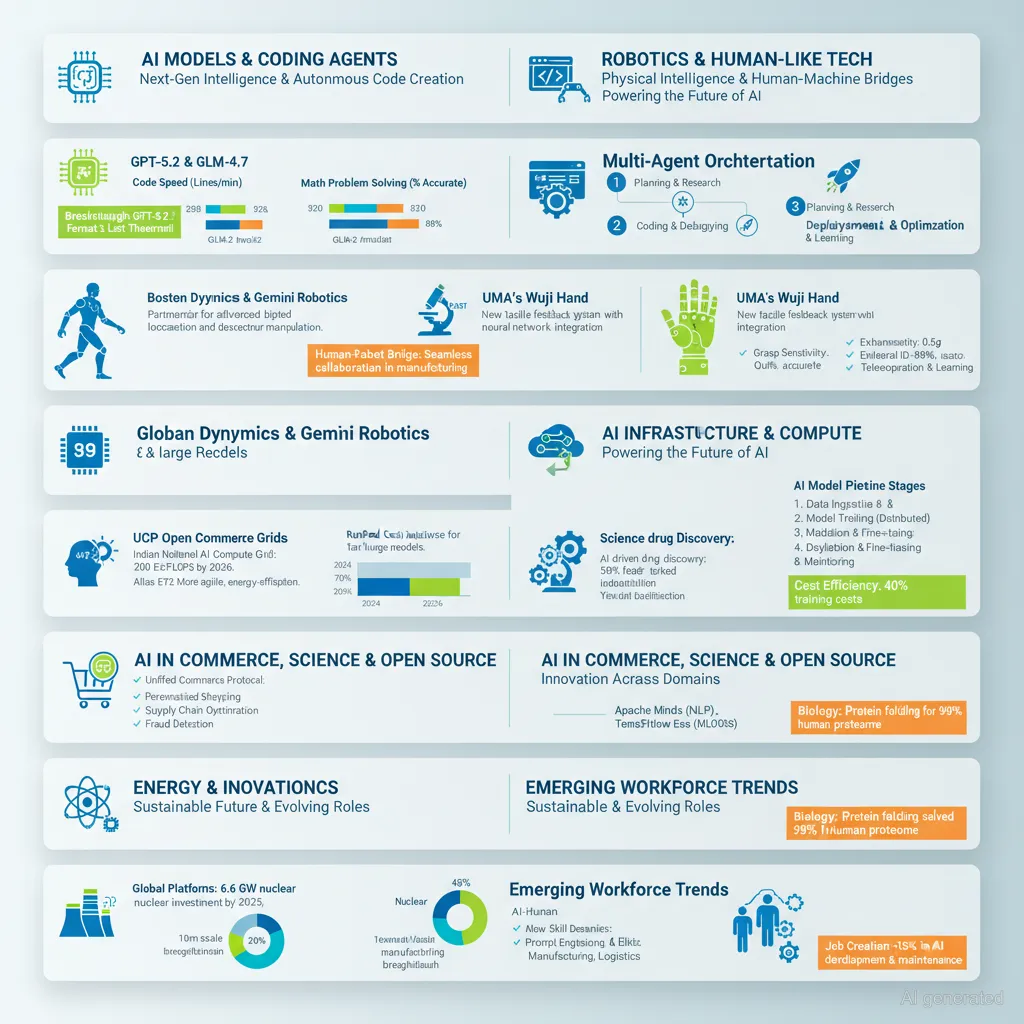
The latest developments in AI, robotics, and computing signal rapid progress across multiple fields, showcasing technological advancements and emerging practical applications in early 2026.
AI Models and Coding Agents
Significant improvements have appeared in open-source large language models (LLMs), with notable examples including GLM-4.7 rivaling Opus 4.5 and GPT-5.2, and MiniMax-M2.1 performing strongly on local 8x RTX 3090 hardware. While Opus offers faster speed and a polished frontend UI, models like Codex typically produce higher-quality code, especially on more complex tasks. Claude Code, now in version 2.1.3, has resolved longstanding memory compaction issues and supports persistent plans and to-do lists, significantly improving programming workflows. New prompting techniques focused on negative instructions (“do not X”) have shown to drastically increase code quality and bug detection rates.
OpenAI’s GPT-5.2 Pro continues to dominate in mathematical reasoning, solving previously unsolved Erdős problems and achieving perfect scores on challenging benchmarks such as the Putnam. Microsoft’s rStar-Math showcases how small LLMs with innovative techniques like Monte Carlo Tree Search and self-evolved trajectories have matched or exceeded previous state-of-the-art math reasoning. OpenAI’s continued focus on coding and research-focused models follows a shift away from sycophantic chatbots. Reinforcement learning plays a significant role in enhancing the reasoning capabilities of these models, with “thinking budgets” increasing output accuracy.
Emerging AI workflows increasingly use agentic approaches instead of traditional retrieval-augmented generation (RAG) pipelines, leveraging “tool calling” to enable sophisticated multi-agent systems. The introduction of multiple graders for agent evaluation, including code-based, model-based (LLM-as-judge), and human review, offers nuanced quality control in agent outputs.
The Claude Code ecosystem and complementary agents such as Cursor are evolving towards orchestration layers capable of managing several specialized coding agents for different tasks, including deep reasoning, rapid prototyping, and debugging. This multi-agent orchestration represents a future direction for AI-powered software development workflows.
Robotics and Human-like Robot Technology
Robotics is on a transformative trajectory, with significant advances in humanoid robot capabilities demonstrated by Boston Dynamics’ Atlas and emerging companies like Aidin Robotics with advanced hands featuring multiple force and torque sensors. Google DeepMind’s acquisition of Gemini Robotics and partnership with Boston Dynamics and Hyundai aims at deploying humanoid robots at scale in industrial contexts starting in 2026. This strategy leverages DeepMind’s extensive AI foundation model work combined with Hyundai’s manufacturing capacity and Boston Dynamics’ hardware excellence. The humanoid form factor promises seamless integration into existing human-centered workspaces, representing a distinct advantage over bespoke robotic warehouse setups.
Robot control innovations such as DreamControl, which learns movement control from human motion rather than code programming, illustrate progress toward intuitive robotic manipulation. UMA Robots’ Wuji Hand exhibits extremely low-latency tactile feedback and control, setting a new bar for dexterity. New demonstrations reveal robotics integrating with AI agents to autonomously manage complex tasks such as palletizing with intuitive gesture controls.
AI Infrastructure, Compute, and Training Advances
The infrastructure landscape enabling AI development is rapidly evolving. Indian compute grids now offer vast NVIDIA H100 resources at significantly lower prices than western cloud providers, opening opportunities for building competitive AI models on more affordable infrastructure. Serverless, on-demand GPU usage platforms like RunPod enable faster iteration cycles critical to model development and deployment.
Research breakthroughs in AI inference speed include the Lookahead Parallel Decoding (LoPA) method, which speeds up decoding by predicting multiple tokens simultaneously without retraining. RelayLLM presents an efficient hybrid inference approach where small models call upon expensive LLMs only at critical reasoning steps, achieving major cost reductions with improved accuracy.
Long-context LLMs benefit from techniques such as dropping positional embeddings post-pretraining, extending context window capabilities significantly. Prompt repetition, where input is sent twice in sequence, also reliably enhances accuracy without increasing latency or tokens.
AI in Commerce and Marketing Automation
Google and Shopify have launched the Universal Commerce Protocol (UCP), an open standard enabling AI agents to discover products, complete checkouts, and transact autonomously across partner retailers such as Etsy, Target, and Walmart. This facilitates seamless AI-powered commerce experiences, including native checkout within AI applications.
n8n’s workflow automation platform has gained traction as a cost-effective alternative to task-based competitors like Zapier, especially for complex AI agent pipelines, due to its per-execution pricing model and visual customization capabilities. AI-generated marketing strategies that automate trend research, UGC content creation, and multi-channel video ads are revolutionizing digital marketing. AI influencers using automated content pipelines are emerging as a dominant trend with organic reach advantages over paid influencer marketing. High-effort content such as articles and videos remains the most effective format to gain engagement with new social media algorithms.
AI in Science, Mathematics, and Biology
Groundbreaking AI models like Stack in biology introduce contextual learning for single-cell RNA sequencing data, enabling condition predictions without retraining and significantly enhancing drug discovery workflows. This approach helps overcome traditional bottlenecks in virtual screening by modeling population shifts at the cellular level.
In mathematics, AI-powered provers have solved complex open problems validated by human experts such as Terence Tao, marking milestones in automated theorem proving and scientific discovery.
Open Source and Community Tools
Projects such as SETA provide an extensive open-source repository of reinforcement learning environments for terminal-agent training, democratizing access in this domain. Open source models and frameworks for AI image generation, coding agents, and robotic control continue to mature with increasing quality and ease of deployment. Tools like Tansu simplify Kafka-like data streaming with PostgreSQL backends, and prompt caching techniques optimize LLM usage costs at scale.
Coding ecosystem improvements include the release of Claude Code plugins such as adversarial-spec, enabling multi-model adversarial review of technical specifications to improve software design quality. CLI tools and integration frameworks are evolving to streamline browser automation, agent orchestration, and workflow management.
Energy and Hardware Innovations
Meta recently secured agreements for 6.6 GW of nuclear power by 2035 to power its AI superclusters, making it one of the largest corporate purchasers of nuclear energy in the U.S. This includes investments in small modular reactors, reflecting broader shifts in sustainable infrastructure for energy-intensive AI operations.
In semiconductors, Dai Nippon Printing in Japan achieved 10 nm lithography through energy-efficient nanoimprint technology, potentially challenging existing EUV lithography bottlenecks.
South Korean researchers developed a magnetically controlled lithium-metal battery anode, promising fourfold energy density improvements and high cycle life with safety benefits.
Emerging Trends and Workforce Perspectives
AI is reshaping labor markets and industry verticals, increasingly rewarding people with strong social skills and broad abilities alongside technical expertise. Coding and Excel are emerging as two of the fastest-growing AI application verticals due to self-serve product-led growth potential and vast market size.
Tools and workflows facilitating rapid software 3.0 development empower individuals to build personalized software with minimal cost and iteration cycles measured in minutes. The role of founders, product owners, and engineers is evolving to include deeper integration and orchestration of AI agents in end-to-end systems.
Summary
The convergence of advanced AI models, efficient infrastructure, robotics innovation, and new commerce protocols signals a paradigm shift in technology and its workforce application in 2026. Research breakthroughs in mathematics and biology attest to AI’s growing role as a scientific partner, while industrial and consumer applications quickly transition from proof of concept to deployed production systems. Open source ecosystems, practical agent orchestration, and affordable compute promise widespread accessibility. The rate of advancement points to an acceleration in the coming years that will redefine work, creativity, and interaction with intelligent systems across all domains.