
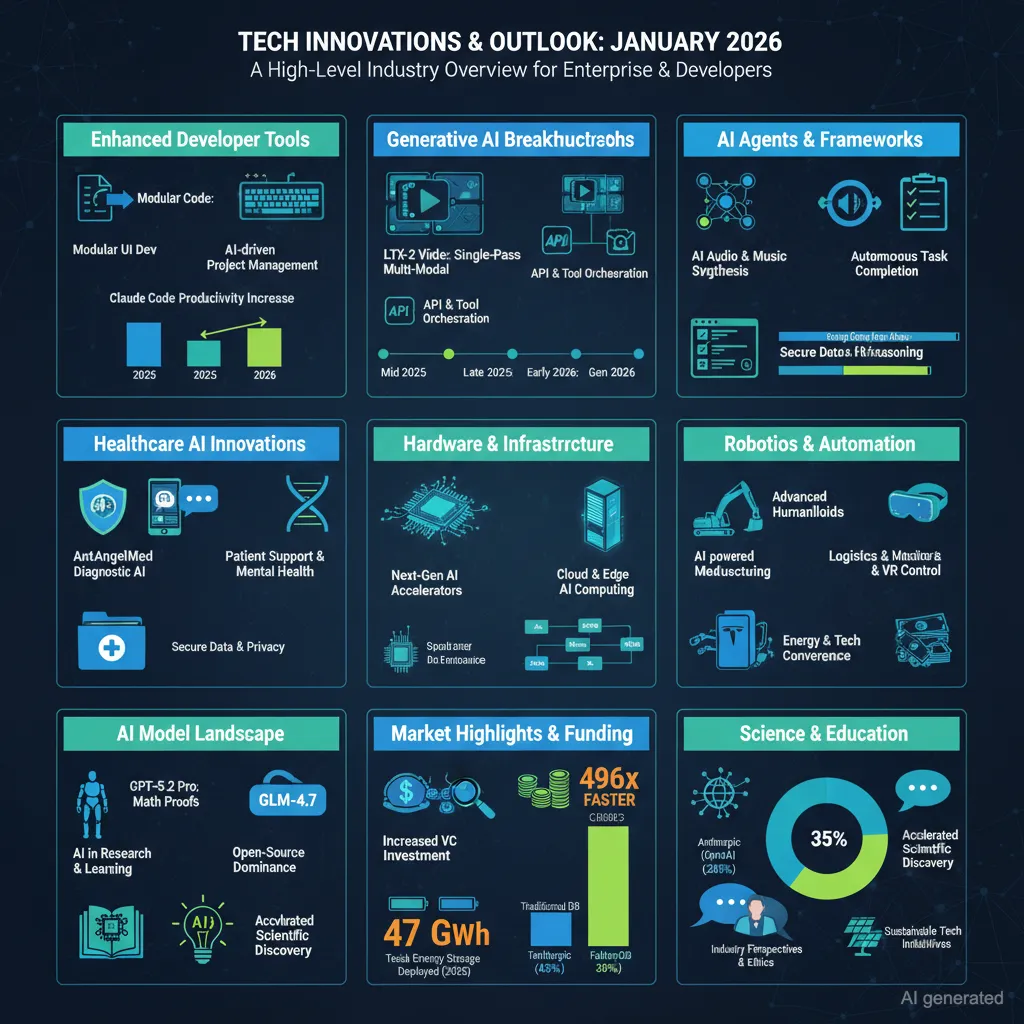
The aggregated news offers a comprehensive overview of developments, insights, and innovations in AI, robotics, healthcare, and technology as of early 2026.
User Interface and Development Tools
Significant enhancements were made to Google AI Studio’s user interface, focusing on streamlining file drag-and-drop, simplifying tool selection, improving mobile support, and unifying design consistency across playground and vibe coding environments. “Vibe coding” has gained popularity as a flexible approach to software development, enabling personalized tool creation through natural prompts. Claude Code, an AI coding assistant, has expanded its capabilities with the addition of keyboard shortcuts, hooks, wildcard tool permissions, and multilingual support, experiencing rapid growth and adoption within development communities. Developers noted increased productivity while leveraging Claude Code for writing and reviewing software, emphasizing a shift toward higher-level problem-solving and specification refinement. Additionally, new workflows for managing AI agents via Kanban boards have improved task tracking and collaboration efficiency, featuring visual alerts for blocked tasks and on-card user interactions. The collaborative use of command-line tools and APIs, such as with Notion integrations, illustrates the evolving synergy between AI and traditional programming paradigms.
Generative 3D, Video, and Audio AI Models
The release and advancement of multiple generative 3D models have been highlighted, including Sparc3D 2.0 with its acclaimed “1536 Pro” mode and over 25 other variants accessible through public platforms. Scenario.gg introduced a normal map view feature within its 3D viewer to enhance visualization workflows. In video generation, the open-source LTX-2 model has emerged as a milestone, delivering high-quality, fast video generation with multi-modal capabilities including motion, dialogue, sound effects, and music in a single pass. It supports multiple video controls like Canny, Depth, and Pose, offering keyframe-driven generation with native upscaling. Collaborations with NVIDIA and Lightricks accelerate local AI video processing by optimizing model checkpoints and integrating them into popular UI frameworks such as ComfyUI. In audio, NVIDIA’s Music Flamingo model provides state-of-the-art audio-language understanding for full-length songs, incorporating music theory reasoning. Open-source advancements also include updates to Pipecat’s Smart Turn model for improved real-time speech turn detection, enabling more responsive voice agent interactions with low latency.
AI Agents, Autonomous Systems, and Multi-agent Frameworks
AI agents have rapidly evolved from basic retrieval augmented generation (RAG) systems to sophisticated agentic RAG frameworks, capable of multi-step reasoning, tool and API integration, and context validation. Projects like Anthropic’s Claude Code illustrate how multi-agent coordination can handle complex workflows with improved message queuing and task management. Flexible coding agents can dynamically generate CLI tools and integrate them with existing APIs to enhance automation and reduce repetitive work. Innovations in multi-agent concurrency have demonstrated productivity gains, emphasizing Unix-inspired modular approaches such as file systems and shell interaction over monolithic AI workflows. Advances also include models like MiroThinker 1.5 that outperform larger parameter baselines in browsing tasks by employing hypothesis generation, evidence retrieval, and verification loops. Additionally, open-source projects like smolagents facilitate quick creation of multi-modal agents using Hugging Face models.
AI in Healthcare and Personalized Health Management
Healthcare applications leveraging AI have made significant strides. OpenAI launched ChatGPT Health, a dedicated, secure environment for health conversations facilitating integration with medical records and wellness apps like Apple Health. These tools provide personalized, context-aware medical guidance, including lab result interpretation, doctor visit preparation, nutrition planning, and symptom explanation, with privacy guarantees such as data isolation and exclusion from model training. Anthropic has demonstrated Claude’s efficacy in medical domains, while open-source models like AntAngelMed (100 billion parameters) have become prominent in medical language understanding benchmarks. Emerging medical biotech research, such as senolytic CAR T-cell therapies for aging, was highlighted, indicating AI’s role in accelerating life sciences innovation. The sector is also seeing startups and enterprises adopt AI for automated medical triaging, diagnostics, and personalized health insights, with integration of electronic health records becoming a pivotal part of user engagement.
Hardware and Infrastructure Innovations
NVIDIA unveiled the Vera Rubin AI supercomputer platform, featuring six new chips designed to accelerate large-scale inference for agentic AI and mixture-of-experts (MoE) model deployments. This infrastructure delivers significant power efficiency gains compared to previous generations, supporting applications with higher transistor counts and improved cooling methods. AMD revealed a comprehensive AI hardware roadmap focused on ubiquitous AI compute capabilities, including yotta-scale rack-level systems, compact enterprise GPUs, and AI-optimized PC chips. The Caterpillar 306 CR Mini Excavator now incorporates real-time AI voice assistants powered by NVIDIA Riva and Jetson Thor platforms, enhancing operator support via interactive simulations through NVIDIA Omniverse. Furthermore, advancements in graph databases were demonstrated by FalkorDB’s matrix-based design, achieving 496x faster query performance than traditional pointer-chasing graph engines, critically benefiting real-time reasoning in AI agents.
Robotics and Automation
Boston Dynamics and key collaborators are progressing toward general-purpose humanoid robots, while the Reachy Mini robot, affordable and available for consumer purchase, gained spotlight exposure at CES 2026 as a potential AI robotics foundation for the near future. The Genie Sim 3.0 dataset was released as the largest open-source simulation dataset for Embodied AI, featuring over 10,000 hours of high-quality demos across 200+ tasks and 100,000 scenarios with multi-sensor data formats. Teleoperation innovations include the open-source dexterous teleoperation stack that uses vision and cost-effective wrist trackers instead of glove sensors, aiming to significantly reduce hardware costs in robotics control. NVIDIA collaborations with Hugging Face and other partners integrate Isaac technologies into accessible robotic frameworks, facilitating development on various hardware platforms, from desktop systems to embedded devices.
AI Model Developments and Open-Source Milestones
Open-source AI continues to advance with models like GLM-4.7, featuring 355 billion parameters, delivering improved reasoning and agentic task performance with extensive token context windows. New large-scale models across multiple languages and modalities have been released on Hugging Face, including advanced instruction-following models and faster audio models. Notably, GPT-5.2 Pro achieved an autonomous mathematical proof of an Erdős problem using the Lean proof assistant without human intervention, marking a major milestone in AI-driven mathematical discovery. Efforts in improving AI model efficiency include novel attention mechanisms like LongCat ZigZag Attention for extended context length with reduced computational costs. Open models and tooling ecosystems are maturing with frameworks like Lightning enabling cost-effective routing between various LLMs. These advancements highlight a gradual transition from proprietary AI dominance to a more open inference landscape.
Enterprise and Market Highlights
LMArena, a crowdsourced AI model evaluation platform originating from UC Berkeley, recently closed a $150 million Series A funding round valuing the company at $1.7 billion, reflecting growing demand for transparent, continuous AI performance measurement across billions of monthly user interactions. Market dynamics reveal distinct revenue structures between leading AI service providers; for instance, Anthropic’s enterprise-heavy revenue contrasts with OpenAI’s consumer-centric base, although both hold similar valuation multiples. Tesla has scaled rapidly to become the world’s largest energy storage provider, deploying nearly 47 GWh in 2025 alone. New startups such as Autonomous leverage AI for wealth management, democratizing elite financial strategies at zero advisory fees. The broader tech ecosystem is witnessing significant cultural shifts as organizations prioritize AI-native practices to enhance workforce efficiency, urging leadership to actively foster AI fluency and workflow automation.
Science, Research, and Educational Initiatives
Academic and industrial research are focusing on new theoretical frameworks and data-driven pursuits. The concept of epiplexity offers a refined measure of learnable information tailored to computationally limited intelligence, influencing data selection strategies for training. Novel papers shed light on improving reinforcement learning with precision-focused pretraining and agent productivity improvements via automated tool generation and hybrid policy optimization. AI-powered learning tools such as DeepTutor aim to transform education by offering capabilities like massive document chats, visual knowledge representations, and exam simulations. Global AI development is becoming more inclusive, with countries like South Korea fostering open-source model development benefiting the international community. Several open-source datasets and model collections facilitate more effective research and deployment in natural language processing, robotics, and multimodal AI contexts.
Notable Industry and Cultural Perspectives
Influential voices emphasize the importance of truth, curiosity, and beauty as foundational AI values to ensure beneficial outcomes aligned with humanity’s best interests. The evolving role of storytelling in technology is recognized as a critical skill for product and business success. Experts highlight the practical need for teams to embrace “Socratic mode” communication with AI agents, encouraging iterative questioning to improve understanding and task outcomes. The infrastructure and software ecosystem increasingly favor Unix-like modularity, emphasizing file systems and CLI tools. New business models embrace AI’s potential to enhance job quality and wealth creation rather than replace human roles outright. There is a shared call for CEOs to drive AI-native transformation across organizations, integrating AI fluency into corporate cultures and workflows. Additionally, environmental initiatives leveraging AI and technology are underway, such as California’s large-scale solar power deployment converting drought-impacted farmland into renewable energy production.
—
This review synthesizes the key themes and insights of the extensive updates spanning AI technologies, models, applications, hardware, and ecosystem developments shaping the current landscape and near future trajectory.