
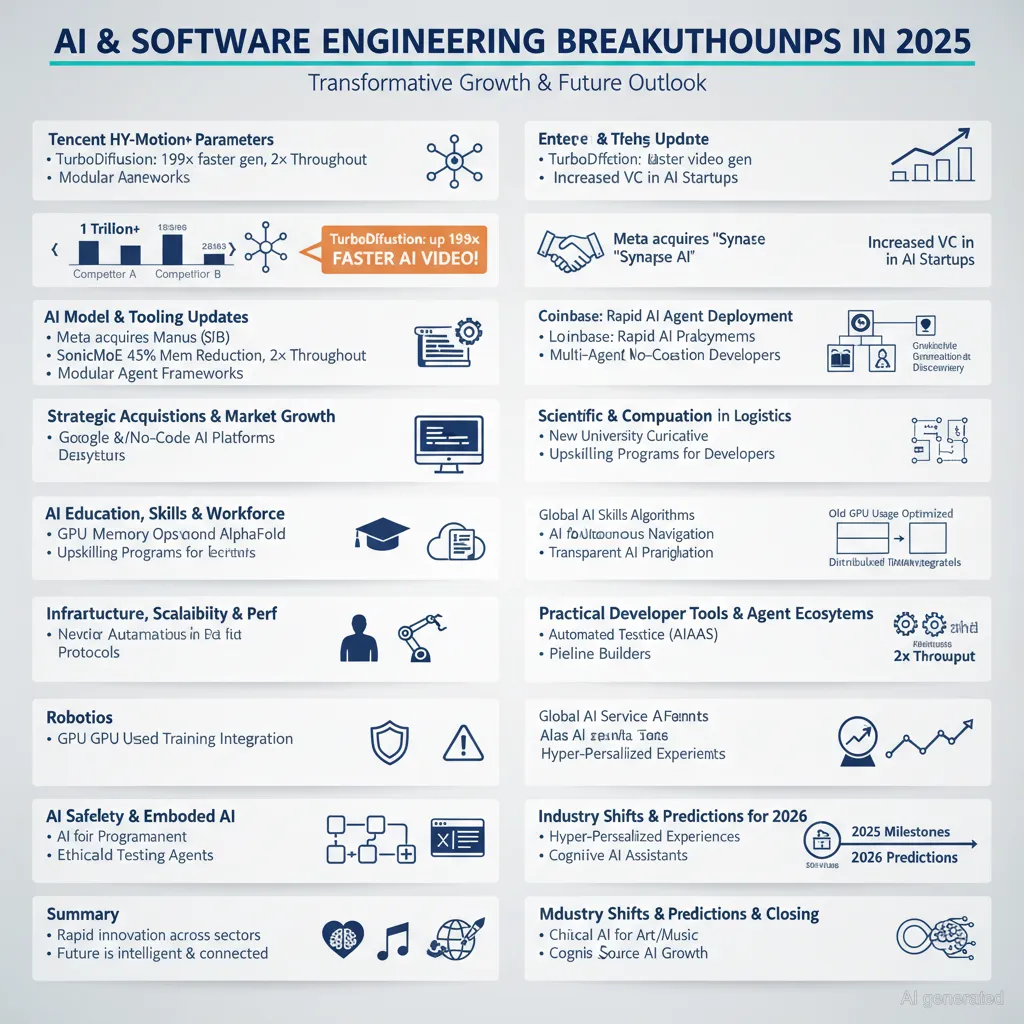
In recent developments in AI and software engineering, significant advancements and strategic moves have shaped the landscape toward increasingly powerful, reliable, and scalable systems.
AI Model and Tooling Updates:
Draw Things (DT) v1.20251223.0 now officially supports Qwen Image Edit 2511 and Qwen Image Layered, enhancing image editing capabilities, notably improving group photo consistency and integrating multiple functional LoRAs. Open-source releases are thriving, with projects such as Tencent’s HY-Motion 1.0-a billion-parameter text-to-motion model that converts natural language into high-fidelity 3D animations-and MiniMax’s M2.1, a coding model surpassing various competitors in multilingual benchmarks and full-stack coding tasks. Similarly, Weaviate’s 1.35 release introduces Object Time-to-Live (TTL) features, multimodal document embeddings enabling efficient image-based document search, and a production-ready Java v6 client alongside Flat Index RQ quantization for improved multi-tenancy performance.
Strategic Acquisitions and Market Growth:
Meta’s acquisition of Manus for over $1 billion reflects market validation of consumer AI applications beyond large labs, reinforcing AI’s evolving role beyond dialogue to dynamic action and creation. Manus’s vision of AI integrated into interfaces like smart glasses illustrates the emerging synergy between agents and everyday user interaction. Meanwhile, Google DeepMind launched the Gemini 3 model with enhanced reasoning and multimodal capabilities, supported by a hackathon offering $100,000 in prizes to encourage innovation.
Enterprise and Developer Ecosystem:
Coinbase demonstrated rapid deployment of AI agents, reducing build times drastically by adopting code-first graphs and observability platforms such as LangSmith, which enable auditability and efficient operation. LlamaIndex advanced agent memory with VectorMemoryBlock by incorporating Weaviate for semantic retrieval, offering persistent, searchable interactions beyond naive message buffering. Additionally, frameworks like BOAD and tools such as AgentCore and Claude Code are enabling robust, traceable, and distributed agent workflows that improve engineering productivity and knowledge distribution across teams.
AI Education, Skills, and Workforce:
Industry experts emphasize balanced approaches for developers entering AI – structured AI courses, hands-on system building, and selective research paper reading are recommended for deeper insight and avoiding redundant work. Curricula and open resources, such as Harvard’s machine learning systems textbook and MIT/Oxford’s agentic AI curriculum, are now freely available, building a solid knowledge foundation. This is crucial as data engineering is projected to grow faster than AI engineering, requiring skills in privacy-compliant data integration, multi-tenant systems, and coding agents for pipeline acceleration.
Scientific and Computational Breakthroughs:
Cutting-edge research addresses major bottlenecks in AI and robotics. ByteDance introduced TurboDiffusion, a significant inference framework that accelerates AI video generation up to 199×, combining sparse linear attention and low-bit quantization for minimal quality loss. New benchmarks like RoboBPP offer realistic physics-based tests for robotic bin packing, improving real-world feasibility. Papers such as “AgentMath” empower large language models (LLMs) to solve complex math problems by integrating code execution during reasoning, while “Generative Adversarial Reasoner” enhances LLM reasoning through adversarial reinforcement learning.
Infrastructure, Scalability, and Performance:
Advances in model streaming and hardware efficiency continue. Run:ai’s Model Streamer allows GPU memory streaming on Google Cloud to reduce load times. SonicMoE introduces IO- and tile-aware optimizations for Mixture of Experts models, cutting memory usage by 45% and increasing throughput by nearly double, lowering required GPU counts. Researchers explore geometric memory representations extending beyond simple lookup tables in Transformers to improve multi-hop reasoning.
Robotics and Embodied AI:
China leads in humanoid robot development with advanced embodied AI, integrating large-scale data and reinforcement learning for robust motor control, scalability, and dexterity. Projects like SpiRobs design soft robotic manipulators inspired by octopus arms, demonstrating broad applicability and significant grasping capabilities. Autonomous navigation advances also emerge with European startups developing GPS-denied drone capabilities using onboard vision and neural networks.
AI Safety and Ethics:
Emphasizing responsible AI development, researchers highlight the importance of regulation to mitigate addictive behaviors in conversational agents and propose methods such as RobustFT-a supervised fine-tuning approach that filters noisy and erroneous training data to enhance model reliability and safety substantially. This direction moves the field from blind data accumulation to truth-verified learning, boosting trustworthiness.
Practical Developer Tools and Agent Ecosystems:
Agent Skills standardization by Anthropic, task reuse mechanisms like AgentReuse, and multi-agent orchestration frameworks improve AI agent robustness and effectiveness. Tools such as Claude Code provide IDE-level intelligent diagnostics and code intelligence, while open-source GUI agents (MAI-UI family) demonstrate industry-leading performance on real-world mobile navigation tasks.
Notable Industry Shifts and Predictions:
The AI-enabled software engineering paradigm shift continues with “vibe coding,” interactive and iterative coding assisted by agents, significantly enhancing productivity and lowering traditional techno-bureaucracy. Enterprise adoption signals-for example, Microsoft’s restructuring toward autonomous AI stack building and growing monthly users of Copilot-powered agents-affirm rapid evolution toward AI-native workflows. In 2026, AI models are expected to cease feeling like autocomplete tools and begin acting as knowledgeable collaborators, exhibiting continual learning and proactive behaviors in daily life.
Miscellaneous Highlights:
Other notable advances include open-source projects like SongGeneration Studio offering free, censorship-free music generation on personal PCs, ESPectre’s Wi-Fi-based motion detection without cameras, and comprehensive GPUs insights demystified in accessible documents. Quantum computing approaches are nearing breakthroughs paralleling AI progress five years prior, heralding future cross-domain innovations.
In conclusion, 2025 closed as a landmark year fueled by rapid AI model enhancements, foundational tooling, and increased enterprise investment, setting the stage for transformative AI adoption in 2026 across industries, science, and consumer applications. The combination of improved model reliability, modular agent frameworks, and advanced hardware infrastructure promises continued acceleration and deeper integration of AI into everyday workflows and scientific discovery.