
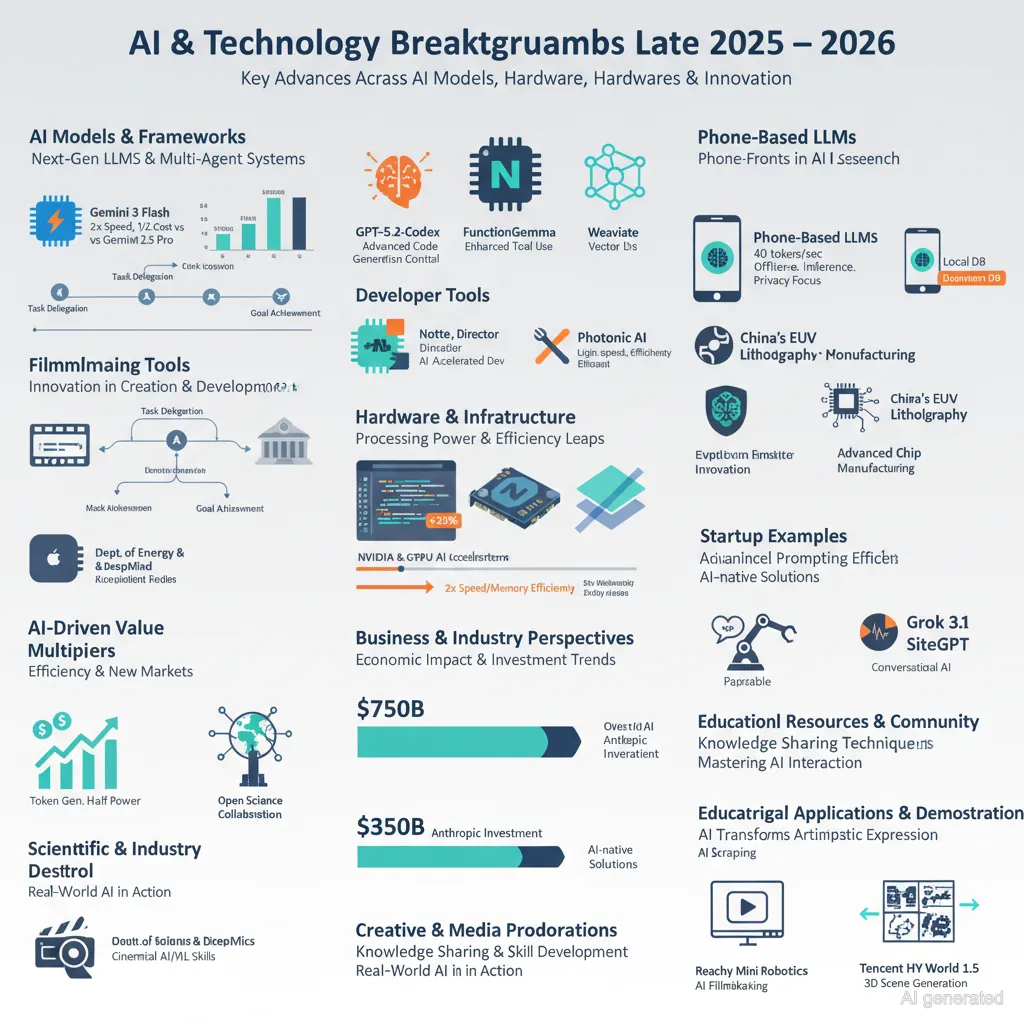
The AI and technology landscape has seen remarkable advancements and diverse innovations across multiple sectors in late 2025 and heading into 2026, spanning AI model releases, filmmaking tools, hardware breakthroughs, developer productivity enhancements, and strategic business insights.
AI Models and Frameworks
Google DeepMind released Gemini 3 Flash, a frontier intelligence model notable for its speed and efficiency, outperforming its predecessor Gemini 2.5 Pro while significantly reducing latency and cost. Gemini 3 Flash’s capabilities include multimodal processing (text, images, video) and frontline reasoning, broadly deployed across consumer apps, developer APIs, and enterprise platforms like Vertex AI. Likewise, OpenAI unveiled GPT-5.2-Codex, optimized for agentic coding with improved long-context understanding and cybersecurity, cementing it as a top-tier model for complex real-world software engineering tasks.
Complementing these large models, Google introduced FunctionGemma 270M, a lightweight open foundation model specifically designed for fine-tuning function-calling models on-device, supporting sub-second latency and privacy-centric local deployments on phones and edge devices. Also notable is NVIDIA’s release of the Nemotron-3-Nano-30B, a modular family of reasoning models optimized for multi-agent AI applications.
The Weaviate vector search engine earned Gartner recognition as an Emerging Leader in Generative AI Engineering, providing embedding storage and hybrid search to power production-grade generative AI applications, with clients like Booking.com deploying it in live environments.
Four key frameworks-LangGraph, CrewAI, AutoGen, and MetaGPT-are shaping the future of autonomous, multi-agent AI ecosystems, enabling agents that collaborate, communicate, and self-improve in complex workflows spanning product development, content creation, and research.
In line with this, innovations in agent memory layers, such as the open-source efforts by Mem0AI, tackle the limitations of stateless agents by enabling true long-term context storage and retrieval across sessions, enhancing user experience with personalized recall and adaptation.
Tools and Productivity Enhancements
AI filmmaking has been revolutionized by tools like the UNLIMITED Wan 2.6 on OpenArt and Kling 2.6 Motion Control, which offers precise multi-shot cinematic consistency over up to 15 seconds with motion capture allowing creators to direct character movement, facial expressions, and lip-sync. A global contest celebrates creativity using Kling 2.6’s Motion Control features, incentivizing innovation in animated storytelling.
Nano Banana Pro by Google DeepMind allows users to perform detailed image editing through annotations, improving final visual outcomes. It also introduced an ultra-high-resolution output feature (up to 4K), benefiting creators across decks, landing pages, and social media content.
Developers can now accelerate their workflows with tools such as Notte’s Demonstrate Mode, which records browser actions and auto-generates automation code, streamlining task automation without complex scripting. Director by Browserbase offers similar no-code web automation via natural language prompts.
Open-source efforts like LlamaParse v2 simplify and reduce the cost of document parsing with enhanced accuracy, enabling continuous ingestion from business tools such as Gmail, Slack, and Notion.
AI-powered productivity agents such as Shopify’s Sidekick redefine AI assistants by interpreting user intent and acting autonomously within commercial platforms, moving beyond traditional chatbots.
For phone-based use, local LLMs running offline on devices like the Pixel 8 and iPhone 15 Pro operate at around 40 tokens/sec with support for advanced models including Qwen3 (0.6B to 32B scale) and FunctionGemma, reflecting a shift toward privacy-focused, on-device inference.
LangChain’s latest Academy course prepares developers to build agents that reason and use tools with observability via LangSmith, accelerating adoption.
Hardware and Infrastructure Advances
Apple’s M4 Pro Mac mini demonstrated superior LLM token generation efficiency compared to same-memory NVIDIA systems, using half the power, reinforcing Apple’s strategic chip design for AI servers.
At the infrastructure level, NVIDIA and Google have significantly improved hardware performance for AI workloads. Collaborations include NVIDIA boosting throughput on Blackwell GPUs by 33% and Google advancing TPU deployment optimized for neural network workloads with custom ASIC design.
New advancements in sparse mixture of experts (MoE) training kernels deliver up to 2x faster speed and memory efficiency. Additionally, breakthrough computation paradigms like photonic AI tensor operations showcased at Aalto University promise orders-of-magnitude energy efficiency improvements by executing inference with light.
Cloud infrastructure improvements appeared in Google’s Cluster Director supporting Slurm on Kubernetes, easing high-performance compute management.
Breakthroughs in graph database querying were realized by FalkorDB, which replaces traditional traversal-based queries with linear algebra over sparse matrices, enabling instant and scalable queries critical for GraphRAG (retrieval augmented generation) applications employing knowledge graphs in LLM contexts.
Scientific and Industry Collaborations
Google DeepMind partnered with the U.S. Department of Energy on the Genesis Mission, providing accelerated access to frontier AI tools to 17 National Labs to enhance scientific research in physics, chemistry, and biosecurity, aiming for AI-powered breakthroughs. NVIDIA also joined this collaborative venture.
Companies like Empire AI demonstrate AI’s transformative potential in public sector environments, enabling billions in economic benefits in regions like New York through accelerated AI infrastructure and applications.
Semiconductor breakthroughs were highlighted by China’s prototype EUV lithography machine, marking a major advance in chip manufacturing capacity, portending global shifts in AI compute leadership.
Business and Industry Perspectives
Industry leaders emphasize the importance of AI-driven value creation over job displacement fears, noting a new development pattern where AI multiplies output speed by factors of 10 to 100, increasing headcounts instead of reducing them.
The AI product business landscape is highlighted by emerging valuation trends: OpenAI reportedly courting private investment at a $750 billion valuation, Microsoft and Nvidia backing Anthropic at approximately $350 billion, and rapid growth in AI unicorn startups.
Entrepreneurship advice centers on leveraging AI to build digital products swiftly, focusing on niche problems with validated demand, and using AI to create courses, guides, and marketing content rapidly. Sales and positioning skills are positioned as critical leverage points beyond technical expertise alone.
Lovable and SiteGPT are examples of startups demonstrating growth by streamlining software creation via AI, lowering barriers by generating production-ready code from conversations without technical handoffs.
Educational Resources and Community
HuggingFace launched nine free, open-source AI courses with practical, hands-on content covering LLMs, agents, vision, gaming, audio, and 3D generation.
The AI open science community remains active, hosting discussions, open peer reviews, and collaborative learning.
New guides on prompting techniques for LLMs emphasize system design approaches beyond simple prompt engineering, encompassing chain-of-thought reasoning, role prompting, prompt chaining, and multimodal inputs for robustness.
Furthermore, advanced publications on geometric deep learning, spherical equivariant graph transformers, and reasoning language modeling enrich academic understanding.
Noteworthy AI Applications and Demonstrations
Novel applications include Paper2Video, which automatically generates presentation videos from scientific papers, surpassing human-created videos in comprehension tests.
Robotics advances include Reachy Mini robots brought to life through voice agent APIs and autonomous microscopic robots developed by the University of Pennsylvania and University of Michigan, capable of complex sensing and operation at scales smaller than a grain of salt.
AI-driven voice assistant platforms such as xAI’s Grok Voice offer multilingual, natural conversational experiences at sub-second latency, now accessible to developers.
Firecrawl Agent enables autonomous data harvesting across complex web sites via natural language prompts.
AI in Creative and Media Production
AI tools continue to revolutionize creativity with multi-shot cinematic storyboarding, real-time video generation with consistent framing, and native audio synthesis. The Wan 2.6 model integrated into Zeely AI allows full cinematic control with native lipsync and sound design, while text-to-video models like Veo 3.1 and Doppl enhance fashion and animation workflows.
Tencent’s open-source HY World 1.5 (WorldPlay) offers real-time, long-term consistent 3D scene generation from text or images with first- and third-person controls, marking advances in interactive world modeling.
Overall, these developments signify a maturing AI ecosystem where agent-native retrieval, efficient multimodal models, real-time control, and on-device inference enable scalable, high-impact applications across science, industry, and creativity. As 2026 approaches, the focus sharpens on building robust, agent-driven AI systems with practical utility and collaborative capabilities that bridge technical innovation with real-world needs.