The past week has seen numerous advancements and announcements across AI development, security, agentic systems, content creation, and tech industry updates.
AI Model Developments and Benchmarks
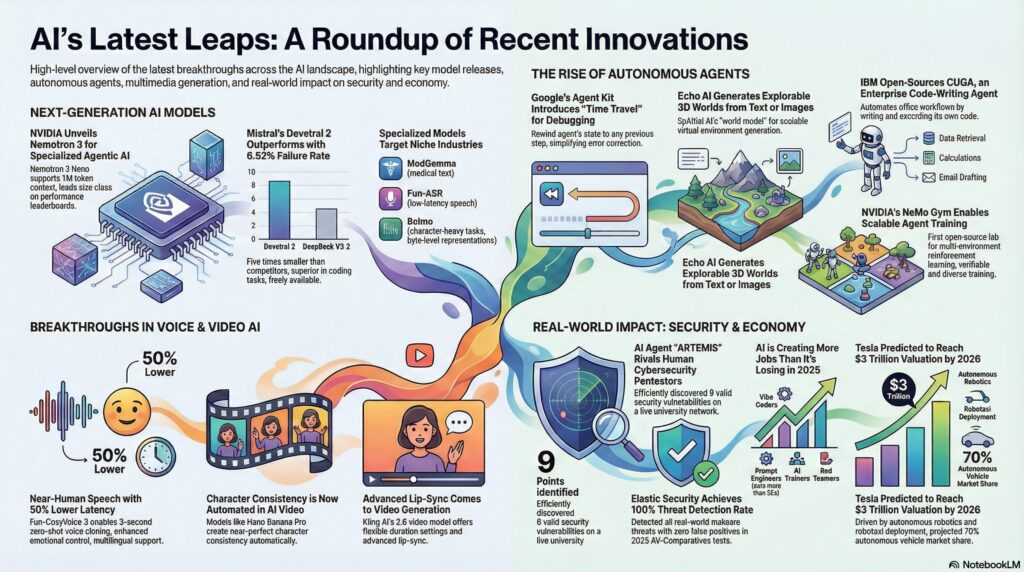
Mistral AI’s Devstral 2 model demonstrated a 6.52% diff-edit failure rate, outperforming competing models like GLM-4.6 (7.58%) and Kimi-K2 (9.29%) despite having roughly 123 billion parameters-five times smaller than DeepSeek V3.2. Devstral remains freely available during its launch promotion.
NVIDIA unveiled the Nemotron 3 family of open models, datasets, and libraries designed for specialized agentic AI applications across industries. The flagship Nemotron 3 Nano-a hybrid Mamba-Transformer mixture-of-experts (MoE) architecture with 31.6 billion total and 3.6 billion active parameters-leads its size class on Artificial Analysis leaderboards. It supports a massive 1 million token context window and scores 52 on the Artificial Intelligence Index, outperforming prior open models such as Qwen3-30B and NVIDIA’s earlier Nemotron Nano 9B V2. The release includes open pretrained weights, data, RL tools (NeMo Gym), and is immediately accessible via major inference providers and Hugging Face. Larger Nemotron 3 Super (~120B parameters) and Ultra (~480B parameters) models are slated for release in the first half of 2026. Importantly, Nemotron 3 Nano is compatible with llama.cpp for efficient local deployment, targeting mid-range hardware.
Other noteworthy model news includes Alibaba’s Fun-ASR offering low-latency speech recognition supporting 31 languages with strong robustness to noise and professional terminology. The open-source Fun-CosyVoice 3 text-to-speech model features half the first-token latency, enhanced code-switching, zero-shot voice cloning requiring only 3 seconds of audio with improved expressive controls, multilingual timbre support, and benchmark gains approaching human-recorded speech quality.
MedGemma, a variant collection based on Gemma 3, is optimized for medical text and image comprehension, accelerating healthcare AI application development.
The newly released Bolmo family of byte-level language models advances beyond token-based models by learning UTF-8 byte representations with minimal pretraining, offering models with 1 billion and 7 billion parameters that excel in character-heavy tasks.
Agentic AI and Reinforcement Learning Innovations
NVIDIA has pioneered multi-environment reinforcement learning with NeMo Gym alongside Nemotron 3 models, supporting scalable and verifiable agent training across diverse environments-a first for an open-source lab. Complementary research from DeepMind proposes scalable agent harnesses that grant early performance wins without extensive post-training, providing clear guidance on use cases.
New research finds that large language model (LLM)-based agents exhibit emergent macroscopic physical laws comparable to equilibrium thermodynamic systems, showing directed convergence in state transitions. This insight opens a path toward measurable, physics-based understanding of generative AI dynamics, promoting predictable agent behaviors beyond heuristic engineering.
SpAItial AI introduced Echo, the first world model that converts text or images into explorable and editable 3D environments. This marks a significant step toward scalable generation of virtual worlds, addressing the core bottleneck in 3D environment creation and bridging geometric understanding with creative generation.
Google’s Agent Development Kit (ADK) innovation enables “time travel” by rewinding agent states to any previous step without losing execution history, facilitating error correction, pathway exploration, and troubleshooting-a unique feature not commonly available in other agentic frameworks.
IBM open-sourced CUGA, an enterprise-focused AI agent that automates tasks by writing and executing code based on workspace files. Integrated with common tools and supporting multi-container platforms, this agent streamlines workflows such as data retrieval, calculation, and communication email drafting, and can be run locally.
Lightning AI launched the Lightning Model Router, enabling developers to deploy and switch among over 20 models using one API key and minimal setup, simplifying scalable inference without self-hosting.
New developments in agent identity primitives now allow for reliable automation of real identity features such as emails, phone numbers, and 2FA, addressing long-standing bottlenecks in signup and login flows.
Mistral’s Devstral 2 model has been noted for strong performance with a low failure rate in diff-edits, and it is available free temporarily during launch.
Security and Safety Updates
Elastic Security achieved a perfect 100% detection rate in AV-Comparatives Real-World & Malware Tests for 2025, detecting all threats without false positives that would interfere with essential business applications. The testing results highlight Elastic’s strong endpoint protection compared to other vendors.
An AI agent, ARTEMIS, showcased in a new research paper comparable to professional cybersecurity pentesters on a live university network. Demonstrating efficient vulnerability discovery with multiple agents operating in parallel and triaging outputs, ARTEMIS found 9 valid vulnerabilities, though challenges remain with GUI-based scenarios. This study provides valuable benchmarks moving beyond toy puzzles to real-world network security.
An AI safety and security research partnership with the AI Security Institute was announced, focusing on critical AI model monitoring and understanding societal impacts to ensure equitable benefits.
Tools, Frameworks, and Ecosystem
An updated open-source MCP package offers a full inspector UI, OAuth support, and session persistence, improving over prior tools FastMCP and others.
Cache-Augmented Generation (CAG) techniques, combining retrieval-augmented generation with selective caching of static knowledge in models’ key-value memories, have been explained as a way to reduce query latency, cost, and redundancy compared to traditional retrieval-for-every-query approaches, with prompting support already available in APIs from OpenAI and Anthropic.
Claude Code’s capabilities for product documentation automation have impressed by checking codebase changes and updating documentation dynamically, streamlining maintenance and improving agent prompt context.
Web automation innovation includes the “Mino” web agent API designed to interact reliably with deep web HTML pages lacking APIs, achieving 85-95% success rates in complex workflows with structured JSON outputs, facilitating automation for large companies and open access for developers.
A comprehensive list of 80+ AI tools across categories such as research, image generation, text writing, website building, video, SEO, chatbots, UI/UX design, audio, and productivity was compiled, highlighting the rich ecosystem powering AI workflows.
Google calls for student researchers interested in multi-agent AI, retrieval-augmented generation, prompt optimization, and self-improving agents for Summer 2026 internships, indicating continued investment in foundational AI research.
CopilotKit and AG-UI emerged as launch partners for Google’s new A2UI open declarative UI specification protocol, bringing more structure and openness to generative UI development.
Wavedash launched its public beta for running high-end PC games directly within web browsers using WebGPU and WebAssembly, offering instant multiplayer access via simple shared links, signaling advances in cloud gaming accessibility.
A novel Visual Tokenizer Pre-training framework improves diffusion-based image generation quality and training speed, producing 65.8% better Fréchet Inception Distance (FID) and 3× faster training.
Voice and Video AI Advances
MiniMax Speech integrated with RetellAI, delivering ultra-low-latency, natural-sounding voices in over 40 languages with smart numeric and link handling, representing a leap forward from prior robotic-sounding voice AI.
Fun-CosyVoice 3, an official open-source text-to-speech model, delivers 50% lower latency with bidirectional streaming, excellent code-switching, enhanced zero-shot voice cloning, support for 30+ timbres including Chinese dialects, and emotion styles, achieving near-human speech quality.
Progress in AI video generation is rapid, exemplified by Nano Banana Pro’s ability to create selfies and videos with near-perfect character consistency automatically-a vast improvement over previous manual workflows.
The AI film “We’ll be home soon” became a top finalist in the Music Video Electronic & EDM category of the 2025 Chroma Awards, a contest uniting AI creators and companies with over $175,000 in cash prizes.
Kling AI’s video model 2.6 offers advanced lip-sync capabilities with flexible duration settings, supporting creative video production workflows.
Industry and Economic Insights
AI is generating more jobs in 2025 than lost, with new roles such as vibe coders, prompt engineers (earning more than software engineers), AI trainers, red teamers, and AI council members emerging in enterprises.
Data annotation remains a pivotal economic activity, providing flexible work opportunities, especially for individuals with disabilities and older adults in the U.S.
Voice AI adoption soared in 2025, reshaping work habits through dictation apps, voice-activated tasks in office settings, and increased microphone usage for hands-free productivity. OpenAI emphasized typing speed rather than model capability as the remaining bottleneck to achieving AGI-level productivity.
Tesla faces optimistic market forecasts for 2026, with Wall Street analysts predicting up to a $3 trillion valuation driven by autonomous robotics and robotaxi deployment plans expanded across US cities. Regulatory easing is expected to accelerate full self-driving progress. Tesla is projected to dominate 70% of the global autonomous vehicle market over the next decade.
Advanced AI is revolutionizing content creation, enabling creators to iterate rapidly, test multiple creative hooks, and amplify organic audience reach on platforms like X (formerly Twitter). The platform remains a prime venue for organic distribution before algorithmic and pay-to-play competition intensifies elsewhere.
Startups and entrepreneurs are advised to build audiences before products, focus on storytelling to cut through abundance, and embrace cross-channel content strategies including long-form, video, and social posts to grow sustainably.
Scholarships, fellowships, and open call opportunities at leading tech firms such as Google highlight ongoing support for AI research interns focused on multi-agent and prompt engineering.
The AI safety and infrastructure ecosystem continues to grow, with donations such as the NeurIPS Foundation’s $500,000 to OpenReview reinforcing vital scientific peer-review infrastructure.
Additional Highlights
– AI voice prompt engineering now leverages detailed per-word emotion tagging for more natural dialogue, exemplified by VEO 3.1 and Sora 2 models.
– A teenager in Ontario succeeded in passing a driving exam by using Tesla dashcam footage to prove compliance at a stop sign, showcasing real-world impact of AI vehicle tech.
– The Chroma Awards highlighted AI’s growing influence across films, music videos, and games, awarding over $1 million in free trials and $175,000 in cash prizes.
– AI agents like “Mino” exemplify breakthroughs in automating complex web tasks previously hindered by the lack of APIs.
– The AI community continues rapid iteration on prompt engineering, agent orchestration, and model integration, increasingly blending open-source releases with scalable deployment infrastructure.
In summary, the AI landscape is marked by rapid model improvements, open-source releases led by companies like NVIDIA, transformative agentic system advances, ecosystem expansion with new tools and protocols, burgeoning economic impact, and growing applications in security, robotics, gaming, voice, and video content creation. This dynamic environment promises even greater innovation and opportunity in the coming months and years.